How to Fish a Chatterbait
A bladed jig is at its best ticking the tops of grass and snapping free. How to pick weight and trailer, the retrieves that trigger strikes, the softer rod that keeps fish hooked, and when a spinnerbait or crankbait is the better choice.
Water safety and rules first. Autumn and spring, the prime seasons for this lure, are also when water is cold enough to make a fall overboard dangerous quickly. Your national or state boating authority publishes the life jacket and cold-water requirements that apply to you - they are the authority, not this article. Licences, seasons and size limits come from your state or provincial fisheries agency. We do not give safety or legal advice; when in doubt, ask them.
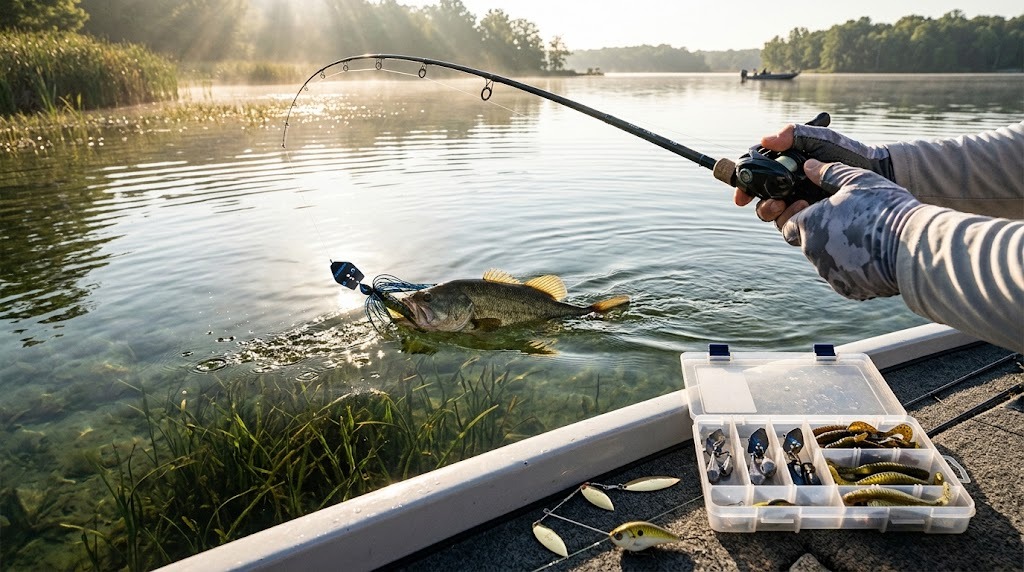
The short version: a chatterbait - the common name for a bladed jig - is a skirted jig with a small metal blade hinged at the nose. Reel it and the blade slaps side to side, sending a hard thump down the line. It catches most of its fish in shallow water with some colour, around grass, on a steady retrieve that lets the lure touch the vegetation and then pop free. Get the weight right for the depth, always add a trailer, and use a rod with some give. Those three things matter more than colour.
What it is and why fish hit it
The blade is the engine. Water pressure pushes it one way, the jig head stops it, and it kicks back the other way many times a second. You feel that as a strong vibration in the rod, and fish sense it through their lateral line before they can see the lure.
The lure also “hunts” - every so often it darts off line for a moment and comes back. That flicker looks like a baitfish losing its balance, and it is one reason bladed jigs draw reaction strikes from fish that ignore a lure running dead straight.
The design is recent as lures go. It reached the wider market in the mid-2000s, and ChatterBait is the brand name that stuck to the whole category. Our chatterbait lure profile has the short reference version; this article goes through how to actually work it.
Where and when it works best
A bladed jig is a shallow-to-mid-depth tool, most at home in about 1 to 8 feet of water.
- Submerged grass. This is the classic setting. The lure runs over and through the tops of the vegetation in a way a treble-hooked crankbait cannot.
- Stained water. Visibility of roughly one to three feet is ideal. Fish rely more on vibration and commit harder.
- Wind. A rippled surface breaks up light and pushes baitfish onto banks and flats. Windy days are bladed jig days.
- Spring and autumn. Water in the 50s and 60s Fahrenheit, with bass feeding in the shallows, is the strongest window. In autumn, follow the baitfish into the backs of creeks and coves - our fall fishing guide covers that movement.
It is weaker in very clear, calm water, where the thump can be too much, and in deep water, where a different lure reaches fish more efficiently. Largemouth bass are the main target, but pike, smallmouth and redfish in shallow salt marsh take it too.
Weight, trailer and colour
Weight. Three sizes cover nearly everything:
- 1/4 oz - very shallow water, a foot or two, or when you want a slow retrieve over grass that grows near the surface
- 3/8 oz - the everyday choice, for roughly 2 to 6 feet
- 1/2 oz - deeper grass lines, strong wind, or a faster retrieve
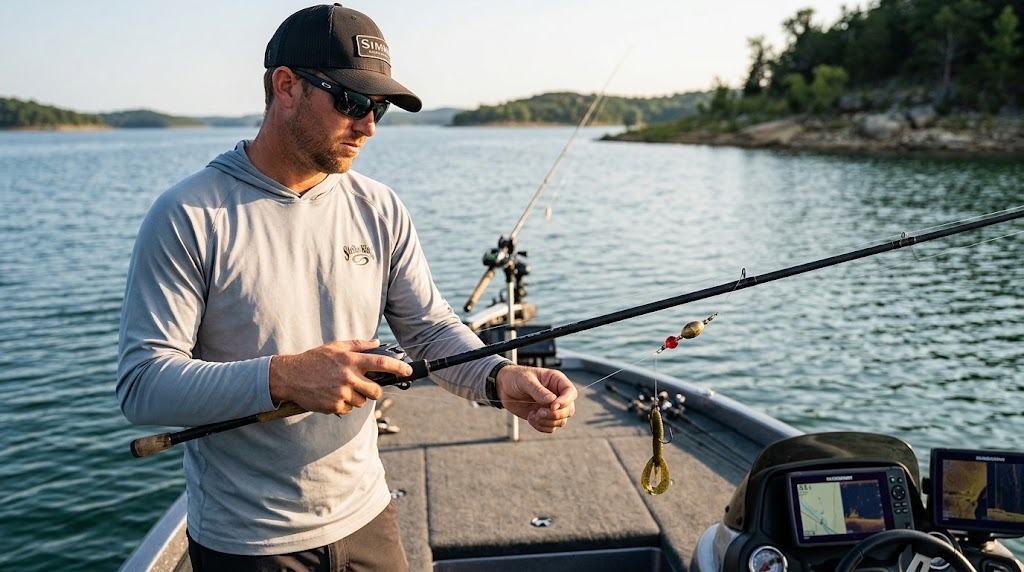
Trailer. A bladed jig without a soft plastic trailer on the hook looks thin and runs poorly. The trailer changes how it behaves:
- A paddle-tail swimbait adds lift and a baitfish profile. It keeps the lure higher, which helps over shallow grass.
- A split-tail or straight-tail trailer adds almost no drag, so the lure runs deeper and hunts more. Many anglers prefer this in cooler water.
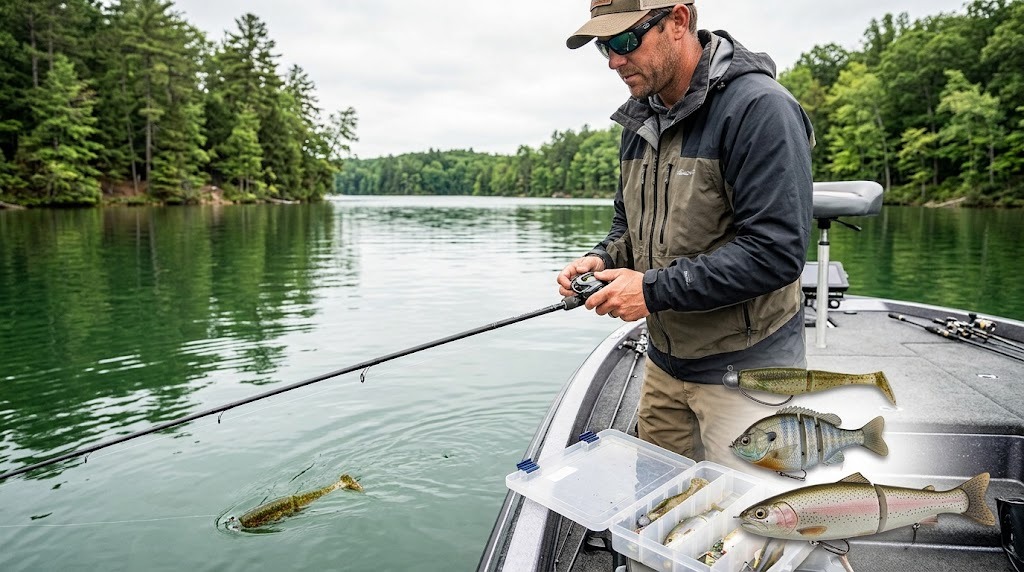
- A craw-style trailer gives a bulkier, bluegill or crayfish look for fishing around wood and docks.
Thread it on dead straight. A trailer that sits crooked makes the lure roll onto its side.
Colour. Keep it simple. Green pumpkin or bluegill patterns around grass, white or shad colours when fish are chasing baitfish, black and blue in muddy water or low light. Match the trailer to the skirt unless you have a reason not to.
The retrieves that get bites
Steady with contact. Cast, let it sink to the depth you want, and reel at a pace where you feel the blade thumping. In grass, aim to feel the lure just brushing the tops. That is the base retrieve, and often it is all you need.
Rip it free. When the lure loads up with grass, do not drag it through. Give the rod a sharp, short snap. The lure jumps clear, the blade restarts, and that moment is when a large share of strikes happen. If you never touch grass, you are fishing too high.
Stall and go. Every few turns, stop the handle for half a second or give it one quick extra turn. The change in rhythm makes following fish commit.
Slow roll. In cooler water or along a deeper edge, reel just fast enough to keep the blade working, close to the bottom. A heavier head helps here.
Bump the hard stuff. Around dock posts, stumps and rock, steer the lure into the cover on purpose. The deflection works the same way as ripping it out of grass.
If the thump stops and the line goes slack or simply feels heavy, reel down and sweep the rod. Fish often overtake the lure from behind, and the bite feels like the vibration switching off.
Rod, reel and line
The most common complaint with bladed jigs is fish coming off, usually on a jump. The lure has one large hook and a heavy head a fish can throw. The fix is in the rod.
- Rod: around 7 feet to 7 feet 3 inches, medium-heavy power, with a moderate or moderate-fast action. A softer tip - composite or glass blanks are popular - lets the fish take the lure deeper before you feel it and cushions head shakes. A stiff, fast worm rod pulls hooks.
- Reel: a baitcaster in the 6.3:1 to 7:1 range. Fast enough to take up slack, slow enough that you do not overrun the lure.
- Line: 15 to 20 lb fluorocarbon for most situations. It sinks, resists abrasion and has a little stretch. Braid is an option in thick grass, where its lack of stretch helps the rip, but then the softer rod matters even more.
Set the hook with a firm sweep to the side, not a hard upward snap, and keep steady pressure through the fight.
Chatterbait, spinnerbait or crankbait?
They overlap, and choosing between them is mostly about cover and clarity:
- Choose the bladed jig for submerged grass and for stained water where you want a tighter, harder vibration and a more compact profile.
- Choose a spinnerbait for wood, laydowns and very dirty water. The wire arm guards the hook better around branches, and big blades give more flash. Our spinnerbait guide covers blade choices.
- Choose a crankbait for clean bottoms, rock and precise depth control beyond what a bladed jig reaches comfortably.
If you are unsure what suits the conditions in front of you, the lure selector narrows it down by depth, clarity and cover.
Common mistakes
- No trailer, or a crooked one. The lure rolls and loses its action.
- Reeling above the grass. Contact is the point. Count the lure down a second longer.
- A rod that is too stiff. You will hook fish and lose them.
- Never changing speed. A steady retrieve is the base, but small breaks in rhythm are what turn followers into biters.
- Ignoring a blade that stops working. A strand of grass on the blade or a bent split ring kills the vibration. If you cannot feel it, clear it or recast.
🛒 Recommended Gear on Amazon
- Bladed jigs - browse current options and reviews on Amazon.
- Soft plastic trailers - browse current options and reviews on Amazon.
- Fluorocarbon line - browse current options and reviews on Amazon.
As an Amazon Associate, we earn from qualifying purchases - at no extra cost to you. This helps us keep producing free, in-depth guides.