How to Fish a Spinnerbait
A spinnerbait catches fish because it can be reeled straight through cover that would foul any other lure. Match the blade to the water clarity, keep the retrieve slow enough to feel the thump, and drive it into wood rather than around it.
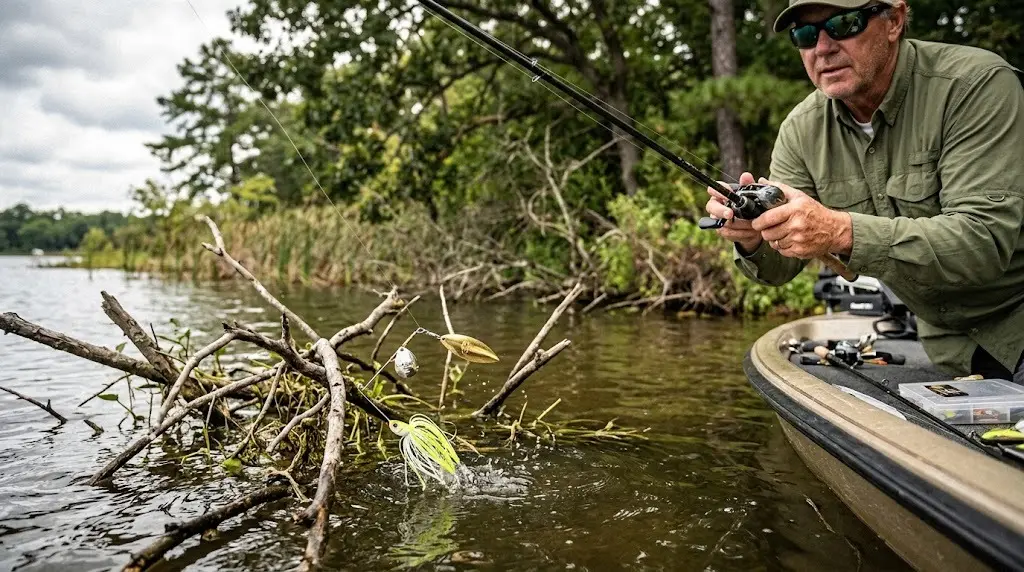
The one thing that makes a spinnerbait worth carrying: it is close to weedless. The wire arm rides ahead of the hook and pushes branches, weed stems and dock cables away from the point, so you can reel it through laydowns and grass edges that would foul a crankbait on the first cast. Everything else about spinnerbait fishing follows from that. You are not fishing open water with it, you are fishing the mess.
The second thing worth knowing: you should be able to feel the blade turning through the rod at all times. If the thump disappears, you have lost contact with what the lure is doing, and you are almost certainly reeling too fast or too slow for that particular bait.
Blade shape decides everything else
Spinnerbaits come with three blade types and they are not interchangeable. Choose by water clarity and temperature.
Colorado blades are round and cupped. They spin at a wide angle, produce the heaviest vibration and the most lift, and run slowest. This is the blade for stained or muddy water, cold water in the low teens Celsius and below, and night fishing. The fish is finding the lure by feel through the lateral line, not by sight, so you want maximum thump.
Willow leaf blades are long and narrow. They flash hard, displace much less water, and cut through grass better than anything else. Use them in clear water, in warm conditions, and any time you want to fish fast. A double willow is the standard clear-water grass-edge setup.
Indiana blades sit between the two, and a Colorado-plus-willow tandem is the most generally useful combination if you only want to carry one. You get the thump of the Colorado for detection and the flash of the willow for the commit.
Weight follows depth, not fish size. A 10g bait is a shallow tool for water under about 1.5m. A 14g bait covers most situations from 1 to 3m. A 21g bait gets down to 4m or more and is what you want for slow-rolling deep structure. If you are unsure what to reach for on a given day, our lure selector narrows it down by conditions.
Skirt colour matters far less than anglers argue about. White or white and chartreuse covers shad-eating fish nearly everywhere. Chartreuse alone earns its keep in stained water. Black is the night colour. That is genuinely most of it.
The four retrieves that cover most days
Slow roll. Cast, let the bait sink to the depth you want, and reel just fast enough to keep the blades turning. This is the cold water and deep structure retrieve, and it is the one most anglers never fish slowly enough. Use a Colorado or tandem so the blades keep thumping at low speed.
Wake it. Reel fast enough that the bait bulges the surface without breaking through. Deadly at dawn and dusk over shallow flats and grass in warm water. Fish commit hard to a waking spinnerbait and it is worth resisting the urge to set the hook on the boil rather than on the weight.
Yo-yo it. Reel a few turns, kill it, let it flutter down on a semi-slack line, then reel again. The strike almost always comes on the fall. This is the retrieve for suspended fish and for structure where you want to cover several depths in one cast.
Bump and deflect. Same principle as fishing a crankbait: aim to make the lure collide with something. Steer it into a stump, a dock post or a rock, let it briefly go off-kilter, and keep reeling. That momentary loss of control is what converts a following fish into a biting one.
Across all four, keep the rod tip low and to the side. It keeps the bait down, keeps the line angle right for a hook set, and stops you lifting the lure out of the strike zone as you reel.
Where to actually put it
Spinnerbaits shine on hard edges and in wood. The list, roughly in order of how reliably it produces:
- Laydowns and flooded timber. Cast past the trunk and reel so the bait tracks along the branches, contacting them.
- Grass edges and points of grass. Willow blade, parallel to the edge, at a speed that keeps the bait just above the tops.
- Riprap and rock banks. Angle casts along the bank rather than straight at it, and keep the bait ticking the rock.
- Docks. Under and along the outside edges. Wind blowing into a dock makes it far better.
- Windblown banks. Wind pushes plankton, which pulls baitfish, which pulls predators. A chop on the surface also breaks up the fish’s view of the lure and makes it less fussy. A windy afternoon on a bank nobody else is fishing is often the whole day.
The lure works on more than bass. Northern pike hit spinnerbaits hard and the wire arm gives some protection against their teeth, though a short wire or heavy fluorocarbon leader is still sensible. Chain pickerel, perch and even walleye in stained water will take one. See our largemouth bass and northern pike profiles for the seasonal patterns that tell you where those fish should be sitting.
Gear, and the trailer hook question
A 2.0 to 2.2m medium-heavy rod with a moderate-fast action is the standard. You want enough backbone to drive a single thick hook home and enough tip to stop the fish tearing free on a short-line strike. Braid of around 20kg in heavy grass, or 8 to 10kg fluorocarbon for cleaner water and clearer conditions. Reels in the 6:1 to 7:1 range give you the speed to take up slack fast without forcing you to fish quickly.
The trailer hook is the honest fix for short strikes. It is a single hook slipped over the main hook point, held with a small piece of tubing. It noticeably lifts your hookup rate on fish that swipe rather than eat, and it costs you a good part of the lure’s weedlessness. The rule of thumb: run one in open water, grass tops and around docks, leave it off in heavy wood.
If you are consistently getting hit and not connecting even with a trailer, the fish are usually telling you the retrieve is too fast. Slow down half a step and the same fish will eat it properly. That, more than any tackle change, is what turns a spinnerbait from a lure you own into one you actually catch on.
Recommended Gear on Amazon
- Spinnerbaits - browse current options and reviews on Amazon.
- Trailer hooks - browse current options and reviews on Amazon.
- Soft plastic trailers - browse current options and reviews on Amazon.
As an Amazon Associate, we earn from qualifying purchases - at no extra cost to you. This helps us keep producing free, in-depth guides.