How to Fish a Carolina Rig
The Carolina rig is a slow, bottom-dragging setup that covers big offshore flats and points better than almost anything else. How to tie it, how long to make the leader, the right weight for your depth, and the retrieve that separates feeling bites from feeling rocks.
Water safety and local rules come first. Carolina rigging usually means fishing from a boat over open water, and autumn water gets cold fast. Life jacket, cold-water and boating requirements come from your national or state boating authority. Licences, seasons, size limits, and any restrictions on lead sinkers come from your state or provincial fisheries agency - several places now restrict small lead weights. They are the authority, not this article. We do not give safety or legal advice.
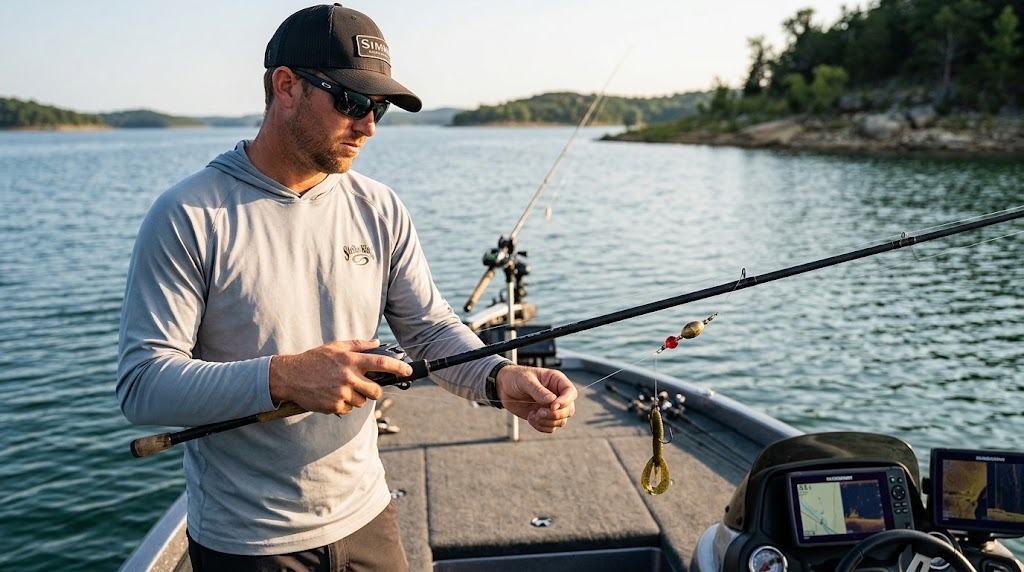
The short version: a Carolina rig is a heavy sliding weight on your main line, a bead and a swivel, then a leader of 45 to 90 cm (roughly 18 to 36 inches) to a hook with a soft plastic. You cast it long, let it hit bottom, and drag it slowly with sideways sweeps of the rod. The weight stays on the bottom and tells you what the bottom is made of; the bait floats and drifts behind it. It is not glamorous, but on big flats, points and ledges it finds fish faster than almost any other bottom presentation.
How the rig is built
From the rod tip down:
- Main line - usually 15 to 20 lb fluorocarbon or braid.
- Sliding weight - a bullet or egg sinker, commonly 3/8 to 1 oz.
- Bead - glass or hard plastic. It protects the knot and makes a clicking sound against the weight that some anglers believe helps draw fish.
- Barrel swivel - stops the weight and joins the main line to the leader.
- Leader - lighter than the main line, usually 12 to 15 lb fluorocarbon.
- Hook - a 2/0 to 4/0 offset or wide-gap hook, rigged weedless with a soft plastic.
The leader being lighter than the main line is deliberate. When you snag - and you will - the leader breaks and you keep the weight, bead and swivel. Our sinker weight tool can help you think through weight for your depth and conditions.
Choosing the weight and leader length
Weight is about contact. You need to feel the bottom constantly. A common starting point:
- 3/8 to 1/2 oz for water under about 3 m (10 ft), or when fish are pressured.
- 3/4 oz for 3 to 6 m (10 to 20 ft), the most versatile size.
- 1 oz for deeper water, wind, or when you need to feel the bottom clearly.
Leader length controls how high and how freely the bait moves:
- Short (30 to 45 cm / 12 to 18 in) keeps the bait near the bottom and is easier to cast. Good in heavy cover or when fish are tight to the bottom.
- Medium (60 to 90 cm / 24 to 36 in) is the all-round choice.
- Long (90 cm and more) lets a bait fall slowly and suspend. It helps with sluggish or pressured fish but is awkward to cast.
Start at around 75 cm and change only if you have a reason.
Baits that work on a Carolina rig
The soft plastic matters less than depth and speed, but a few shapes are classic:
- Lizards - the traditional choice, especially in spring.
- Creature baits - lots of appendages that flutter as the bait settles; see our creature bait guide for shapes and colours.
- Finesse worms and straight-tail worms - quieter, better for pressured fish.
- Floating or buoyant plastics - keep the bait above the weight and any bottom debris.
Natural colours - green pumpkin, brown, watermelon - cover most situations. Darker colours help in stained water.
The retrieve
This is where the rig either works or does not.
Cast, then let the weight hit bottom. Keep the rod low, pointing roughly at the line, and sweep the rod sideways a metre or so, slowly. Then reel in the slack as you bring the rod back. Pause. Repeat.
Sweeping, not reeling, is the key. Reeling pulls the weight too fast and lifts it off the bottom. A slow sweep lets you feel exactly what the weight is dragging over:
- Soft mud feels mushy and slow.
- Gravel feels like fine vibration.
- Rock knocks and ticks.
- Weeds feel like a heavy, gradual load.
Changes in bottom texture are often where fish sit. When you feel the weight cross from mud to gravel, slow down.
A bite on a Carolina rig often feels like “extra weight” rather than a tap. If something feels heavier or different, reel down until the line is tight and sweep the rod firmly sideways to set the hook. A long, sideways sweep moves more line than an overhead jerk, which matters with a long leader.
Where and when to use it
The Carolina rig shines anywhere you need to search large areas of bottom:
- Points and long tapering flats, especially after the spawn and in autumn when bass move along them following baitfish.
- Ledges, humps and drop-offs offshore.
- Edges of submerged grass, where the weight can crawl along the base.
It is less efficient in dense cover, where a weight and long leader snag constantly. In those spots a Texas rig or jig is a better choice.
In early autumn, bass on many lakes are feeding on baitfish along points before moving deeper. A Carolina rig lets you cover that transition quickly, and it is a natural partner to finesse options like a drop shot rig when fish get fussy.
Rod and reel setup
A 7 to 7 ft 6 in medium-heavy casting rod with a moderate-fast action is standard. The length helps with long casts and sweeping hooksets. A reel with a medium gear ratio (around 6.4:1 to 7.1:1) balances pickup speed with power.
The rig is most associated with largemouth bass, but walleye, smallmouth and even catfish anglers use variations of the same idea. The principle is always the same: let the weight find the bottom, and let the bait follow.
🛒 Recommended Gear on Amazon
- Tungsten bullet weights - browse current options and reviews on Amazon.
- Barrel swivels - browse current options and reviews on Amazon.
- Fluorocarbon leader line - browse current options and reviews on Amazon.
As an Amazon Associate, we earn from qualifying purchases - at no extra cost to you. This helps us keep producing free, in-depth guides.