How to Fish a Jerkbait
The jerkbait is a cold-water specialist that catches fish on the pause, not the jerk. How to cadence it by water temperature, the rod and line setup that matters, why slack-line twitches beat hard yanks, and how to tune a bait so it truly suspends.
Cold-water safety and rules first. Jerkbait season overlaps with the months when water is cold enough that a fall overboard becomes dangerous within minutes. Your national or state boating authority publishes the life jacket, cold-water and boating requirements that apply to you - they are the authority, not this article. Fishing licences, seasons and size limits come from your state or provincial fisheries agency. We do not give safety or legal advice; when in doubt, ask them.
The short version: a jerkbait is a slim, lipped minnow imitation that you twitch forward and then stop. Most strikes come while it is hanging still. The single variable that decides whether it works is how long you pause, and the rule is simple - the colder the water, the longer the pause. In warm water a brisk jerk-jerk-pause of a second or two works; in cold, clear water the right pause can be ten seconds or far longer. Everything else - rod, line, colour - supports that one idea.
What a jerkbait is and why it works
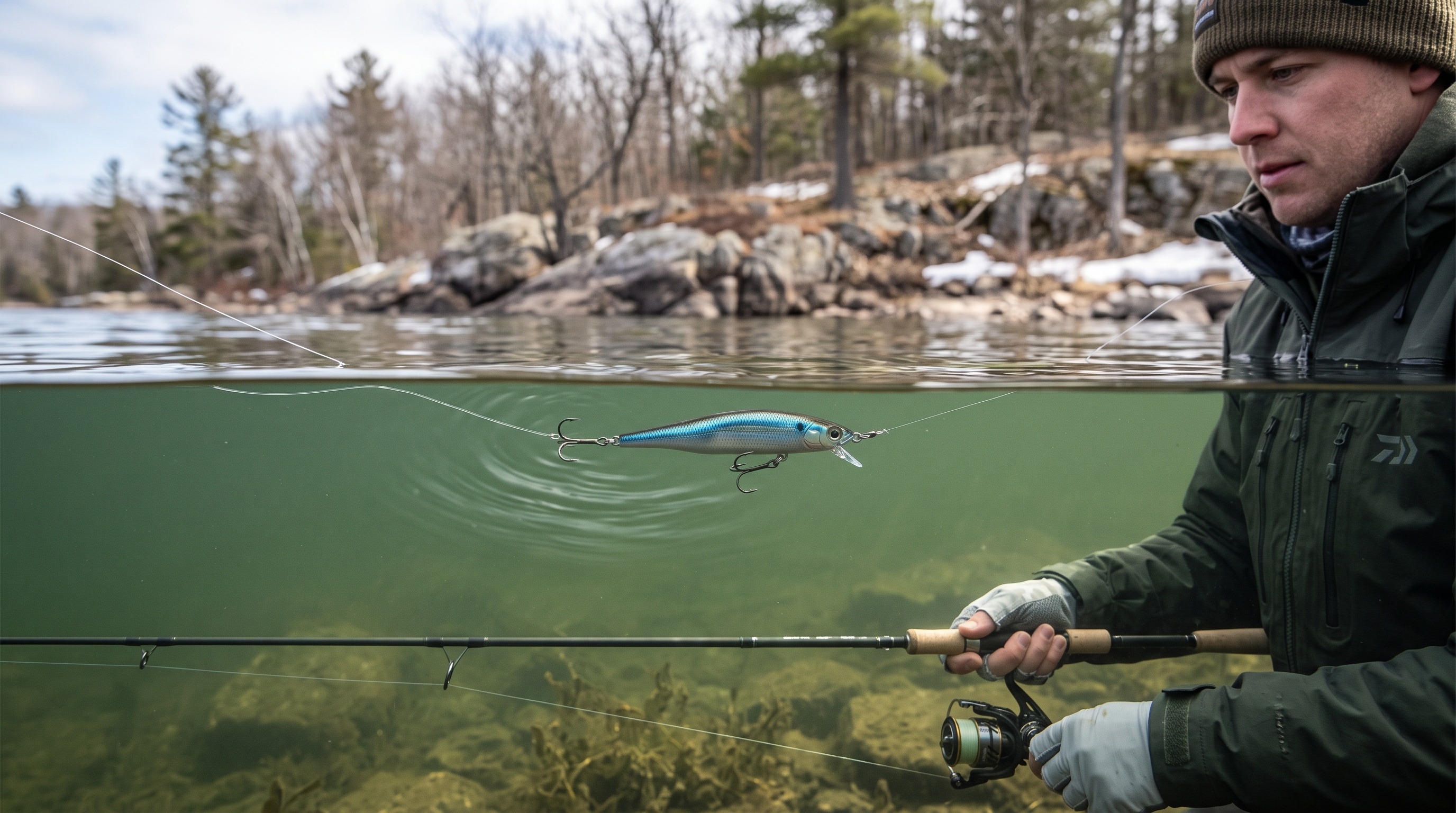
A classic hard jerkbait is a long, narrow minnow body with a small diving lip. Pulled steadily, it wobbles like a shallow crankbait. Snapped with the rod tip, it darts sideways, flashes, and then - if it is a suspending model - stops dead and hangs at depth.
That stop is the trick. In cooler water, predators like bass, walleye and pike become less willing to chase, but a wounded-looking baitfish that darts and then hovers within reach is an easy meal. The jerk gets attention; the pause gets the bite.
There are three main types:
- Suspending - holds its depth when paused. The workhorse, especially in cold water.
- Floating - rises slowly on the pause. Useful over shallow cover, weeds or when fish are looking up.
- Sinking or slow-sinking - drops on the pause, reaching deeper fish.
Soft plastic stickbaits fished weightless are sometimes called jerkbaits too, and work on a similar dart-and-glide principle - our soft jerkbait page covers that style. This article focuses on hard baits; the jerkbait lure profile has the specifics on sizes and diving depths.
Where and when it shines
Jerkbaits are at their best in:
- Cool to cold water, roughly in the 40s to high 50s °F (about 5-14°C). This is why they become a go-to in autumn and again in early spring.
- Clear to lightly stained water, where fish can see the flash from a distance.
- A little wind, which breaks up the surface and makes fish less cautious.
- Around bait, points, the edges of flats, and transitions from shallow to deep.
In muddy water or warm summer conditions other lures usually outperform it. As water cools through autumn, fish often push toward baitfish and predictable edges - our fall fishing guide explains that seasonal shift.
Rod, reel and line setup
You do not need specialised gear, but a few choices make it noticeably easier.
Rod. Around 6’6” to 7’, medium power, with a moderate or moderate-fast action. A slightly softer rod does two jobs: it keeps you from tearing hooks out of fish that nip the bait, and it makes repeated twitching less tiring. A very stiff, fast rod tends to lose fish.
Reel. Spinning or baitcasting both work. A medium-speed gear ratio helps you gather slack between twitches without over-pulling the bait.
Line. Many anglers use 8-12 lb fluorocarbon. It sinks slightly, which helps a bait reach and hold its depth, and its low stretch transmits the twitch crisply. Braid with a fluorocarbon leader gives longer casts; straight monofilament floats and makes baits run shallower.
Hooks. Most jerkbaits carry two or three treble hooks. Handle them with care, keep them sharp, and consider flattening barbs if you plan to release fish - check your local rules, since some waters require barbless hooks.
The retrieve: cadence and pause
Cast and wind down. After the cast, make several fast turns of the handle or a sweeping pull to get the bait down to its running depth.
Twitch on slack line. This is the part most beginners miss. Leave a small bow of slack in the line and snap the rod tip down with a short, sharp flick. The bait darts sideways. If you pull on a tight line, the bait just moves forward and loses its erratic action.
Pause. Let it sit. Take up only the slack you created.
Match the pause to the water.
- Warm water (60°F / 16°C and above): jerk-jerk, pause 1-2 seconds, repeat. Faster and more aggressive.
- Cool water (50s°F / 10-15°C): jerk-jerk, pause 3-6 seconds.
- Cold water (40s°F / below 10°C): a single soft twitch, then pause 10-20 seconds or more. It feels endless. That is the point.
Fish tell you the right cadence. Try a variation, and when a bite comes, repeat exactly what you were doing.
Detecting strikes. Bites on the pause are often subtle - the line jumps, goes slack, or the next twitch feels heavy. Answer with a firm sweep of the rod rather than a violent hookset, then keep steady pressure. For the final stages of the fight, our guide on how to land a fish covers handling it cleanly.
Tuning a bait so it truly suspends
“Suspending” on the package means suspending in someone else’s water temperature. In very cold water many baits float slightly; in warm water some sink.
A simple test: at the side of the boat or dock, pull the bait down a couple of feet and watch it pause.
- If it rises, add a little weight - adhesive lead-free suspend strips or dots on the belly, or a slightly heavier hook.
- If it sinks, trim weight or use a lighter split ring.
- Goal: it hangs level or sinks very slowly.
Also make sure it runs straight. If it veers to one side on the retrieve, gently bend the line tie in the opposite direction, a tiny amount at a time.
Colour and size
Keep it simple: natural baitfish colours (silver, shad, shiner, translucent) in clear water; something with more flash or a bright belly when there is stain or low light. Size the bait to the local forage - larger baits for pike and big bass, smaller ones for pressured fish or smaller species.
Common mistakes
- Pausing too briefly in cold water.
- Twitching on a tight line, so the bait swims forward instead of darting.
- Using a rod too stiff and losing fish that bite lightly.
- Not tuning the bait, so it floats up during every pause.
- Giving up too soon - jerkbait fishing rewards patience and repetition.
Master the pause and the jerkbait becomes one of the most dependable lures in the box from autumn through early spring.