Greater Amberjack
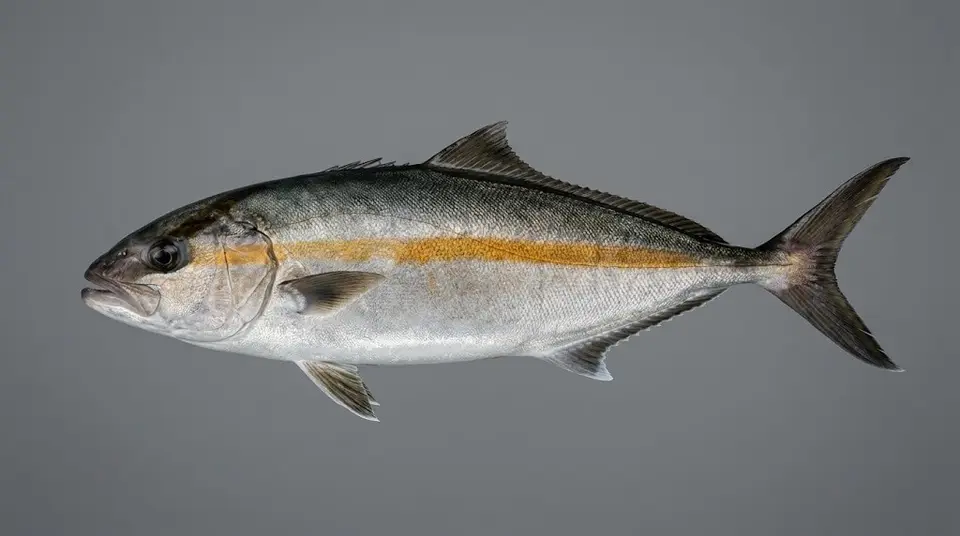
The greater amberjack (Seriola dumerili) is a jack with a dark amber stripe on its head, running from the nose to the first dorsal fin, which NOAA Fisheries says becomes more defined when the fish is excited or feeding.
Last reviewed: November 2026
 AI illustration
Overview
The greater amberjack (Seriola dumerili) is a jack with a dark amber stripe on its head, running from the nose to the first dorsal fin, which NOAA Fisheries says becomes more defined when the fish is excited or feeding. NOAA Fisheries calls greater amberjack large trophy fish prized by anglers and says recreational harvest is by hook-and-line (NOAA Fisheries). In 2024, recreational anglers landed 2.6 million pounds (about 1,180 tonnes) of greater amberjack and commercial landings totaled 500,000 pounds (about 230 tonnes), according to the same NOAA Fisheries profile.
Identification
NOAA Fisheries describes a brownish or bluish-grey back, a silvery-white belly and an amber horizontal stripe along the middle of the body, and says juveniles are yellow with five or six dark vertical bars along the sides (NOAA Fisheries). The North Carolina Division of Marine Fisheries places the dark head stripe from the nose through the eye to the front of the first dorsal fin, notes an occasional amber or pinkish color on the body and a long anal fin base, and names the lesser amberjack and the almaco jack as the fish it is sometimes confused with. NOAA Fisheries adds that almaco jack, greater amberjack, lesser amberjack and banded rudderfish can look very similar, which can make them difficult to identify, especially when they are juveniles or small (NOAA Fisheries, almaco jack). The lesser amberjack can be told from the greater amberjack by its proportionately larger eye and deeper body (South Atlantic Fishery Management Council). Its maximum reported size is 27 inches (68 cm) fork length, according to the same South Atlantic Fishery Management Council page.
Range & Habitat
NOAA Fisheries says greater amberjack are found in the Atlantic and Pacific Oceans; in the western Atlantic they range from Nova Scotia to Brazil, including the Gulf of Mexico and the Caribbean (NOAA Fisheries). The South Atlantic Fishery Management Council adds the Mediterranean Sea and the Indian Ocean to the range. Juveniles school around mats of floating Sargassum in the Gulf of Mexico and move from open-water to near-bottom habitats at about 5 to 6 months of age, while sub-adults and adults gather around reefs, rocky outcrops and wrecks at depths of 60 to 240 feet (18 to 73 m), according to NOAA Fisheries. Some populations stay in one place while others migrate, likely using a variety of habitats through the year (NOAA Fisheries).
History
During the period of high landings in the 1980s and 1990s, greater amberjack became an important alternative to red drum, whose commercial landings had decreased, according to NOAA Fisheries. In the Gulf of Mexico, Amendment 12 to the reef fish plan, implemented on January 15, 1997, reduced the greater amberjack bag limit from three fish to one fish per person (NOAA Fisheries, Gulf reef fish amendments). In 2001 the National Marine Fisheries Service determined that the Gulf of Mexico greater amberjack fishery was overfished, and in 2003 it announced approval of a 10-year stock rebuilding plan (NOAA Fisheries, Gulf reef fish amendments). A 2009 stock assessment update showed that the stock remained overfished and was still experiencing overfishing, and Amendment 35, which modified the rebuilding plan, was implemented on December 13, 2012 (NOAA Fisheries, Gulf reef fish amendments).
Behavior & Diet
NOAA Fisheries says adults eat mostly crab, squid and other fishes found on reefs, while juveniles feed on plankton, including crustacean larvae and other small invertebrates (NOAA Fisheries). Predators include seabirds and larger fishes such as yellowfin tuna, and schooling decreases as greater amberjack mature, according to the same NOAA Fisheries profile. The North Carolina Division of Marine Fisheries calls amberjacks opportunistic predators that feed over reefs and wrecks in small groups, and the South Atlantic Fishery Management Council says they are friendly to divers.
Best Seasons
NOAA Fisheries says greater amberjack spawn primarily from March to June; spawning takes place on reefs and shipwrecks (NOAA Fisheries), and the North Carolina Division of Marine Fisheries gives offshore spawning from March through July with a peak in May or June. Studies indicate that amberjack move in the spring from the Carolinas to southeast Florida, according to the same North Carolina Division of Marine Fisheries page. Federal rules include closed seasons in both the South Atlantic and the Gulf of Mexico, and NOAA Fisheries says the South Atlantic commercial closure falls when the fish aggregate to spawn and are highly vulnerable to fishing (NOAA Fisheries). The dates change, so check the current seasons on the South Atlantic Fishery Management Council species page and with NOAA Fisheries before a trip.
Where to Find Them
Look over structure: the South Atlantic Fishery Management Council says greater amberjack concentrate around reefs, rock outcrops and wrecks, and NOAA Fisheries gives 60 to 240 feet (18 to 73 m) as the depth where sub-adults and adults congregate (NOAA Fisheries). The North Carolina Division of Marine Fisheries describes amberjack as an offshore fish found near reefs, wrecks, rocky outcrops, Sargassum patches and floating debris, from the outer reefs to open waters.
How to Catch Them
The North Carolina Division of Marine Fisheries says anglers catch amberjack by drifting with live or cut baits and by trolling spoons and other deep-running artificial lures, that chumming attracts and holds schools near the boat, and that anglers commonly catch amberjacks while targeting king mackerel. NOAA Fisheries says recreational harvest is by hook-and-line, while electric and hydraulic reels and hand lines take most of the commercial catch (NOAA Fisheries). The same agency says the gear used for greater amberjack rarely contacts the ocean floor and that bycatch is low because the gear is selective (NOAA Fisheries). In South Atlantic federal waters, the gear allowed for the species is vertical hook-and-line, including hand lines and bandit gear, and spearfishing gear without rebreathers (South Atlantic Fishery Management Council). Our saltwater jigging guide covers vertical jigging for bottom and mid-water fish in general.
Tackle & Rigs
Greater amberjack are managed under the Snapper-Grouper Fishery Management Plan in the South Atlantic and under the Reef Fish Resources of the Gulf of Mexico Fishery Management Plan in the Gulf (NOAA Fisheries), and both regions set gear rules. For snapper-grouper species in South Atlantic federal waters, the South Atlantic Fishery Management Council lists a descending device that must be readily available, at least one dehooking tool, and non-stainless steel hooks for hook-and-line fishing with natural baits, with non-offset, non-stainless steel circle hooks required north of 28° N latitude. To count as readily available, the descending device must be attached to a minimum of 16 oz (about 450 g) of weight and 60 feet (18 m) of line (South Atlantic Fishery Management Council). The council explains that circle hooks are less likely to snag a fish in a lethal area such as the eye, gills or stomach, and that non-stainless steel hooks rust out of a fish more quickly than stainless steel if the hook stays in (South Atlantic Fishery Management Council). In the Gulf of Mexico Exclusive Economic Zone, the DESCEND Act, in effect since January 13, 2022, requires commercial and recreational fishermen to possess a venting tool or descending device that is rigged and ready for use when fishing for reef fish (NOAA Fisheries). The North Carolina Division of Marine Fisheries calls amberjacks powerful fighters that test anglers' tackle. Gear rules change, so check the current requirements before a trip.
Best Baits & Lures
The North Carolina Division of Marine Fisheries names live or cut baits fished on the drift, and spoons and other deep-running artificial lures fished by trolling, and says chumming attracts and holds schools of amberjack near the boat. NOAA Fisheries says adults eat mostly crab, squid and other fishes found on reefs (NOAA Fisheries). In South Atlantic federal waters, natural baits must be fished on non-stainless steel hooks (South Atlantic Fishery Management Council).
Landing, Handling & Release
Sub-adult and adult greater amberjack gather at 60 to 240 feet (18 to 73 m) (NOAA Fisheries), and the South Atlantic Fishery Management Council says fish caught deeper than 30 feet (9 m) generally suffer some effects of barotrauma, the expansion of gases after being reeled up rapidly from depth, which makes it difficult for a fish to swim back down on its own. The signs it lists are bulging eyes, anal prolapse, bubbling scales, the stomach protruding from the mouth and floating on the surface after release. The council's recommended treatment is a descending device, a weighted device that helps the fish return to depth, with 1 pound of lead per 5 pounds of fish (0.45 kg per 2.3 kg) so the fish reaches the bottom, and it says to return fish to the depth of capture (South Atlantic Fishery Management Council). It calls venting effective when used carefully but prefers descending devices because they do not puncture the fish's abdomen (South Atlantic Fishery Management Council). It also advises holding fish horizontally with wet hands or rubberized gloves, taking pictures quickly, limiting air exposure and not playing a fish to exhaustion in case it needs to be released (South Atlantic Fishery Management Council). Our catch-and-release guide covers handling in general.
Size & Growth
NOAA Fisheries says greater amberjack can grow up to 6 feet (1.8 m) long, live to be 17 years old and weigh up to 200 pounds (91 kg), though they are most commonly found at up to 40 pounds (18 kg), and that females grow larger and live longer than males (NOAA Fisheries). The South Atlantic Fishery Management Council gives a size of 6 feet and a weight of nearly 200 pounds, while the North Carolina Division of Marine Fisheries says they grow to 6 feet and more than 200 pounds. NOAA Fisheries says they mature at about 3 to 4 years of age and that a female can release between 18 and 59 million eggs during a single spawning season (NOAA Fisheries). The North Carolina Division of Marine Fisheries puts female maturity between ages 3 and 5, and the South Atlantic Fishery Management Council says greater amberjack that are at least 5 years of age, or 33.5 inches (85 cm) long, spawn. The Mississippi all-tackle state record is a greater amberjack of 126 pounds (57 kg), caught on conventional tackle on 22 March 2014, according to the Mississippi Department of Marine Resources.
Table Quality
NOAA Fisheries describes greater amberjack as sweet and mild in flavor, with a tender, firm and delicate texture, and says its high oil content gives it a buttery texture (NOAA Fisheries). The FDA says many fish species have been associated with ciguatera poisoning, jacks among them, that ciguatera is commonly related to subtropical and tropical reef fish, and that the highest incidences of ciguatoxins occur between latitudes 35° north and 35° south, including the Caribbean Sea, the Gulf of Mexico and the Atlantic (FDA). The FDA's table of investigated illnesses on the same page lists ciguatera cases from Florida in 2023 and 2025 in which laboratory analysis confirmed ciguatoxin (C-CTX) in fish identified as greater amberjack (FDA). We do not give food-safety advice; the FDA page linked here is the official guide.
Before you eat what you catch, read the FDA and EPA advice about eating fish (written for pregnant people and young children) and the advisories that states, territories and Tribes issue for fish from local waters (listed by the EPA). We do not give food-safety advice.
Where Anglers Go Wrong
Keeping the wrong fish: NOAA Fisheries says greater amberjack, lesser amberjack, almaco jack and banded rudderfish can look very similar, especially when small (NOAA Fisheries, almaco jack), so be sure of the species before counting a fish toward a limit. Leaving the descending device in its packaging: the South Atlantic Fishery Management Council says a device still in the package or in the console does not qualify as readily available, and that getting fish back to depth quickly is key to their survival. Venting by default: the same council prefers descending devices over venting because they do not puncture the fish's abdomen, and reminds anglers who vent that they still need a descending device readily available (South Atlantic Fishery Management Council). Fighting a fish to exhaustion: the council advises against it when the fish may need to be released (South Atlantic Fishery Management Council).
Regulations & Conservation
There are two stocks: NOAA Fisheries says the Gulf of Mexico stock is overfished (2021 stock assessment) but not subject to overfishing based on 2024 catch data, and the South Atlantic stock is not overfished (2020 stock assessment) and not subject to overfishing based on 2023 catch data (NOAA Fisheries). NOAA Fisheries and the South Atlantic and Gulf of Mexico Fishery Management Councils manage the fishery with size limits, bag and trip limits, closed seasons and gear rules, and a rebuilding plan for the Gulf stock has a target date of 2028 (NOAA Fisheries). Seasons, size limits and bag limits change; check the current federal rules on the South Atlantic Fishery Management Council species page or with NOAA Fisheries, and the state rules where you fish. We do not give legal advice.
FAQ
How do you tell a greater amberjack from a lesser amberjack? The South Atlantic Fishery Management Council says the lesser amberjack has a proportionately larger eye and a deeper body than the greater amberjack.
How big do greater amberjack get? Up to 6 feet (1.8 m) and 200 pounds (91 kg), though most are up to 40 pounds (18 kg), according to NOAA Fisheries.
How deep do greater amberjack live? Sub-adults and adults gather around reefs, rocky outcrops and wrecks at 60 to 240 feet (18 to 73 m), according to NOAA Fisheries.
What has the FDA found about ciguatera in greater amberjack? The FDA's table of investigated illnesses lists ciguatera cases from Florida in which ciguatoxin was confirmed in fish identified as greater amberjack (FDA). We do not give food-safety advice.
Sources
All sources were checked on 15 November 2026.
- NOAA Fisheries: Greater Amberjack
- NOAA Fisheries: Almaco Jack
- NOAA Fisheries: Gulf of Mexico Reef Fish Historical Amendments and Rulemaking (1983-2017)
- NOAA Fisheries: DESCEND Act of 2020 (descending device and venting tool)
- South Atlantic Fishery Management Council: Greater Amberjack
- South Atlantic Fishery Management Council: Lesser Amberjack
- South Atlantic Fishery Management Council: Best Fishing Practices
- North Carolina Division of Marine Fisheries: Greater Amberjack
- Mississippi Department of Marine Resources: All-Tackle State Records
- FDA: How to Report Seafood-Related Toxin and Scombrotoxin Fish Poisoning Illnesses
Tackle for greater amberjack
As an Amazon Associate we may earn from qualifying purchases - at no extra cost to you. We link gear types, not sponsors' picks: you choose the exact product. The partner-store link may earn us a commission too.