Snowy Grouper
The snowy grouper is a deep-dwelling grouper of the western Atlantic, prized by deep-drop anglers for its thick, firm white fillets.
Last reviewed: October 2026
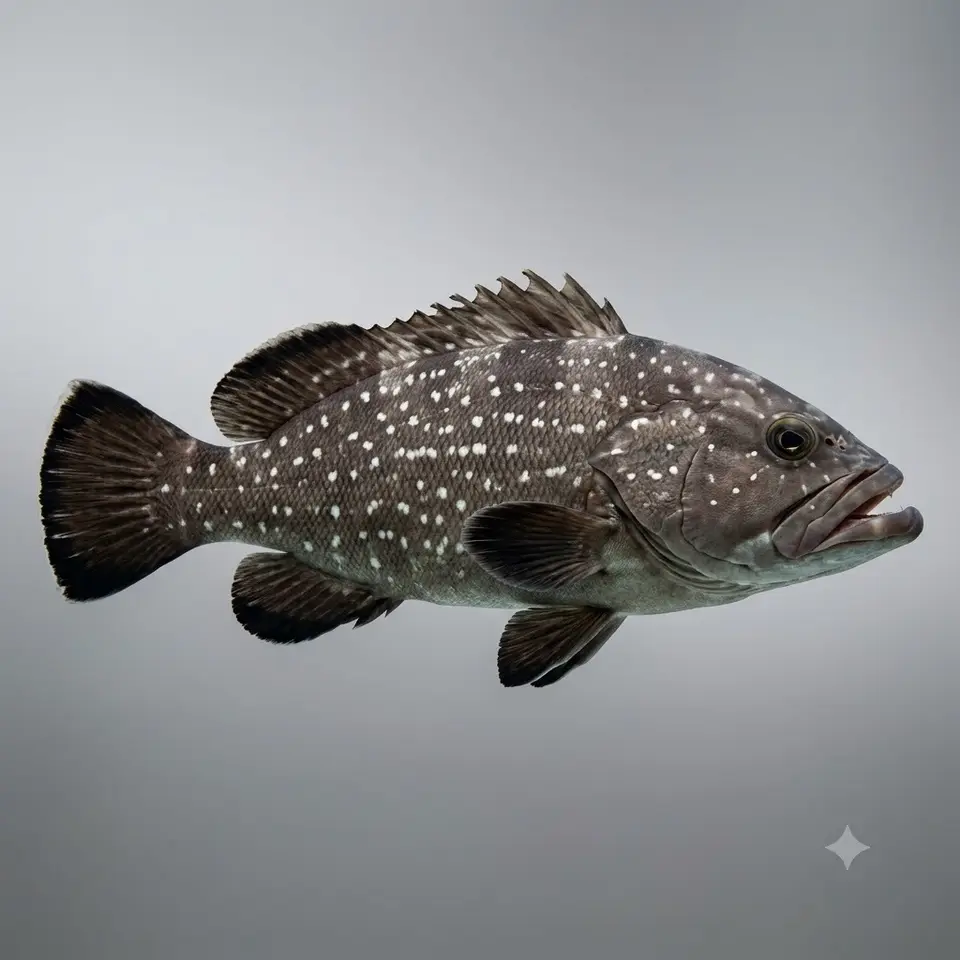 AI illustration
 Overview
The snowy grouper is a deep-dwelling grouper of the western Atlantic, prized by deep-drop anglers for its thick, firm white fillets. It is slow-growing and long-lived, which makes it far more vulnerable to overfishing than its size suggests. The species name "niveatus" (snowy) comes from the white spots that cover juveniles.
Identification
Juveniles are dark brown to nearly black, covered in evenly spaced pearly-white spots arranged in neat rows, with a dark saddle blotch on top of the caudal peduncle (the base of the tail). Adults lose most of the spots, becoming a fairly uniform dark gray-brown with darker fin margins. The body is robust with a large mouth and the classic heavy grouper profile.
Range & Habitat
Found in the western Atlantic from New England south through the Gulf of Mexico and Caribbean to southern Brazil, it is most common off the Carolinas and Florida. Adults hold on deep rocky ledges, drop-offs, and hard bottom, often in 400-800+ feet of water. Juveniles use shallower nearshore hard bottom before moving deeper with age.
Behavior & Diet
This is an ambush predator that holds tight to structure at depth, eating fish, squid, and crustaceans such as crabs. It is a protogynous hermaphrodite - individuals mature first as females and some later become males. Combined with a lifespan well over two decades, that slow biology means populations rebuild very slowly.
Best Seasons
Because it lives in deep, temperature-stable water, snowy grouper are catchable year-round whenever weather allows offshore access. In practice your season is set more by calm-sea windows and by regulatory open periods than by the fish itself. Confirm the current open season before running offshore.
How to Catch Them
This is pure deep-dropping over hard bottom and ledges. Mark structure on quality sonar, drop straight down, and keep your bait right near the bottom. Use fresh cut bait - squid, bonito, or cigar minnow strips - on a weighted multi-hook rig, and be ready to crank hard to pull a hooked fish up out of the rocks.
Tackle & Rigs
Electric or heavy conventional reels loaded with 60-100 lb braid handle both the depth and the lead. A standard deep-drop rig with two or three circle hooks above 2-3 lb of bank sinker works well. Adding a light stick or LED helps draw fish in the near-total darkness at depth.
Landing, Handling & Release
Fish from these depths suffer severe barotrauma - bulging eyes, an everted stomach, and a bloated belly. Any fish you must release needs a descending device or weighted release to return it to depth; venting alone is often not enough. Handle with wet hands, minimize air time, and get releases back down fast.
Table Quality
Excellent - the meat is thick, white, mild, and firm, holding up to nearly any cooking method. As a deep-water species its ciguatera risk is generally low, though very large groupers taken in tropical zones still warrant normal caution.
Where Anglers Go Wrong
Fishing too high off the bottom, using undersized weight that never reaches the strike zone, and skipping a descending device on releases. Another is keeping over your limit, since snowy grouper allowances are unusually strict.
Regulations & Conservation
Snowy grouper has been overfished and is managed under rebuilding measures, especially in the South Atlantic, where recreational limits are very tight (often a single fish per vessel per day) and seasons or quotas apply. Descending devices are required for reef fish in federal South Atlantic waters. Always check current SAFMC, Gulf, and state rules before fishing.
FAQ
Q: Why is it called "snowy"? Juveniles are covered in snow-white spots on a dark body; adults lose the spots and darken as they mature.
Q: Do I really need an electric reel? Not strictly, but at 400-800 feet a manual crank is exhausting, so most anglers use electric or heavy conventional gear.
Q: Is it safe to eat? Yes - it is a well-regarded food fish with generally low ciguatera risk as a deep-water species.
Tackle for snowy grouper
As an Amazon Associate we may earn from qualifying purchases - at no extra cost to you. We link gear types, not sponsors' picks: you choose the exact product. The partner-store link may earn us a commission too.