Great Hammerhead Shark
The great hammerhead is the largest of the hammerhead sharks, a powerful coastal-to-semi-oceanic predator of warm US waters.
Last reviewed: October 2026
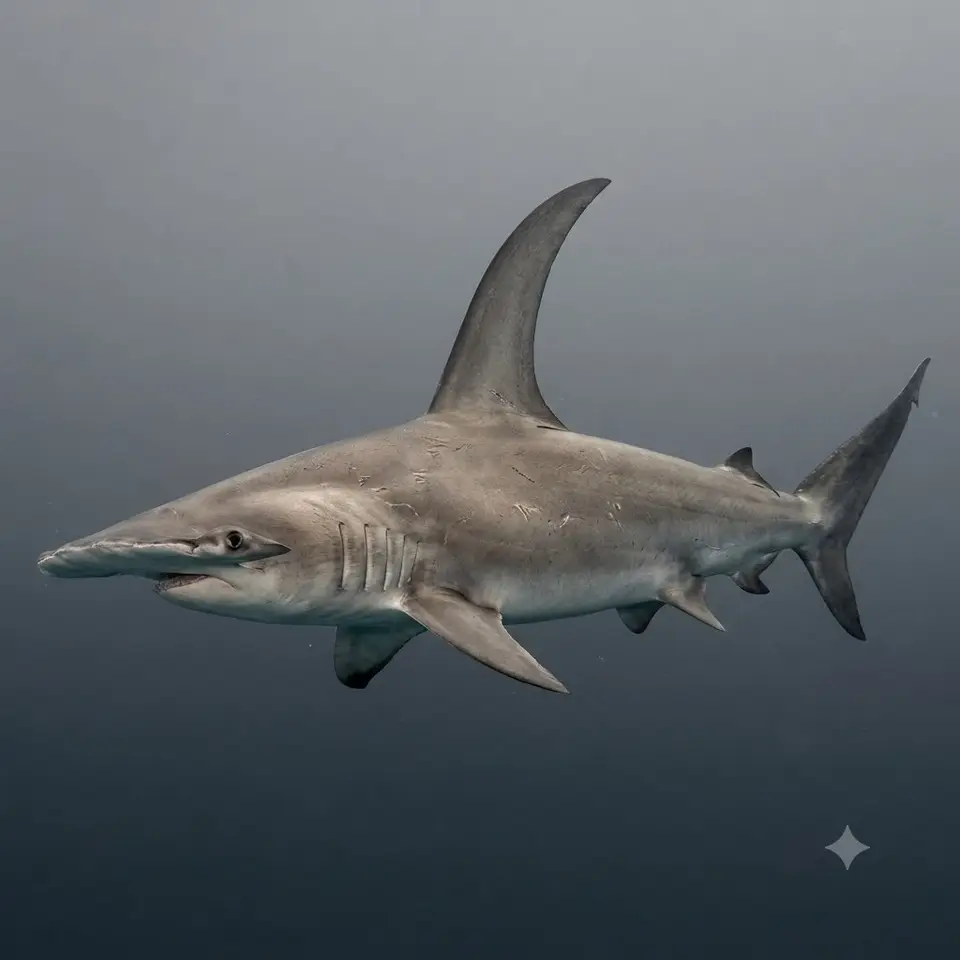 AI illustration
 Overview
The great hammerhead is the largest of the hammerhead sharks, a powerful coastal-to-semi-oceanic predator of warm US waters. It is a prized but extremely fragile land-based and boat target, listed by the IUCN as Critically Endangered. If you hook one, treat it as a catch-photo-release fish only - survival depends entirely on how fast and carefully you handle it.
Identification
Look for the enormous, very tall, sickle-shaped (falcate) first dorsal fin - the tallest of any hammerhead and the fastest field ID. The head (cephalofoil) is wide and nearly straight across the front with a shallow central notch, unlike the scalloped hammerhead's strongly indented, scalloped edge. Coloration is grey-brown above fading to a pale underside.
Range & Habitat
In the US it occurs throughout the Gulf of Mexico and along the Atlantic coast, common off Florida and ranging north to the Carolinas and beyond in warm months. It favors continental shelves, reef edges, drop-offs, channels, and beachfronts, moving between shallow flats and deeper water. Distribution is warm-temperate to tropical.
Behavior & Diet
Great hammerheads are specialized ray hunters, using the broad head to pin stingrays to the bottom before feeding - many carry stingray barbs harmlessly lodged in their jaws. They also eat other sharks, skates, groupers, and crustaceans. They are strong, enduring fighters that run hard and are easily pushed into fatal exhaustion.
Best Seasons
Fishing is best in the warmer months, roughly spring through fall, as the sharks follow migrating rays, tarpon, and other bait into the shallows. In Florida, spring around the tarpon and ray runs is a classic window. Cooler water usually pushes them offshore or south.
How to Catch Them
This is big-bait, bottom-fishing work from the surf, piers, or a boat, often using a kayak to drop baits past the bars. Fresh, oily whole baits - stingray, jack, mullet, ladyfish, or bonito - fished on the bottom draw them in. Keep drags reasonable and fight the fish hard and fast to end the battle quickly.
Tackle & Rigs
Use heavy conventional gear (50W-80W class) with heavy braid or mono so you can apply real pressure. Run a long wind-on leader to a heavy mono or single-strand/cable bite trace and a large non-offset, non-stainless-steel circle hook, which is required in many US fisheries and improves survival.
Landing, Handling & Release
Great hammerheads have among the highest post-release mortality of all sharks, so keep the fish in the water at all times - never drag a big one onto the sand or deck. Minimize fight and handling time, cut the leader close to the hook, and revive the shark by holding it in moving water until it swims off strongly.
Table Quality
Not a food fish for anglers: it is protected from harvest in many US waters, and shark flesh carries high mercury plus urea, with large reef-associated predators posing a ciguatera risk. There is no good reason to keep one. Release every fish.
Mistakes That Cost You Fish
The biggest error is using light tackle that drags the fight out and kills the shark through exhaustion. Others include removing the fish from the water for photos, gaffing, or delaying the release. Fish heavy, work fast, and keep it wet.
Regulations & Conservation
The great hammerhead is Critically Endangered and prohibited from harvest in Florida and several other states, where it must remain in the water and be released. Federal HMS rules also restrict hammerheads. Always confirm current state and federal regulations before fishing, and default to catch-and-release.
FAQ
Q: How do I tell a great hammerhead from a scalloped hammerhead? The great hammerhead has a much taller, sickle-shaped first dorsal fin and a nearly straight front edge on its head, versus the scalloped's shorter dorsal and strongly notched, scalloped head.
Q: Can I keep one to eat? No - it is protected in many US waters and carries high mercury, so it should be released.
Q: Why does it die so easily after a fight? It is highly stress-prone; a long fight or time out of the water causes exhaustion and often death, so quick handling is essential.
Tackle for great hammerhead shark
As an Amazon Associate we may earn from qualifying purchases - at no extra cost to you. We link gear types, not sponsors' picks: you choose the exact product. The partner-store link may earn us a commission too.