How to Fish a Wacky Rig
A wacky rig is a soft stick worm hooked through the middle and left to sink on a slack line. How to rig it, where to throw it, how to work it, how to spot the bite and when to add a weight or a weed guard.
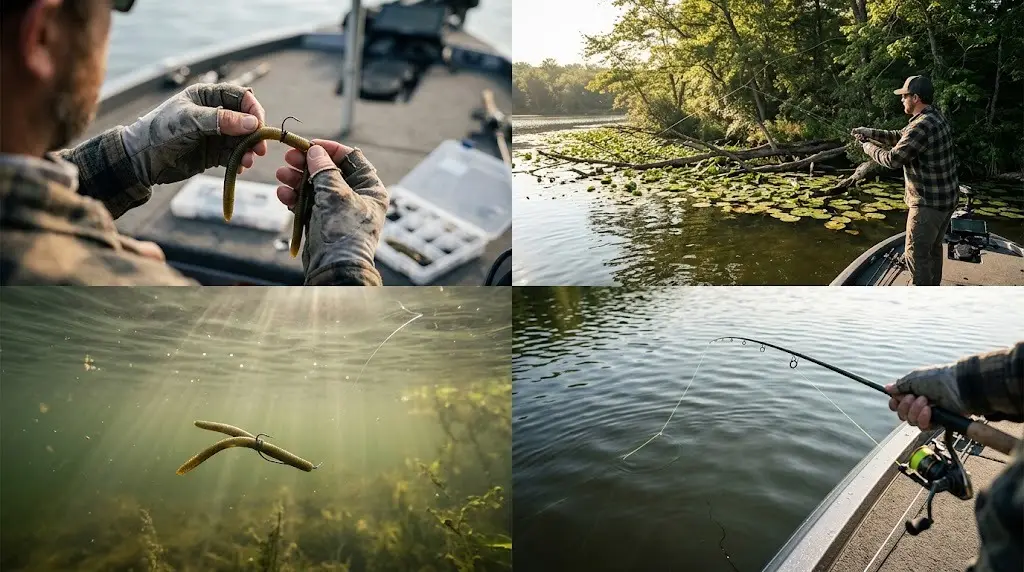
The short version: hook a soft plastic stick worm through the middle so both ends hang free, cast it next to cover, and let it sink on a slack line. Most bites come while the worm is falling. Watch the line, reel up the slack when it does something odd, and lean into the fish. That is nearly all there is to it, which is why the wacky rig is one of the first bass rigs worth learning.
What a wacky rig is
Most soft plastic rigs hook the worm through the nose so it follows the line in a straight path. A wacky rig hooks it crosswise through the middle. With the hook at the balance point, the worm sinks level and slowly, and both ends flutter on the way down.
There is no weight in the basic version. The worm’s own weight carries it down, so it falls slower than a Texas rig and stays in front of a fish longer. It is a finesse presentation - our finesse fishing guide covers where it sits among the other light-line rigs.
How to rig it
You need three things: a stick worm, a short-shank hook with a wide gap, and optionally a small rubber O-ring.
- Find the middle of the worm. On most stick worms there is a smooth band near the centre. Balance the worm across a finger if you are not sure.
- Push the hook point through the worm at that spot, straight across the body, and leave the point exposed.
- Hold it up. Both ends should hang about evenly.
The O-ring option. Soft stick worms tear, and a worm hooked through the body often flies off on the cast or on the first fish. Sliding a small O-ring to the middle of the worm and passing the hook under the ring, not through the plastic, keeps the worm on the hook for longer. A simple wacky rigging tool makes it easy to slide the ring on.
Weedless or not. An open hook point gives the easiest hookup, and it also catches every twig and weed stem. Around brush, reeds or dock cables, a wacky hook with a wire or fibre weed guard saves a lot of retying.
Tackle that suits it
A wacky rig is light, so it casts best on spinning gear with a rod that has a soft enough tip to throw a weightless bait and enough backbone to move a fish away from cover. If you are choosing between reel types, our comparison of spinning and baitcasting explains why spinning gear handles light baits more easily.
Line is a matter of water and cover. Clear open water rewards thin, low-visibility line. Heavy cover asks for something stronger, and many anglers use braid with a leader so they can see the main line move. Our guide on how to choose fishing line goes through the trade-offs.
Where to throw it
The wacky rig is a target bait. It does not cover water quickly, so it earns its place where you already suspect a fish is sitting:
- Dock posts and walkways. Drop it tight to the shade line and let it fall beside the post. A wacky worm also skips well under low docks. See how to fish docks for reading the structure.
- Weed edges and holes in the weed. Let it sink down the outside edge or into an open pocket.
- Laydowns and overhanging branches. Cast past the cover where you can and let the worm fall alongside it.
- Shallow flats in spring. A slow fall in front of a fish holding near the bank is hard for it to ignore.
It is mainly a largemouth bass rig, and it works on smallmouth bass around rock and clear water too.
How to work it
The retrieve is mostly patience.
- Cast to the target and, as soon as the worm lands, give it slack. If you hold the line tight, the worm swings back towards you in an arc and leaves the spot. On slack line it falls straight down, which is the whole point.
- Watch the line where it enters the water while the worm sinks.
- When the line goes limp on the surface, the worm is on the bottom. Let it sit for a few seconds.
- Lift the rod tip gently to raise the worm off the bottom, then drop the tip and let it fall again on slack line.
- After two or three lifts, reel in and cast to the next target. Away from the cover the rig is doing little, so do not drag it all the way back.
The most common mistake is working it too fast. If you are not getting bites, slow down before you change anything else.
Reading the bite
You will often see a wacky bite before you feel it. Typical signs:
- the line twitches or jumps once while the worm is falling
- the line starts moving sideways
- the line keeps running out after the worm should have reached bottom
- the line goes slack too early, because a fish took it on the way down
- when you lift, there is a soft, heavy feeling instead of the bottom
When any of that happens, reel down until you feel weight and then sweep the rod firmly to the side. A hard, snapping hookset is not needed with a light wire hook and an exposed point, and it is a good way to break light line.
When to add weight
The weightless rig is slow. In deeper water or in wind, that turns into waiting a long time and losing track of the line. Two fixes:
- A weighted wacky jig head in place of the plain hook. The worm falls faster and the ends quiver more sharply on each lift.
- A small nail weight pushed into one end of the worm. That end sinks first and the worm tips over and scoots backwards along the bottom when you twitch it. This version has its own name, the Neko rig.
Start with the lightest weight that lets you keep contact with the bait. Too heavy, and you lose the slow fall that makes the rig work.
A note on fish care and rules
Fish often take a wacky worm deep because it sits still and looks easy. Paying attention to the line and setting the hook as soon as you see a bite keeps most hooks in the mouth. Keep pliers or forceps within reach, and see our catch and release guide for handling.
Torn soft plastics do not belong in the water. Put used worms in a pocket or a bag and take them home. Some waters restrict certain tackle or baits, and season and size rules for bass vary from one state and water to the next, so check your state agency’s current regulations before you go.
🛒 Recommended Gear on Amazon
- Soft plastic stick worms - browse current options and reviews on Amazon.
- Wacky rig hooks with weed guard - browse current options and reviews on Amazon.
- Wacky rig tool and O-rings - browse current options and reviews on Amazon.
As an Amazon Associate, we earn from qualifying purchases - at no extra cost to you. This helps us keep producing free, in-depth guides.