How to Fish Docks
The short answer: docks are shade, structure and food in one package, and most anglers fish the wrong 90 percent of them. Here is how to rank a dock before you cast, and how to get a bait into the part that actually holds fish.
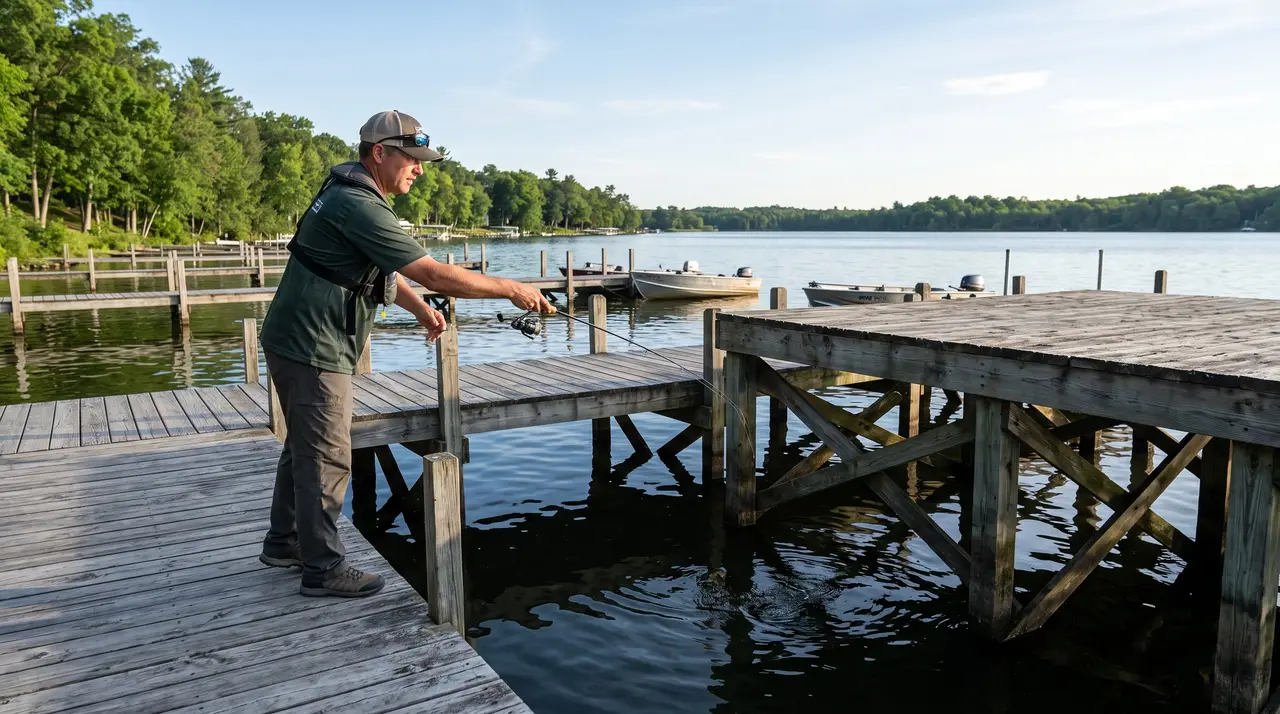
The short answer: a dock is shade, cover, vertical structure and a baitfish magnet stacked in one spot, and fish use the darkest, deepest, least accessible part of it. That means the fish are usually under the dock rather than beside it, and the angler who can put a bait three metres back in the shadow catches several times what the angler casting at the outside posts does. Everything else about dock fishing is deciding which docks are worth that effort.
Late summer makes this an especially good pattern. Surface water is warm, light is high, and shade becomes the most valuable thing in the lake.
Why fish live under docks
Four things happen under a floating platform at once:
- Shade breaks up the light. A hard shadow line gives an ambush predator the visual advantage back, which is the same reason fish stack under overhanging trees and bridges.
- Vertical structure concentrates everything. Posts, cross-braces and cables give baitfish something to orient to, and give bass a wall to pin prey against.
- Temperature and oxygen. Shaded water runs a degree or two cooler than the open flat next to it in summer, which matters more than it sounds when the surface is baking.
- Food is already there. Bluegill and other panfish live around dock posts almost permanently, and where bluegill live, largemouth bass follow.
Not all docks are equal
This is the part that saves the most time. Before you make a cast, rank the dock:
- Depth is first. A dock with 2.5 to 4 metres of water under the outer end, or one that sits close to a channel swing or drop-off, holds fish far more consistently than a dock sitting over 60 cm of flat sand.
- Age and material. Older wooden docks with weathered posts, algae growth and barnacle-like fouling hold more life than new aluminium and clean plastic floats. Growth means invertebrates, which means baitfish.
- Clutter underneath. Brush piles, sunken timber, old ladders and mooring blocks under a dock multiply its value. Many dock owners sink brush deliberately.
- Boat lifts and pontoons. These give the deepest, darkest shade and the most metal structure, and they are often the single best square metre on a lake.
- Wind and current. A dock on a wind-blown bank or near an inflow gets fed. A dock in a dead corner does not.
If you can only fish ten docks in a morning, fish the ten that check the most boxes rather than the ten nearest the ramp.
Getting a bait where the fish are
Casting at the visible outside edge catches the occasional fish. Getting under the platform catches the rest.
- Skipping is the core skill. A sidearm, low, flat cast that lands the lure on the water at a shallow angle and lets it bounce back into the shade. A flat, compact bait skips best - a wacky-rigged soft stickbait, a small swimbait on a light head, or a compact jig with a trimmed skirt.
- Practise on open water first. Skipping is a wrist and release-timing skill and it takes an afternoon of failed attempts before it stops backlashing. Spinning gear is more forgiving to learn on than a baitcaster.
- Work the shade line if you cannot skip yet. Cast parallel to the outside edge, let the lure fall right against the posts, and work the boundary between light and dark rather than throwing over the top of it.
- Fish the whole structure. Front posts, then the corners, then the walkway to shore, then the deepest pilings. Fish often sit on one specific post, and that post is frequently the one hardest to reach.
Lures that work around wood and cable
- Jigs are the classic answer because they fall vertically along a post and come through timber well. Our jig fishing guide covers the retrieve in detail.
- Soft stickbaits, wacky or Texas rigged, for a slow horizontal fall in the shade - hard to beat when fish are lazy in bright light.
- Swim jigs and bladed jigs for covering several docks quickly to find the active ones.
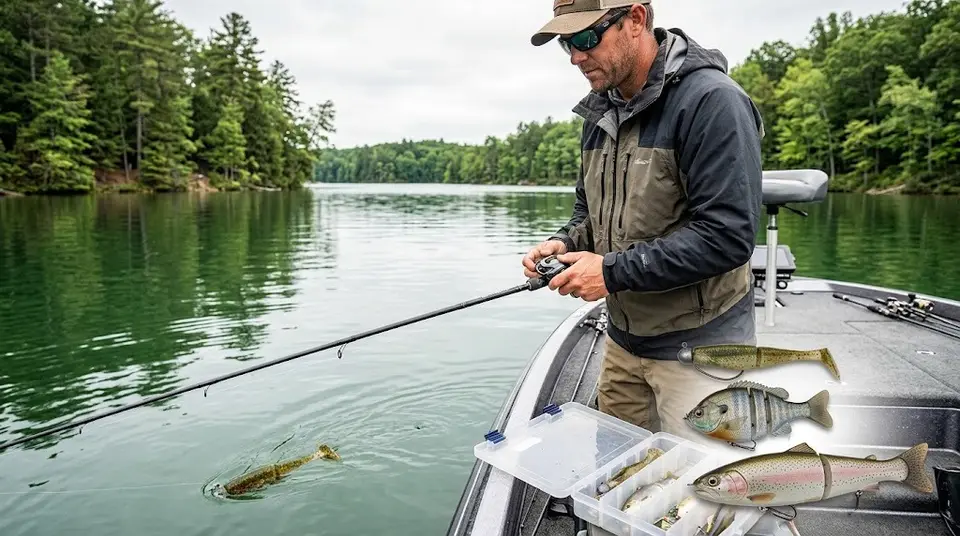
- Small swimbaits where the forage is clearly bluegill or shad.
- Topwater early and late, cast tight to the outside edge before the sun gets over the water.
Line choice matters more here than in open water. Docks are full of abrasion points, and a fish hooked under a platform will head straight for the nearest post, so heavier line or a robust leader is normal practice around wood and cable. If you are shore-bound rather than in a boat, the same reading applies from the bank - the bank fishing guide covers angles and approach.
Access, etiquette and safety
Docks are private property in most places, and the water rights around them vary by country, state and even lake. Local access rules, distance requirements and any posted signage are the authority here, not general advice - check your local fisheries or waterway regulator before assuming a dock is fair game. Beyond the legal side, the practical etiquette is straightforward: do not fish an occupied dock, do not tie up or step onto private structure, keep noise down early in the morning, and do not leave line or lures wrapped around posts. Snagged line on a dock is the fastest way to get a whole stretch of shoreline posted.
The honest bottom line
Dock fishing rewards selectivity and casting skill more than tackle. Pick docks with depth, age, clutter and shade, get the bait as far under the platform as you can manage, fish the darkest and deepest parts first, and use gear that survives contact with wood. Most of the fish on a developed lake live within a few metres of somebody’s boat lift, and almost nobody puts a bait there.
🛒 Recommended Gear on Amazon
- Skipping jigs - browse current options and reviews on Amazon.
- Braided line - browse current options and reviews on Amazon.
- Weedless soft plastics - browse current options and reviews on Amazon.
As an Amazon Associate, we earn from qualifying purchases - at no extra cost to you. This helps us keep producing free, in-depth guides.