Wels Catfish
The wels is Europe's largest freshwater fish and a genuine bucket-list target for US anglers willing to travel.
Last reviewed: October 2026
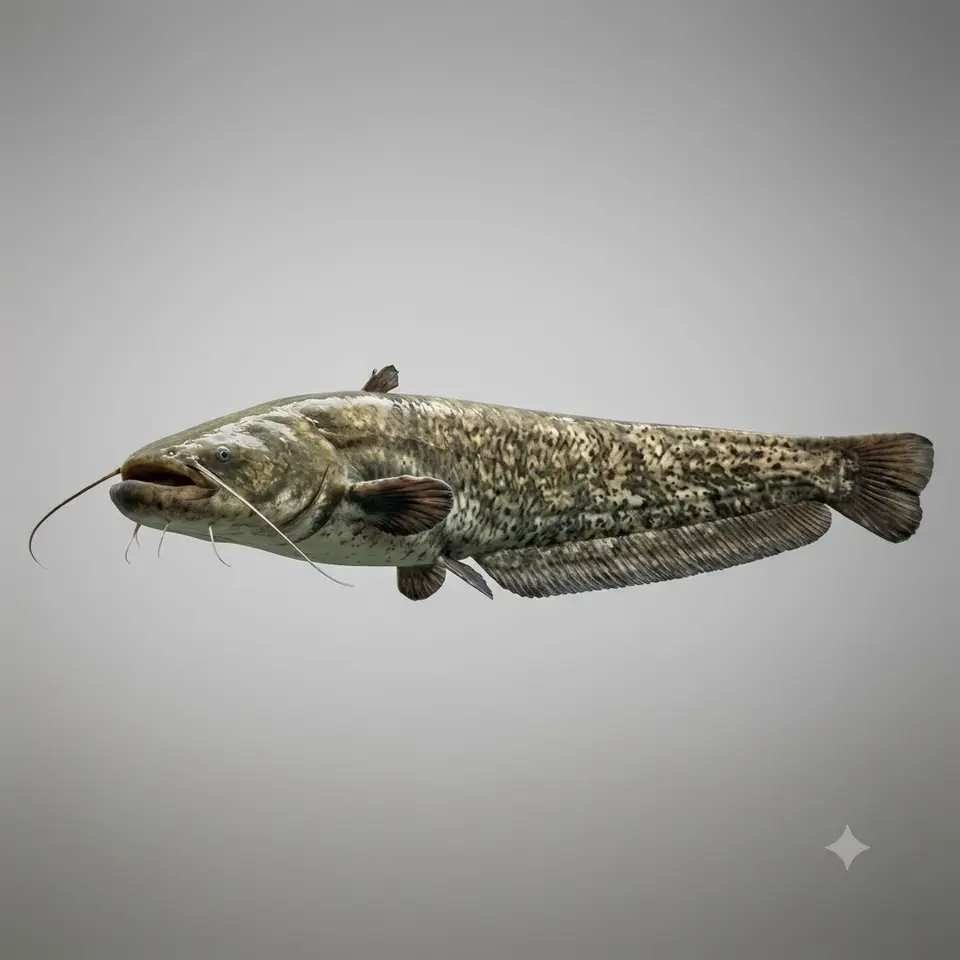 AI illustration
 Overview
The wels is Europe's largest freshwater fish and a genuine bucket-list target for US anglers willing to travel. It routinely tops 6 feet and well over 100 pounds in prime rivers, with the biggest specimens far heavier. There are no wild wels in North American waters, so chasing one means booking a trip to Europe.
Identification
A long, scaleless, almost eel-like body with a broad flattened head and a wide mouth lined with tiny rasping tooth pads. It carries six barbels: two long ones on the upper jaw and four shorter beneath. A very long anal fin runs most of the way to the tail while the dorsal fin stays tiny; coloration is mottled olive-brown to near-black over a pale, marbled belly.
Range & Habitat
Native across central, eastern, and southern Europe in basins draining to the Baltic, Black, and Caspian seas (Danube, Volga, Dnieper and others). It has been introduced and now thrives in western waters like Spain's Ebro, Italy's Po, and rivers in France. Look for them in large slow rivers, warm lakes, and reservoirs, holding in deep holes, near dams, and around submerged timber.
Behavior & Diet
A nocturnal ambush predator that hunts most actively at dusk and after dark. It eats almost anything it can engulf - fish, crayfish, frogs, and occasionally waterfowl or small mammals - using its barbels and lateral line to track prey in low light. Spawning happens in late spring and early summer, with males guarding the nest.
Best Seasons
Wels are warm-water fish, so late spring through early autumn is prime as water temperatures climb. Warm, stable summer nights trigger the strongest feeding. Cold winter water slows them dramatically and makes them tough to tempt.
How to Catch Them
Big baits fished on the bottom near structure account for many fish - live or dead baitfish, worm bundles, and pellets. Boat anglers vertical-jig deep holes or use "clonking," tapping a shaped tool on the surface to draw fish up. Lure and soft-plastic fishing also works well in warmer months, especially around dusk.
Tackle & Rigs
This is heavy tackle: powerful rods, strong reels, and 80-plus-pound braid with an abrasion-resistant leader. A simple running rig with a strong single or large circle hook covers most bottom presentations. Sub-float rigs suspend baits off the bottom over soft or snaggy ground.
Landing, Handling & Release
Use a big sling or padded mat, and never hoist a large wels vertically - support it horizontally to protect its spine and organs. Wet your hands, mind the rough tooth pads, and keep the fish in or over water. Most anglers release trophies, which are old, slow-growing fish a fishery cannot quickly replace.
Table Quality
Smaller wels are edible and popular in parts of eastern Europe, with firm, mild flesh. Large, old fish tend to be fatty, muddy-tasting, and more likely to carry accumulated contaminants, so they are usually released rather than eaten.
Where Anglers Go Wrong
Going undergunned is the classic error - light gear loses fish and leaves exhausted giants hard to revive. Others fish cold water and blank, or hold big fish upright for photos and risk internal injury. Always check whether local rules require you to keep or humanely dispatch fish in waters where wels are invasive.
Regulations & Conservation
Globally the wels is listed as Least Concern and is stable across its native range, so it is not an endangered fish. Even so, trophy-sized specimens are prized and widely released to keep fisheries healthy. Where it has been introduced it is often treated as invasive, and returning one may be restricted or illegal - always read local regulations before your trip.
FAQ
Q: Are there wels catfish in the United States? No wild population exists in US waters, so catching one means traveling to Europe.
Q: Do wels catfish bite people? They lack dangerous teeth, but a large fish can grip and graze skin with rough tooth pads, so handle it with care.
Q: How big do they really get? Reliable fish exceed 6 feet and 100-plus pounds, and the largest specimens are considerably heavier.
Tackle for wels catfish
As an Amazon Associate we may earn from qualifying purchases - at no extra cost to you. We link gear types, not sponsors' picks: you choose the exact product.