Tigerfish
The African tigerfish (*Hydrocynus vittatus*) is a fierce characin of sub-Saharan rivers and a genuine bucket-list target for traveling anglers.
Last reviewed: October 2026
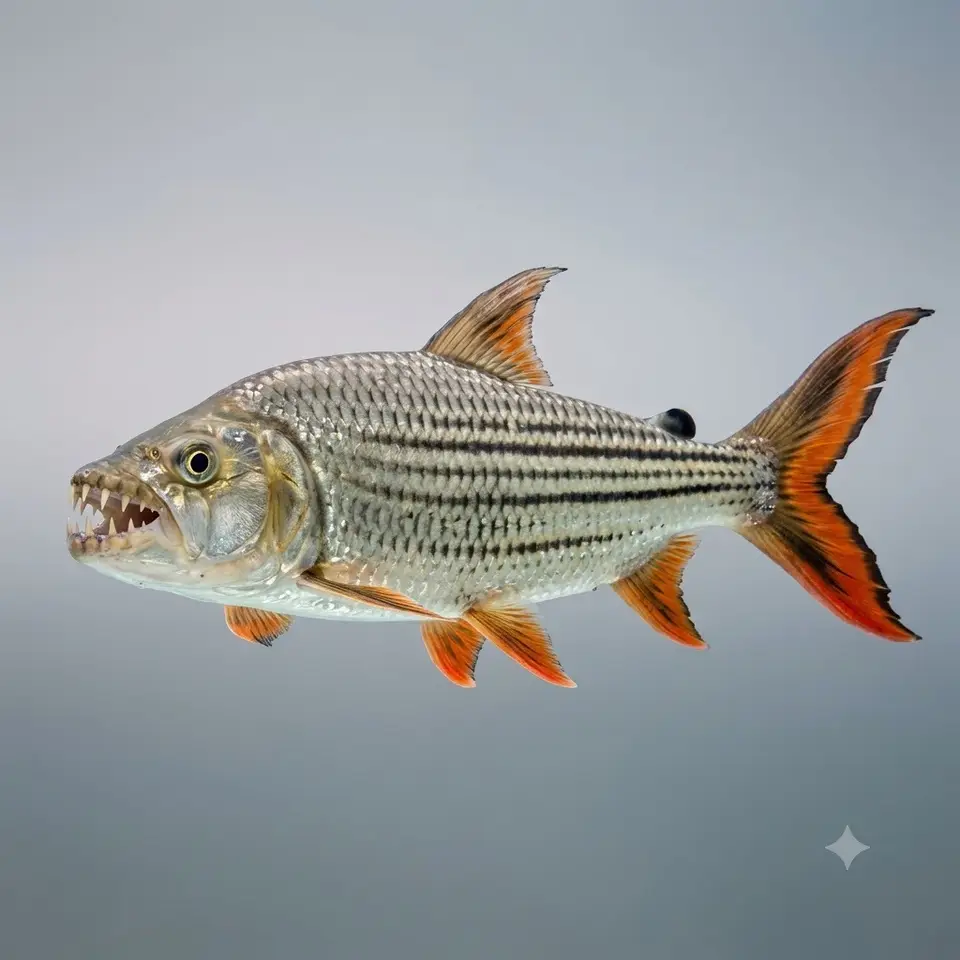 AI illustration
 Overview
The African tigerfish (Hydrocynus vittatus) is a fierce characin of sub-Saharan rivers and a genuine bucket-list target for traveling anglers. Best known from the Zambezi, Okavango Delta, and Lake Kariba, it fights with blistering runs and acrobatic jumps that routinely throw hooks. This is not a US native - reaching one means booking an international trip - and catch-and-release is the sporting norm.
Identification
Look for a silvery, laterally compressed body marked with several dark horizontal stripes running the length of the flanks (the name vittatus means "striped"). Fins are typically tinged orange to red with dark edges, and the deeply forked tail often shows a black trailing margin. The dead giveaway is the mouth: large, conical, interlocking dagger teeth that stay visible even when the jaws are closed. Its far larger cousin, the goliath tigerfish (H. goliath), is a separate Congo-basin species.
Range & Habitat
Tigerfish are widespread across warm sub-Saharan systems - the Zambezi, Okavango, Congo, Limpopo, and lakes such as Kariba and Tanganyika. They favor warm, well-oxygenated water and hold near channels, confluences, drop-offs, and current seams where baitfish funnel. Being cold-sensitive, they turn sluggish when water cools.
Behavior & Diet
This is an aggressive, fast predator that hunts smaller fish, hammering prey with those interlocking teeth: eight per jaw, replaced on both jaws at the same time. Small tigerfish hunt in large schools, while big ones hunt alone, and the species has even been seen leaping from the water to catch barn swallows in flight. By day they tend to feed nearer the surface, moving deeper at night; spawning is thought to take place over a couple of days in December or January, when the rains swell the rivers. Tigerfish push bait into the upper water column and are famous for slashing surface strikes. They orient to structure and flow, using current to ambush.
Best Seasons
In these southern-hemisphere fisheries, the prime window is the late dry season into early summer (roughly September to November), when warming, clearing water sparks aggressive feeding - the Okavango's catfish "run" can produce spectacular action. Winter months (June-July) tend to be slower as cold water shuts fish down. Always confirm timing with your lodge or outfitter, since it varies by system.
How to Catch Them
Cast and rip spoons, spinners, and shallow crankbaits, drift or troll strip baits and small dead baitfish, or strip large baitfish streamers on the fly. A hard, deliberate hook-set is essential - their bony mouths shed hooks, and most anglers lose more fish than they land. Keep hooks needle-sharp and retrieve fast with erratic action to trigger the chase.
Step by Step: A Tigerfish Trip
1. Choose the water. The classic fisheries are on the Zambezi, including man-made Lake Kariba, and in the Okavango, but the species ranges from the Niger and the Nile south to the Limpopo and Lake Jozini (Wikipedia).
2. Read the local rules. Licences, closed seasons, size limits and catch-and-release rules differ by country and by park; ask the lodge or guide which permits you need before you travel.
3. Pick the season. The late dry season into early summer, roughly September to November, is the prime window on many southern waters; the cold months are slower, and spawning comes with the rains around December or January.
4. Bring the right tackle. A medium to medium-heavy spinning or baitcasting outfit with braid, or an 8-9 weight fly rod, always with a wire trace and strong, very sharp hooks.
5. Fish the current seams. Channels, confluences, drop-offs and seams where baitfish gather; by day the fish are often high in the water.
6. Retrieve fast and strike hard. An erratic, fast retrieve triggers the chase, and a firm hook-set is needed to drive the hook into the bony mouth.
7. Keep tension through the jumps. Tigerfish throw hooks in the air; keep the line tight and the rod working.
8. Handle with care and release. Never lip a tigerfish: support it over the back and belly, unhook with long pliers, and revive it facing into the current. Follow your guide's rules at the water's edge.
Tackle & Rigs
Medium to medium-heavy spinning or baitcasting outfits with braided line handle the runs and jumps; fly anglers favor 8-9 weight rods. Always run a wire bite trace (single-strand or nylon-coated) - those teeth slice through mono instantly. Use strong, chemically sharpened hooks and check the points constantly.
Landing, Handling & Release
Lead with catch-and-release. Those teeth are genuinely dangerous, so never lip the fish - support it over the back and belly with wet hands or a cradle, keep it in the water as much as possible, and use long pliers to unhook. Revive it fully, facing into the current, before letting go.
Table Quality
Edible but unremarkable and riddled with fine bones, so it is rarely a food target for sport anglers. Local subsistence fishers do eat them. For visiting anglers, the value is entirely in the fight, and releasing fish keeps the fishery strong.
What Costs Anglers Bites
The classic error is fishing without a wire trace and getting bitten off on the very first strike. Others include setting the hook too softly for that bony mouth, retrieving too slowly, and running dull or undersized hooks.
Regulations & Conservation
Hydrocynus vittatus is currently assessed by the IUCN as Least Concern, so it is not globally threatened - but local populations face pressure from overfishing and habitat change, and many premier fisheries enforce catch-and-release, closed seasons, or size limits. As a traveling angler, follow your outfitter's guidance and each country's or park's rules, which vary widely. Practicing release protects trophy fish and the future of the sport.
FAQ
Q: Do I really need a wire leader? Yes - their interlocking teeth cut straight through monofilament, so a wire bite trace is essential to avoid instant break-offs.
Q: How big do they get? Most fish are modest; the species is recorded at up to 105 cm (41 in) in standard length. Exact sizes vary by system, so check current records for your destination rather than trusting rumor.
Q: Are they good to eat? They are edible but bony and unremarkable, and sport anglers almost always release them.
Tackle for tigerfish
As an Amazon Associate we may earn from qualifying purchases - at no extra cost to you. We link gear types, not sponsors' picks: you choose the exact product.