European Perch
The European perch is the Old World cousin of the North American yellow perch, and for a traveling US angler it is a genuine bucket-list "coarse" and light-tackle sport fish.
Last reviewed: October 2026
 AI illustration
 Overview
The European perch is the Old World cousin of the North American yellow perch, and for a traveling US angler it is a genuine bucket-list "coarse" and light-tackle sport fish. It is bold, handsome, and hard-fighting for its size, and it is one of the most widely pursued freshwater targets in Europe. A striped, red-finned perch on light gear is a highlight of any UK or Continental fishing trip.
Identification
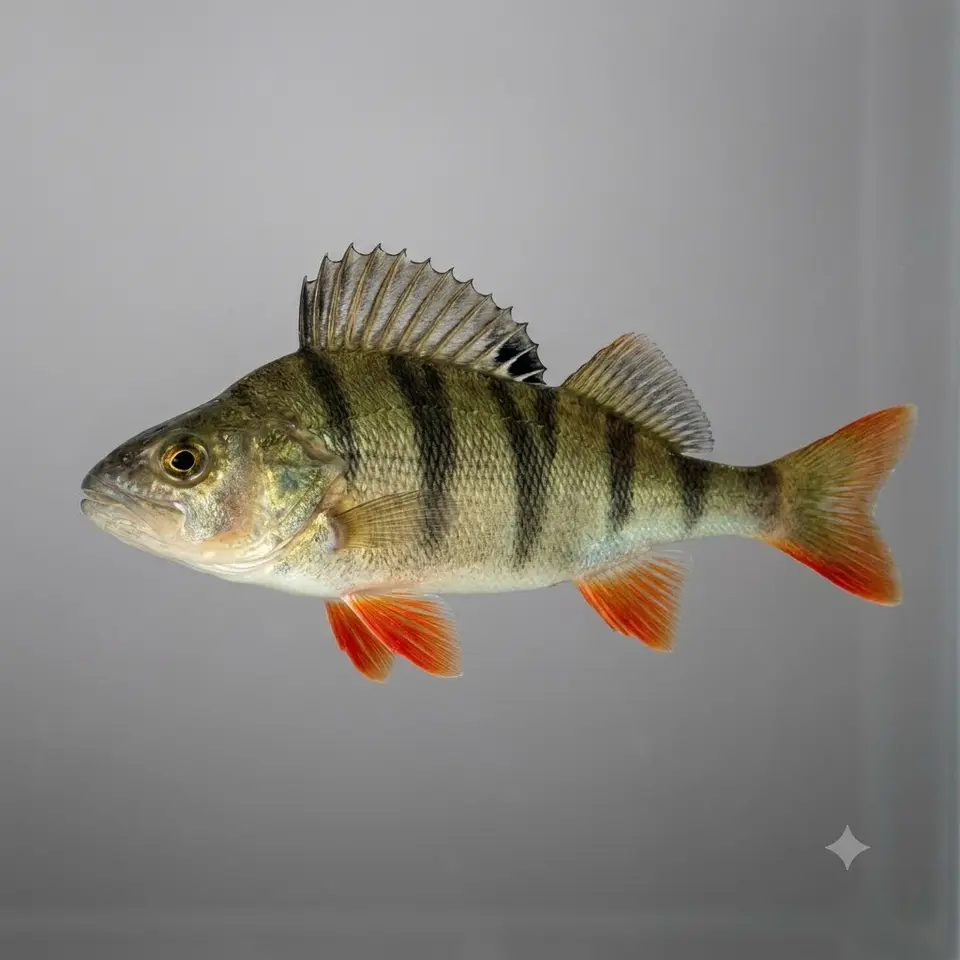
Look for a deep, slightly humped body in olive to bronze-green with 5 to 9 bold dark vertical bars down the flanks. The two dorsal fins are separate: the front one is spiny and carries a distinctive dark blotch at its rear, while the pelvic, anal, and lower tail fins flush bright red-orange. The gill cover ends in a sharp spine, so handle with care.
Range & Habitat
Native across most of Europe and northern Asia, from the British Isles east into Siberia, it has also been introduced to Australia, New Zealand, and South Africa. It thrives in lakes, reservoirs, canals, slow rivers, and gravel pits, and tolerates brackish water in the Baltic. Perch relate hard to structure: weed edges, drop-offs, sunken timber, bridge pilings, and boat docks.
Behavior & Diet
Perch are shoaling ambush predators, with smaller fish traveling in packs and the big "stripeys" often hunting alone. They eat invertebrates, insect larvae, and small fish, and larger perch turn heavily piscivorous, hunting fry against structure. Feeding peaks around dawn and dusk.
Best Seasons
Autumn is prime, as perch feed hard and gorge on the year's fry before winter, often producing the biggest fish. Spring after spawning is also strong, and cold-water winter perch can be caught deep and slow. Midsummer fishing is best early and late in the day.
How to Catch Them
Target structure and edges with small lures or bait, and once you catch one keep casting, because a shoal is usually nearby. Effective methods include drop-shotting soft plastics, small jigs, spinners, and small crankbaits, plus classic float-fished worm or livebait. Vertical jigging over deep structure shines in cold water.
Tackle & Rigs
A light spinning rod, 6 to 10 lb line or braid with a fluorocarbon leader, and a sensitive tip cover most situations. Drop-shot rigs, small jigheads with 2 to 3 inch soft plastics, size 6 to 10 hooks under a float, and small inline spinners all produce. Downsize when fish are finicky.
Landing, Handling & Release
Support the fish and beware the sharp gill-cover spine and spiny dorsal; grip firmly behind the head rather than squeezing. Use a knotless net, unhook over a mat or your lap, and keep the fish wet. Wet your hands, minimize air time, and release quickly.
Table Quality
Perch is excellent eating, with firm, white, mild flesh prized across Europe as "filet de perche." Scaling is a chore, but the fillets are worth it. In its native range a few for the pan is fine; where introduced it is best kept and eaten rather than returned.
Where Anglers Go Wrong
Fishing too big is the classic error, as oversized lures and heavy hooks put off all but the largest perch. Anglers also give up too soon after a single fish instead of working the shoal, and many ignore structure in favor of open water. Manhandling the fish onto that gill spine ruins a good day.
Regulations & Conservation
Globally the European perch is IUCN Least Concern and locally abundant, so this is not a threatened species. In the UK and much of Europe, catch-and-release is a strong coarse-angling cultural norm, and match anglers return their catch as a matter of course. Where it has been introduced (Australia, New Zealand, South Africa) it is an invasive pest and must not be released or moved. Always buy the local rod license or permit, check size and bag limits, and respect closed seasons.
FAQ
Q: Is a European perch the same as a US yellow perch? No, they are close relatives in the same genus but different species; the European fish tends to be deeper-bodied with bolder bars and brighter red fins.
Q: What is a trophy size? Anything over about 2 lb is a very good perch and a 3-pounder is a genuine trophy; the largest verified fish approach the IGFA all-tackle record of roughly 6 lb 6 oz.
Q: Do I need a license to fish for them abroad? Yes, most European countries require a rod license or local permit, so arrange one before you fish.
Tackle for european perch
As an Amazon Associate we may earn from qualifying purchases - at no extra cost to you. We link gear types, not sponsors' picks: you choose the exact product.