Alligator Gar
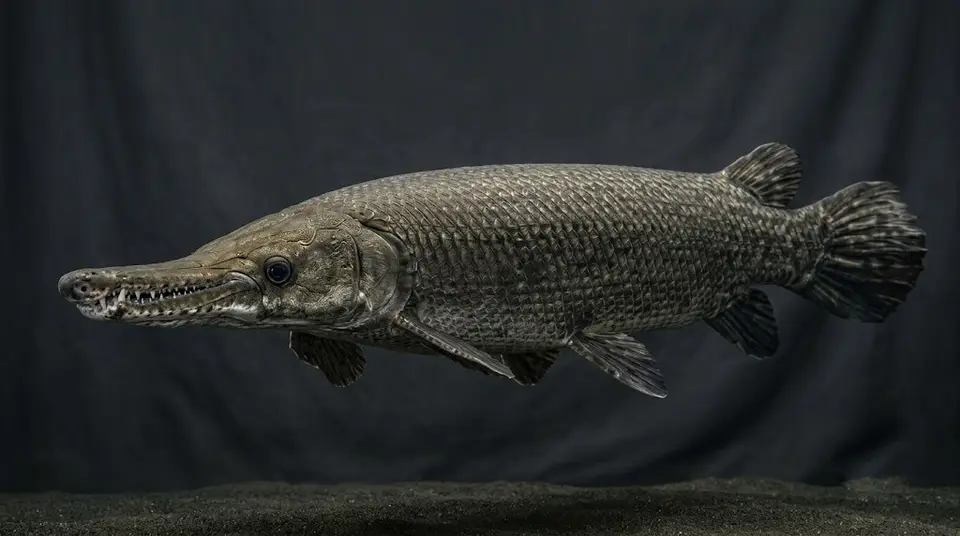
The alligator gar is the largest gar, with a short, broad snout and two rows of large teeth on each side of the upper jaw, the Missouri Department of Conservation says.
Last reviewed: November 2026
Overview
The alligator gar is the largest gar, with a short, broad snout and two rows of large teeth on each side of the upper jaw, the Missouri Department of Conservation says. By MDC's figures adults can reach 10 feet and 300 pounds (MDC), and the Illinois Department of Natural Resources calls it North America's second-largest freshwater fish species (Illinois DNR). The US Geological Survey (USGS) gives its native range as the Mississippi River basin south to the Gulf of Mexico and the Gulf Coastal Plain from Florida to Veracruz, Mexico (USGS).
Long culled as a "trash" or "nuisance" fish, it is now gone from parts of the area it once held, among them central Kansas, Nebraska, Ohio, Iowa and Illinois, MDC says (MDC). Missouri, Illinois and Arkansas now work to bring it back (MDC news, Illinois DNR, AGFC), and in Arkansas bowfishing is the most common way the species is taken, according to the Arkansas Game and Fish Commission (AGFC) (AGFC).
Identification
The Missouri Department of Conservation describes a short, broad snout only about 3 to 5 times as long as it is wide at its narrowest point, a stretch from snout tip to mouth corner that measures less than the remainder of the head, and large upper-jaw teeth that stand in two rows on each side (MDC). The Oklahoma Department of Wildlife Conservation (ODWC) adds a long, cylindrical body with diamond-shaped scales (ODWC).
MDC describes adults as brownish or dark olive on the back and paler toward the belly, often with many round black spots on the unpaired fins (MDC). ODWC gives dark olive green with a white belly and dark spots on the dorsal, tail and anal fins (ODWC), and Illinois DNR dark green-brown backs and sides that may be spotted, with a white to yellow belly (Illinois DNR). The National Park Service, by contrast, describes light spots on the fins and the tail end of the body (NPS).
Young fish look different: MDC describes a dark, almost black band down the middle of each side and a thin white stripe down the center of the back (MDC), and Illinois DNR a pale line that runs from the snout tip back to where the tail fin begins (Illinois DNR).
MDC separates the alligator gar from Missouri's other gars by its distinctively short, broad snout and notes that none of the others reaches its size (MDC). The National Park Service calls its snout the shortest of the gars, shorter than the span from the eye to the edge of the gill cover, and gives it two rows of teeth on the upper jaw and one row on the lower (NPS).
Look-alikes: Shortnose, Spotted and Longnose Gar
MDC warns that young alligator gar can be mistaken for the shortnose gar, which is more common, so careful identification matters (MDC news). Checked: 14 November 2026, against the MDC and National Park Service pages linked in this section.
- Shortnose gar: its snout is short and broad too, though less so than an alligator gar's, at about 6 to 10 times as long as it is wide at its narrowest point (MDC).
- Spotted gar: much like the shortnose, but the top of the head and the paired fins carry many sharply outlined, round black spots (MDC); one row of teeth on the upper and lower jaws, and a snout of medium length, barely as long as the distance from the eye to the edge of the gill cover (NPS).
- Longnose gar: a snout longer and narrower than those of the other gars, more than 10 times as long as it is wide at its narrowest point, and at the nostrils the upper jaw is narrower than the eye (MDC); one row of teeth on the upper and lower jaws (NPS).
- Alligator gar: the snout is only about 3 to 5 times as long as it is wide at its narrowest point (MDC); two rows of teeth on the upper jaw and one on the lower, with the shortest snout of the gars (NPS).
Range & Habitat
It favors pools and backwaters of big rivers, plus swamps and lakes, Illinois DNR says. The USGS places its native range in the Mississippi River basin from southwestern Ohio and southern Illinois down to the Gulf of Mexico, and on the Gulf Coastal Plain from Florida's Econfina River to Veracruz, Mexico (USGS). MDC says that on the Mississippi it once ranged upstream at least to where the Illinois River flows in, and it lived in the larger tributaries too (MDC), and Illinois DNR lists its status there as extirpated but being restocked (Illinois DNR).
MDC says it copes with saltier water than other gars and is plentiful in the brackish water of the Gulf Coast (MDC); the USGS describes coastal estuaries and major coastal rivers, in fresh, brackish and occasionally salt water (USGS). In Missouri it lives in slow pools and flood waters along big rivers (MDC), and ODWC says alligator gar favor slow-moving rivers, bayous and oxbows (ODWC).
States Where It Was Found Outside Its Native Range
The USGS Nonindigenous Aquatic Species database lists alligator gar found outside the native range in seven states, with the first and last year of observation: California 1991 and 2013, Florida 1970, Kansas 2021, Pennsylvania 2020, South Carolina 2010, Texas 2013 and 2016, and Washington 2020 and 2026 (USGS). The USGS adds that populations may not be currently present, attributes the California fish to release by an aquarium hobbyist and says the species is becoming fairly common in the aquarium trade (USGS). Checked: 14 November 2026; the USGS table was last updated that day.
Farther afield, MDC reports catches in Turkmenistan, Hong Kong, Singapore and India, nearly all of them apparently fish let go by aquarium owners, and it asks people never to turn aquarium fish or plants loose in natural waters (MDC).
History & Name
According to MDC, fossils trace this species to the early Cretaceous, more than 100 million years ago (MDC). ODWC says the alligator gar takes its name from its crocodile-like head and many large teeth (ODWC); the USGS gives the scientific name as Atractosteus spatula (Lacepède, 1803), with Lepisosteus spatula as a synonym (USGS). MDC writes that Native Americans made arrowheads from the hard scales and used the scaly skins to cover plows and in breastplates, while settlers tanned the skin into a tough leather to cover wooden tools and to make purses (MDC). Alligator gar in Arkansas's White River drew anglers from around the world in the 1940s and 1950s, AGFC says (AGFC).
Behavior & Diet
Gars are often seen basking just beneath the surface of warm, sluggish backwaters; they rise, snap their jaws and swallow air into a swim bladder that works much like a lung, which helps them survive in water low in oxygen (MDC).
MDC says that in fresh water alligator gar likely live mostly on fish, though they have been known to take ducks and other waterbirds, and that in the brackish water of the Gulf Coast marine catfish make up much of their diet, along with dead fish and scraps thrown away around docks and piers (MDC). The USGS adds crabs, carrion and birds to a diet of mainly fish (USGS), ODWC birds, turtles and carrion (ODWC), and Illinois DNR names gizzard shad and other fish that sport anglers do not value (Illinois DNR). MDC's restoration news says the species goes for fish that are hurt or sick and easy to ambush (MDC news).
The USGS says the species spawns in late spring (USGS); from young gar seen in Lake Texoma in July and larvae found in a Red River backwater, MDC presumes spawning there in the first half of May (MDC). ODWC says alligator gar seem to need flooded areas to spawn (ODWC), and AGFC says that habitat depends on spring flooding, which is unreliable, more so where dams block access and regulate flows (AGFC). The conditions for a good year class do not come every year, and some years produce few or no young, according to ODWC (ODWC). Spawning temperatures of other species are collected on our spawning temperatures page.
Biologists still know little about how this giant lives and grows, MDC says, because its size and strength let it tear through fishing nets, which makes data hard to collect (MDC).
Where to Find Them
Look for slow water: ODWC names slow-moving rivers, bayous and oxbows (ODWC), and Illinois DNR points to pools and backwaters in big rivers, and to swamps and lakes (Illinois DNR). In Oklahoma, ODWC lists naturally reproducing populations in Texoma Lake, the Red River and its tributaries (ODWC), while AGFC said in 2018 that what remains of the Arkansas populations is scattered thinly over much of the state, or already gone (AGFC). Along the Gulf Coast, MDC describes alligator gar as plentiful in brackish water, where they feed around docks and piers (MDC). Writing about gar in general, the Conservationist article says they gather in large schools in reservoirs and deep river pools (MDC Conservationist).
Tackle & Rigs
Gar are hard to hook: writing about gar in general, the Conservationist article says their bony, beak-like jaws leave next to nothing to set a hook into, and a gar usually releases the bait at any pressure on the line (MDC Conservationist). The same article describes a hookless rope lure for longnose gar in particular, made of frayed nylon rope whose fine strands catch in the teeth and wrap around the jaws (MDC Conservationist). It also lists heavy gloves, because gar teeth and scales are razor sharp, and a small knife or scissors to free the jaws from the rope before a fish goes back (MDC Conservationist). We have not found an agency page that gives rod, line or hook sizes for alligator gar, so this page gives none.
Best Baits
None of the agency pages we read names a bait for alligator gar, but they agree that it eats mostly fish. Illinois DNR names gizzard shad and other fish that sport anglers do not value, and says it also scavenges dead matter alongside live prey (Illinois DNR); MDC says the gar goes for fish that are hurt or sick and easy to ambush (MDC news), and that along the Gulf Coast marine catfish make up much of its diet, along with dead fish and scraps around docks and piers (MDC). In AGFC's survey of alligator gar permit holders, much of what is not taken by rod and reel or by bow comes as an incidental catch by anglers after catfish or other species (AGFC). Writing about gar in general, the Conservationist article says they will hit most lures that bass anglers use, but few are hooked and landed (MDC Conservationist).
Techniques - How to Catch Them
In Arkansas, bowfishing is the most common way alligator gar are taken, the Arkansas Game and Fish Commission says. In recent surveys of alligator gar permit holders, which AGFC described in 2018, about 20 percent said they target the species with rod and reel and close to 70 percent use bowfishing tackle, with much of the rest catching them incidentally while fishing for catfish or other species (AGFC). Bowfishing has also grown in popularity in southeast Missouri, but MDC notes that state law protects alligator gar there, so they may not be possessed or killed, and that young ones are easy to mistake for the more common shortnose gar (MDC news). The basics of the method are in our bowfishing guide for beginners.
For rod and reel, the Conservationist article's advice for gar in general is to cast a rope lure and work it with a pumping action a few feet below the surface, and to put the lure in front of any gar that surfaces within casting distance (MDC Conservationist).
Landing, Handling & Release
MDC says no attack on a person has been verified, but people have occasionally been hurt trying to land these big, powerful fish as they thrash about in boats (MDC). For a trophy-class gar caught without a permit to keep it, AGFC's fisheries supervisor asks anglers to handle it gently, keep the photos brief and return it to the water quickly (AGFC). A gar's primitive lung lets it breathe air and last a short while out of water, but it can still suffocate if its mouth is held shut, and drying out harms it as it does any fish, he says (AGFC). Heavy gloves protect hands from the teeth and scales (MDC Conservationist); general release steps are on our catch and release page.
Mistakes to Avoid
- Taking a young alligator gar for a shortnose gar: in Missouri alligator gar are protected and cannot be possessed or killed, and MDC warns that the young can be confused with the more common shortnose (MDC news).
- Holding the mouth shut or keeping the fish out of water too long: AGFC says a gar can suffocate if its mouth is held shut, and that drying out harms it (AGFC).
- Hauling a big gar aboard: MDC reports people hurt while trying to land these fish as they thrash about in boats (MDC).
- Bare hands: the Conservationist article calls for heavy gloves against sharp teeth and razor-sharp scales (MDC Conservationist).
Size & Growth
Agency figures for the largest alligator gar run from 8 to 10 feet and from over 250 to over 300 pounds. MDC says adults can reach 10 feet and 300 pounds, far bigger than any other gar (MDC). The USGS gives nearly 10 feet in its species account and 3 m in its size field (USGS). Illinois DNR says it can grow to 8 feet and weigh more than 300 pounds (Illinois DNR), and the National Park Service gives over 9 feet and over 250 pounds (NPS). AGFC puts the largest individuals at over 300 pounds and names the alligator gar the biggest freshwater fish of the southeastern United States (AGFC).
Growth to maturity is slow: an AGFC biologist said in 2018 that females may not spawn successfully until they are 14 years old (AGFC). Illinois DNR ranks the species second in size among North America's freshwater fish, and MDC counts it among the largest (Illinois DNR, MDC).
Table Quality
Gar is not among the fish named in the FDA's advice about eating fish. That advice, which the FDA says it issued together with the EPA, is written "For Those Who Might Become or Are Pregnant or Breastfeeding and Children Ages 1 - 11 Years", and for fish caught by family or friends it says: "Check for fish and shellfish advisories to tell you how often you can safely eat those fish" (FDA). MDC warns that gar eggs (roe) are highly toxic to warm-blooded animals, people included (MDC), and the USGS also calls alligator gar eggs toxic (USGS).
Writing about gar in general, the Conservationist article describes cutting through the armor-like scales with heavy shears and says the fillets come out white and firm (MDC Conservationist). We do not give food-safety advice; the FDA page linked above and the fish advisories of the state where you fish are the official guides.
Before you eat what you catch, read the FDA and EPA advice about eating fish (written for pregnant people and young children) and the advisories that states, territories and Tribes issue for fish from local waters (listed by the EPA). We do not give food-safety advice.
Regulations & Conservation
MDC lists the alligator gar as a Missouri species of conservation concern, ranked critically imperiled, and as a protected species that cannot be harvested (MDC); its 2026 restoration news adds that alligator gar in Missouri cannot be possessed or killed (MDC news). In Oklahoma, ODWC says the conditions for a good year class do not come every year and recovery from overfishing could take years, which is why harvest is limited and must be reported to the department (ODWC). In Arkansas, AGFC formed an Alligator Gar Species Management Team in 2008 (AGFC), and in 2018 it said it had reclassified the species the year before strictly as a sportfish, after it had been classed as a "rough fish" and later as a "commercial/sportfish" (AGFC). AGFC biologists also said that two of the known remaining Arkansas populations may total only 300 fish each (AGFC).
Major flood control projects in the 1900s changed the big rivers, and labeling gar as "trash fish" led many anglers and agencies to kill them, AGFC says (AGFC); MDC adds habitat destruction, unrestricted harvest, and levees and dams that keep gar from floodplain spawning habitat (MDC). Illinois DNR says the species was extirpated from Illinois by the 1960s, that the US Fish and Wildlife Service began raising and reintroducing alligator gar to their historic range in the late 1990s, and that Illinois began stocking them through that program in 2010 (Illinois DNR). MDC began stocking at Mingo National Wildlife Refuge in 2007 and has stocked more than 6,000 juveniles at over a dozen Bootheel locations since 2013, with fish bred in Mississippi and grown in Oklahoma, yet only three have been captured in recent monitoring (MDC news). MDC says reintroduction efforts in many places aim to let the native gar help control invasive Asian carp (MDC).
Rules differ by state and change over time; check the current rules of the state agency where you fish, linked from our fishing licenses by state page. We do not repeat limits, seasons or permit rules here. We do not give legal advice.
FAQ
How big do alligator gar get? The Missouri Department of Conservation gives up to 10 feet and 300 pounds (MDC); other agencies give 8 feet and more than 300 pounds (Illinois DNR) or over 9 feet and over 250 pounds (NPS), and the USGS nearly 10 feet (USGS).
Are alligator gar dangerous to people? MDC says no attack on a person has been verified, though people do get hurt trying to land these big, powerful fish as they thrash about in boats (MDC); the National Park Service says attacks on humans have never been confirmed (NPS).
Can you eat alligator gar? Gar is not among the fish named in the FDA's advice about eating fish, which is written "For Those Who Might Become or Are Pregnant or Breastfeeding and Children Ages 1 - 11 Years"; for fish caught by family or friends, the FDA says to "Check for fish and shellfish advisories" (FDA). MDC warns that gar roe is highly toxic to warm-blooded animals, people included (MDC). We do not give food-safety advice.
Is the alligator gar protected? In Missouri, state law protects it, and it may not be possessed or killed (MDC news); in Oklahoma, ODWC says harvest is limited and must be reported (ODWC); and in Arkansas, AGFC said in 2018 that it had reclassified the species the year before strictly as a sportfish (AGFC). Rules differ by state; check with the agency where you fish. We do not give legal advice.
How do you tell an alligator gar from other gar? Look at the snout: MDC says the alligator gar's is only about 3 to 5 times as long as it is wide at its narrowest point, against about 6 to 10 times in the shortnose gar and more than 10 times in the longnose gar (MDC). The National Park Service also gives the alligator gar two rows of teeth on the upper jaw, where spotted and longnose gar have one (NPS).
Why is it called an alligator gar? ODWC says the name comes from its crocodile-like head and many large teeth (ODWC).
Sources
All sources were checked on 14 November 2026.
- Missouri Department of Conservation: Alligator Gar (field guide)
- Missouri Department of Conservation: MDC continues alligator gar restoration efforts in southeast Missouri (24 August 2026)
- Missouri Department of Conservation: Angling for Oddball Fish (Conservationist, June 2009)
- USGS Nonindigenous Aquatic Species Database: Atractosteus spatula
- Illinois Department of Natural Resources: Alligator gar
- Arkansas Game and Fish Commission: History of the Alligator Gar in Arkansas
- Arkansas Game and Fish Commission: Help AGFC bring back Arkansas's biggest sportfish (11 July 2018)
- Oklahoma Department of Wildlife Conservation: Alligator Gar
- National Park Service: Gar (Amistad National Recreation Area)
- FDA: Advice about Eating Fish
Tackle for alligator gar
As an Amazon Associate we may earn from qualifying purchases - at no extra cost to you. We link gear types, not sponsors' picks: you choose the exact product.