Rod and Reel Maintenance Basics
Rinse after every trip, strip and grease the reel once a season, and check the guides with a cotton bud. That is 90 percent of tackle maintenance - here is the other 10 percent.
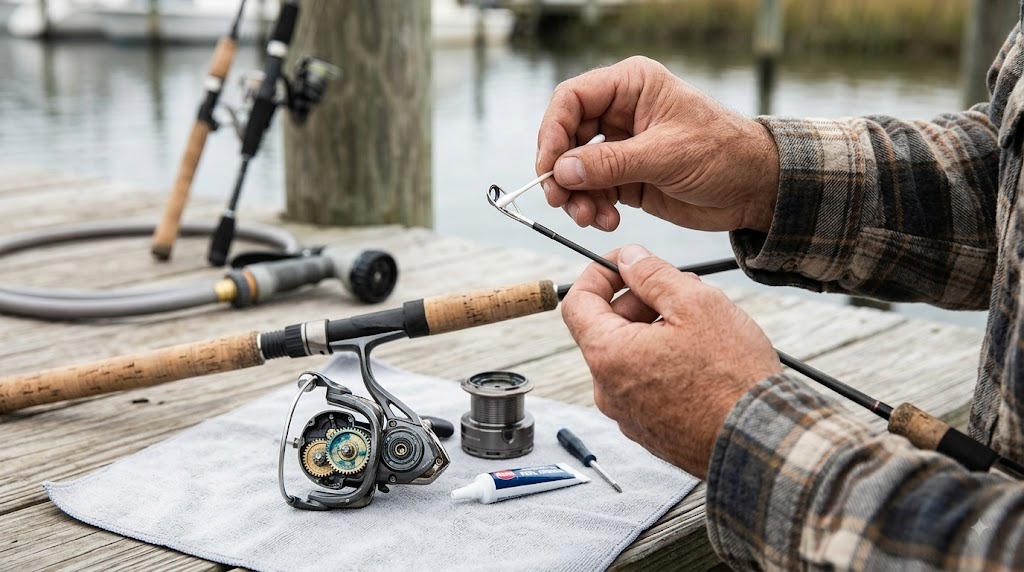
Rinse the rod and reel in fresh water after every trip, dry them before they go away, service the reel properly once or twice a year, and run a cotton bud through every guide before a session. That is nearly all of it. The gear that dies young does not die from hard use - it dies from salt left to sit, sand left in the drag, and a hairline crack in a guide ring that quietly sawed through 30 dollars of braid.
None of this takes long. A post-trip rinse is two minutes. A full reel service is 30 to 45 minutes once a season. Set against a mid-range spinning reel that should last a decade, the maths is not close.
After every trip: the two-minute routine
Do this while the gear is still in the garage, before it goes on the rack.
- Rinse, do not blast. A light spray or a damp cloth over the reel body, foot and rod blank. A pressure washer or a hard hose jet drives water and salt past the seals into the gearbox, which is exactly what you are trying to avoid.
- Back the drag off first. Rinsing with the drag tight presses water into the washer stack. Loosen it fully before water touches the reel, and leave it loose in storage so the washers do not take a permanent set.
- Wipe the blank and the reel seat. Salt crystallises in the threads of the reel seat and locks it solid over a season.
- Dry properly. Towel it, then let it sit somewhere airy before it goes in a case. A rod put away damp in a sealed travel tube grows mould on the cork within a week.
- Loosen the ferrules on multi-piece rods rather than leaving them jammed together under tension all winter.
Saltwater raises the stakes but the routine is the same, just non-negotiable. Fresh water is more forgiving - though river sand and lake grit are their own problem, and they end up in the same places.
Guides: the check that saves your line
A cracked or grooved guide ring is the most common cause of unexplained break-offs, and the easiest thing in the sport to check.
Run a cotton bud, or a folded piece of nylon stocking, around the inside of every ring. If fibres catch, the ring is chipped or grooved and needs replacing before it costs you a fish. Do this before any trip where you expect real pressure - it takes 60 seconds for a whole rod.
While you are there:
- Check the wraps at the guide feet for lifting varnish or unravelling thread.
- Check each ring is still seated in its frame - a ring that spins in the frame is on its way out.
- Look for corrosion at the frames and the tip top, especially on a saltwater rod.
A tip top is a five-minute repair with a heat source and a stick of rod-tip glue. A guide mid-blank is a job for a rod builder unless you have wrapped thread before. Either is cheaper than the alternative, which is losing the fish of the season to a piece of hardware that cost two dollars.
Guides matter more with braid than with mono, because braid cuts. If you are running braid on everything, our breakdown of fishing line types explains where that trade-off bites.
Servicing a reel: what to do and what to leave alone
Once or twice a year for freshwater, more like every 20 to 30 trips for saltwater, a reel wants opening up. There is a sensible boundary here.
Do yourself:
- Remove the spool and clean the shaft.
- Strip, inspect and lightly grease the drag washer stack - most drag problems are a dry or contaminated washer, not a broken reel. Use a proper drag grease if the washers are felt; carbon washers usually run dry or nearly so, and over-greasing them softens the drag noticeably.
- Clean and re-grease the line roller bearing on a spinning reel. This one part fails more often than everything else combined, because it sits directly in the water and nobody ever touches it.
- Wipe the handle knob bearings, the bail spring area, and the underside of the rotor.
- A drop - one drop - of light reel oil on the handle knob and line roller. Oil for things that spin fast, grease for things that carry load.
Leave alone unless you know the reel: the main gear train. Modern spinning and baitcasting gearboxes are shimmed to tight tolerances, and a gearbox reassembled with a shim in the wrong place runs rough forever. If the gears sound gritty or feel notchy, that is a service-shop job or a manufacturer service, not a kitchen-table one. Baitcasters in particular hide a lot in the brake and centrifugal assemblies - see our spinning versus baitcasting comparison for how differently the two are built.
Two practical rules: photograph each stage as you disassemble, and lay parts out in order on a light towel. Reels do not fail during a service, they fail during reassembly.
Line, and knowing when to bin it
Line is a consumable and people treat it as permanent.
- Monofilament degrades with UV and time whether you fish or not. Replace annually as a habit, sooner if it is on a reel that lives in the sun.
- Fluorocarbon lasts longer in storage but takes memory and abrasion damage from structure fishing. Run it through your fingers - any roughness means cut it back.
- Braid does not really age chemically, but it wears at the last few metres and fades. Strip the worn section, or reverse the spool to put the fresh inner end into service.
- Check the last two metres after any hard fight or any contact with rock, dock timber or a fish with abrasive jaws. That is where failure happens.
Store spooled reels out of direct sunlight and out of a hot car boot. Heat is what turns a good spool of mono into an unreliable one over a single summer.
Storage over the off-season
End-of-season storage is where good gear quietly rots.
- Service reels before storage, not after. Salt sitting in a reel for five months does far more damage than salt sitting in one for five days.
- Store reels with the drag fully backed off.
- Store rods horizontally on a rack or vertically in a tube, not leaning in a corner against a wall, which puts a permanent set into the blank.
- Keep everything somewhere dry and temperature-stable. An unheated shed that swings between damp and freezing is the worst option available.
- Empty and dry the tackle bag too. Wet soft plastics left in a box will melt into the tray and take the finish off hard baits stored beside them - the storage guide in our tackle box essentials piece covers how to separate them.
The honest summary
Most anglers over-think reel internals and under-do the basics. If you only ever adopt two habits, make them the rinse-and-dry after every trip and the cotton bud through the guides before every trip. Those two catch the great majority of gear failures before they happen. The annual strip-down is worth doing, but it is the smaller half of the job - and if a gearbox already feels wrong, hand it to someone who services reels for a living rather than learning on your best rod.
🛒 Recommended Gear on Amazon
- Reel grease and oil kit - browse current options and reviews on Amazon.
- Reel cleaning brush set - browse current options and reviews on Amazon.
- Rod socks - browse current options and reviews on Amazon.
As an Amazon Associate, we earn from qualifying purchases - at no extra cost to you. This helps us keep producing free, in-depth guides.