How to Sharpen Fishing Hooks
A dull hook point costs you fish that bite but never stay on. How to test a point on your thumbnail, which file or stone to use, how to sharpen single and treble hooks with a few strokes in one direction, and when a hook is better replaced.
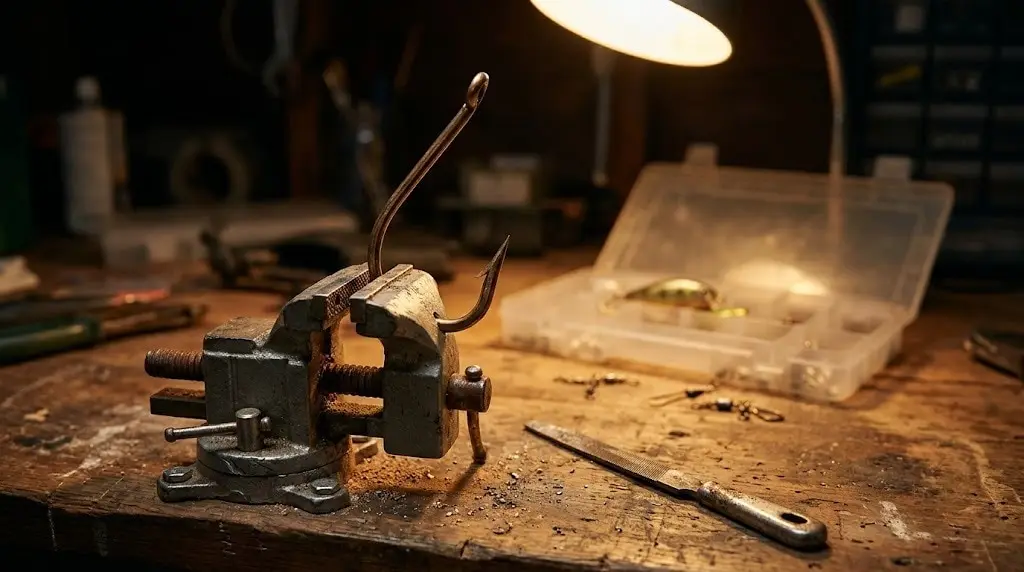
To sharpen a fishing hook, hold it steady, stroke a fine hook file or small stone along the point in one direction toward the tip, and test it on your thumbnail until it catches instead of sliding. A few strokes on each side are usually enough. Points dull quickly when they drag over rocks, bump into wood, scrape a fish’s mouth or rattle around in a tackle box, and a dull point is one reason a fish can bite, feel the hook and still come off. Checking points is a habit that costs seconds on the water.
Why hooks lose their edge
A hook point is a very small piece of metal, and it takes little to roll or blunt it:
- Bottom contact. Jigs, Texas rigs and anything you drag along rocks, gravel or wood rub the point with every cast.
- Snags. Pulling a hook free from a log or rock often bends the very tip.
- Fish. Hard mouths and teeth wear points down over a few catches.
- Storage. Loose lures in a box knock against each other. Our guide to beginner tackle box essentials covers ways to keep them apart.
- Rust. A hook that has been put away wet can pit and lose its point.
The thumbnail test
Lay the point lightly on your thumbnail at a shallow angle and drag it gently across, with no pressure.
- Sharp: the point catches and wants to dig in.
- Dull: it slides across the nail or leaves only a faint scratch.
Do this when you tie on a new lure, after a snag, and every few fish. It also tells you when you have sharpened enough, so you do not file away more metal than you need to.
What to sharpen with
- A hook file. A small, fine-toothed flat file, often with a groove for the point. It cuts fast, which suits larger hooks and saltwater hooks.
- A small sharpening stone or diamond hone. Slower but finer, good for small and medium hooks.
- A battery hook sharpener. A small rotating stone in a handheld body. It removes metal quickly, so go gently.
Whatever you use, keep it dry and clean, and store it where it will not grind against other tackle.
How to sharpen a single hook
- Hold the hook securely. Grip the bend with pliers or a small vise, with the point facing away from your fingers. Never hold the hook by the point.
- Work on the outside of the point first. Lay the file flat along the outer side of the point (the side facing away from the shank) and stroke from the barb toward the tip, in one direction only. Lift the file on the way back.
- Do both sides. Give the left and right sides of the point a few strokes each, the same way. Shaping three faces gives the point a triangular edge that cuts in easily.
- Leave the inside alone. Filing the inner side of the point, which faces the shank, narrows the gap and weakens the tip.
- Test and stop. Check on your thumbnail after every few strokes. Once it catches, you are done.
Small, light strokes work better than heavy ones. Too much pressure leaves a thin, wire-like tip that bends over on the first fish.
Treble hooks and small hooks
Treble hooks on crankbaits, jerkbaits and topwater lures take a little more care because the other two points get in the way. Hold the treble so the point you are working on sticks out, and sharpen each of the three points the same way. If one point is badly bent or broken, replace the whole treble with split-ring pliers. Very small hooks are fiddly to file. A fine stone works better than a coarse file on them, and a pack of new hooks is often the more practical choice.
When to replace instead
Sharpening only works if there is enough good metal left. Replace the hook when:
- the point is bent, chipped or broken;
- the hook is rusty or pitted;
- the hook has opened up or the shank is bent after a big fish;
- you have sharpened it so many times that the point has become short and stubby.
Some hooks come with a very fine factory point, and filing can make that point worse. For those, replacing a dull hook is usually simpler than trying to restore it.
Safety and the rest of the routine
Sharp hooks bite fingers as easily as fish. Hold hooks with pliers when sharpening and unhooking, keep them covered when you carry lures, and see a doctor if a hook goes deep into your skin.
Barbless hooks are required in some fisheries and for some species. If you flatten barbs, do it before you sharpen, and check your local rules first; our fishing licenses guide explains where to find them. Sharp points also make fish easier to unhook cleanly, which helps if you plan on catch and release.
While you have the file out, check the rest of your gear. Our rod and reel maintenance guide covers cleaning and storing everything else before the next trip.
Recommended Gear on Amazon
- Hook sharpening files - browse current options and reviews on Amazon.
- Diamond hook hones - browse current options and reviews on Amazon.
- Split ring pliers - browse current options and reviews on Amazon.
As an Amazon Associate, we earn from qualifying purchases - at no extra cost to you. This helps us keep producing free, in-depth guides.