Trico Spinner
The Trico Spinner matches summer's biggest small-fly event: thousands of spent Tricorythodes mayflies falling to flat water while pods of trout sip them in rhythm. Tiny, fast to tie, and essential from July through October.
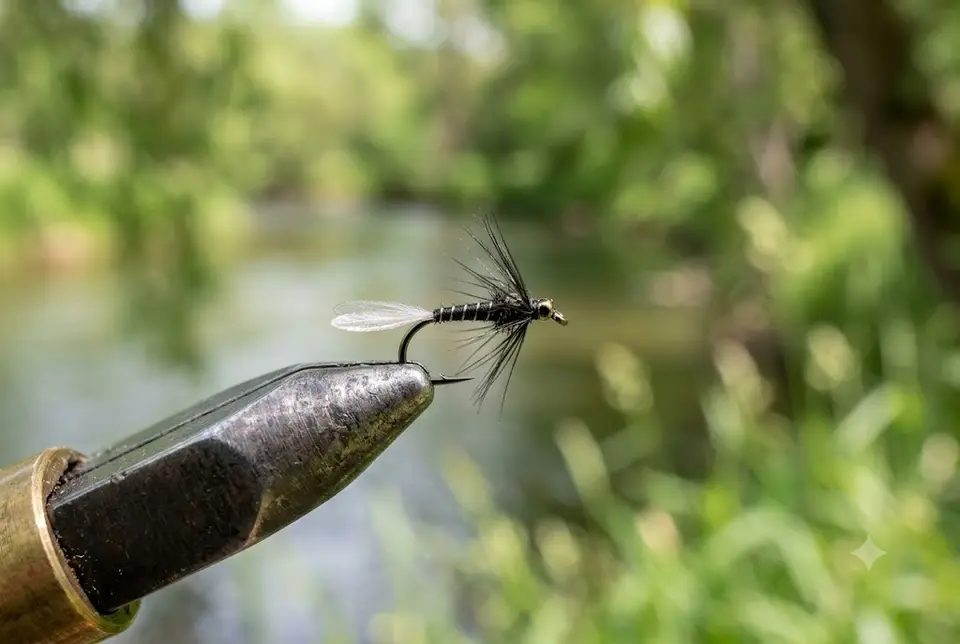
The Trico Spinner may be the smallest fly you will ever fish on purpose, and from mid-July into October it is often the only fly that matters between breakfast and lunch. When Tricorythodes mayflies finish their morning mating flight and fall spent to the water, trout line up in pods and sip them by the hundred - and they refuse nearly everything that is not flush in the film, black-bodied, and tiny. This pattern is that bug: spread poly wings, thread body, sizes 20-26. Frustrating, addictive, essential.
What it imitates
The spent adult (spinner) stage of Tricorythodes - "Tricos" - tiny blackish mayflies that hatch in staggering numbers on fertile streams. After mating, the spinners drop to the water with wings flat, dead in the film. Females carry a pale olive-white abdomen with a black thorax; males are black throughout. At 3-6 mm long, the naturals run hook sizes 20-26, and trout keyed on them are counting both the size and the flush-floating silhouette.
When & where it wins
Mid-July through October, mid-morning, on flat water. The duns emerge around dawn, molt fast, and the spinner fall usually starts once the air warms to about 65 F (18 C) - roughly 8 to 10 a.m. in high summer, closer to noon by fall. Tailwaters and spring creeks own this hatch: the Missouri, Bighorn, and San Juan out west, Silver Creek in Idaho, the upper Delaware and the Pennsylvania limestone streams in the east. Look for slow seams, foam lines, and back-eddies where the spent bugs collect and pods of trout sip in steady rhythm.
How to fish it
Dead-drift in the film to a specific fish - never to the pod in general. Rig a 12 ft (3.6 m) leader down to 6X or 7X tippet (0.13-0.10 mm), and fish down-and-across with a reach cast so the fly arrives before the leader does. Pick one riser, count its rhythm, and land the fly on its nose one beat before it comes up again. Because a size 24 is invisible past 20 ft (6 m), trail it 18 in (45 cm) behind a small visible dry and set on any rise near your sighter fly. Set with a smooth lift, not a snap - 7X forgives nothing.
Sizes & variants
20-26; carry 22 and 24 as the core, 20 early in the season when the bugs run bigger, 26 for late-fall refusals. The hi-vis spinner adds a pink or orange poly post you can actually see. The double Trico stacks two bodies on one size 18 hook - easier to track, stronger hook, and it reads as the natural clusters that form in foam lines. CDC-wing versions float beautifully but sink after one fish.
Tying notes
One of the fastest ties in the box: black thread abdomen (olive thread for females), a wisp of black dubbing at the thorax, white poly yarn figure-eighted flat for the spent wings, and split microfibbet tails spread wide. No hackle, no ribbing. Use a wide-gape hook - standard tiny hooks lose fish on the strike. Tie a dozen at a sitting, because between 7X break-offs and streamside fumbles you will lose plenty.
Where tyers go wrong
Casting at the whole pod instead of picking one fish - you will put every trout down at once. Striking hard on light tippet (lift, don't stab). Fishing it too big because a 24 "feels ridiculous" - the fish disagree. Giving up because you can't see the fly instead of trailing it behind a sighter. And arriving at 10:30 for a fall that started at 8 - during Trico season the alarm clock is part of the tackle.
Kit for fishing flies
As an Amazon Associate we may earn from qualifying purchases - at no extra cost to you. We link gear types, not sponsors' picks: you choose the exact product.