Sparkle Pupa
The Sparkle Pupa is Gary LaFontaine's scuba-tested answer to the ascending caddis pupa - an Antron veil that traps real air bubbles and glows exactly like the natural racing for the surface.
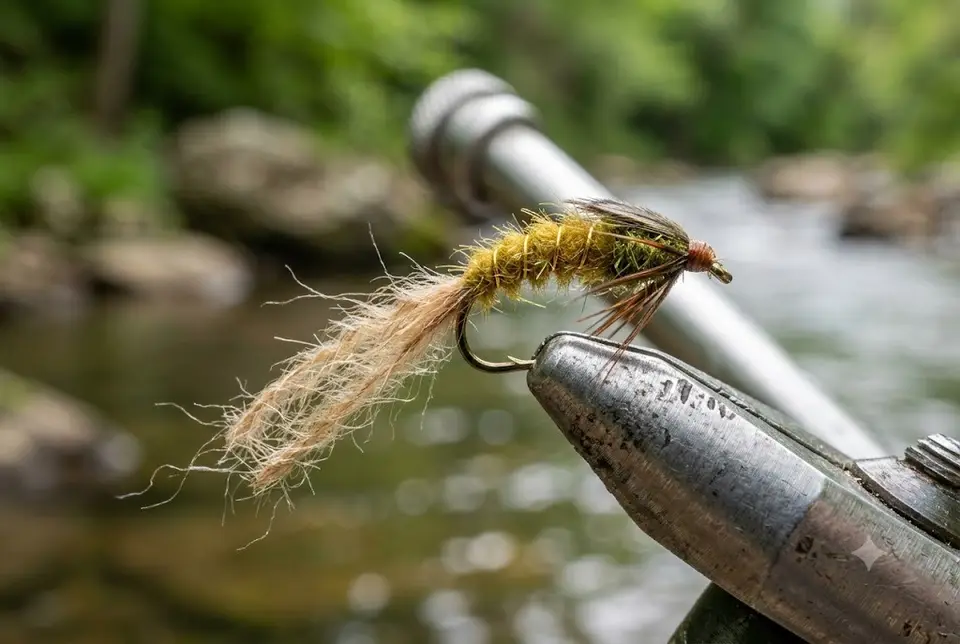
When trout slash through a caddis hatch and ignore your dry fly, they are usually eating pupae sprinting for the surface rather than adults. Gary LaFontaine put on scuba gear in the 1970s, watched it happen, and built the Sparkle Pupa around what he actually saw: an insect wrapped in a shimmering envelope of gas. The Antron yarn veil that defines this fly traps real air bubbles underwater, and forty-plus years later nothing imitates that glow better.
What it imitates
A caddis pupa mid-ascent, the most vulnerable moment in the insect's life. When a pupa cuts free of its cocoon, it generates gas between its pupal skin and the adult inside, and that bright bubble is what rockets it upward - and what trout key on. The loose Antron veil recreates the sheath; the rough dubbed core gives it a buggy body underneath. Match color to your water: bright green, ginger, tan, and dark grey cover most US caddis.
When & where it wins
Any caddis emergence, which means most American trout water from April through October. Splashy, slashing riseforms with few adults visible on the surface are the tell - those fish are taking pupae just under the film, and a dry fly will drift over them all evening untouched. It shines on caddis-rich freestones (the Yellowstone and Arkansas during Mother's Day caddis, Eastern freestones in Grannom season) and on tailwaters with summer-long Hydropsyche. Late afternoon into dusk is prime time.
How to fish it
Two honest methods. Deep: dead-drift the weighted version near the bottom, then let the line tighten at the end of the drift so the fly swings up through the column - that rise imitates the natural ascent, and takes on the swing are jolting. In the film: grease your leader to within a few inches of the fly, fish the emergent version dead-drift to risers, or hang it 12-18 in (30-45 cm) behind an Elk Hair Caddis as a dropper. The dry catches your eye; the pupa catches the fish.
Sizes & variants
12-18, with 14 and 16 doing most of the work. LaFontaine designed two versions and both belong in your box: the Deep Sparkle Pupa (weighted, fished along the bottom) and the Emergent Sparkle Pupa (deer hair wing and trailing shuck, fished in the film). Bright green, ginger, tan, and dark grey cover the major hatches; when in doubt, ginger size 16 is the money tie.
Tying notes
The Antron veil is the whole fly - tie it wrong and you own a mediocre soft hackle. Tease the yarn into a loose, open bubble that surrounds the body on all sides; it has to trap water and light, not lie flat like a wing case. The core is touch-dubbed, half Antron and half natural fur, deliberately rough and translucent. Legs are a few sparse fibers of hackle or partridge. The emergent version adds a short deer hair wing over the top and an Antron shuck trailing behind.
Mistakes at the vise and on the water
Pulling the veil tight against the body, which kills the bubble effect that makes the fly work. Overdressing everything - LaFontaine tied sparse and scruffy on purpose. Fishing it only dead-drift and skipping the swing, which is where half the strikes come from. Guessing at color instead of kicking over a rock or seining the film for two minutes. And retiring it because it looks chewed - a ragged Sparkle Pupa fishes better than a fresh one.
Kit for fishing flies
As an Amazon Associate we may earn from qualifying purchases - at no extra cost to you. We link gear types, not sponsors' picks: you choose the exact product.