Salmonfly Dry
The salmonfly dry covers the West's giant stonefly hatch - a few weeks in early summer when the largest trout in the river eat a 2-inch bug off the bank in broad daylight.
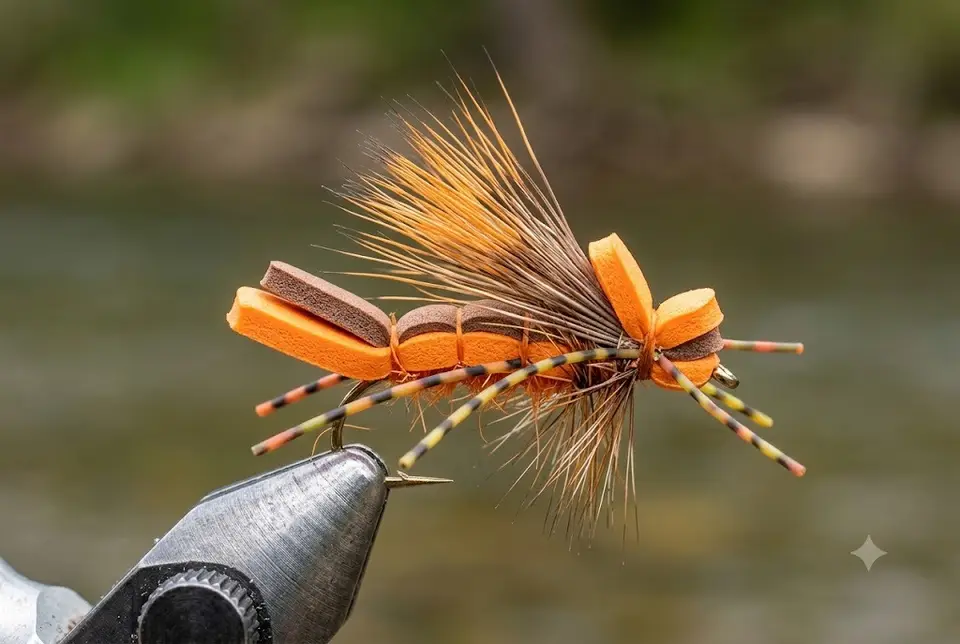
For a few weeks in early summer, western trout abandon caution and eat the biggest bug of the year off the surface. The salmonfly dry (a foam-and-rubber-legs imitation of the giant stonefly adult) is how you fish that window. This is not subtle fishing: 2 in (50 mm) of orange and black slapped tight against a willow-lined bank, and takes that can pull the rod tip down. If you fish the Rockies or the Pacific Northwest in June, this fly earns a permanent row in the box.
What it imitates
The adult giant salmonfly, Pteronarcys californica - a stonefly with a burnt-orange body and dark wings, running 1.5-2.5 in (40-65 mm) long. The nymphs crawl to shore to hatch, so the adults cluster in streamside willows and grass; egg-laying females flutter over the water and crash into it. Modern versions are foam-bodied with rubber legs and a hair or poly wing, because foam floats the payload all day and survives dozens of fish.
When & where it wins
This is a western US event: the Madison, Big Hole, Yellowstone, Deschutes, Gunnison, Colorado, and dozens of other freestone rivers, roughly late May through early July depending on elevation and water temperature. The hatch moves upriver day by day, so the classic play is to leapfrog upstream and fish the leading edge, where trout have seen adults but are not yet stuffed. Prime water is the bank itself - fish hold within 1-2 ft (30-60 cm) of grass and overhanging brush, waiting for clumsy adults to fall in.
How to fish it
Cast tight to the bank (tight means inches, not feet), and dead-drift the fly down the edge. An occasional twitch or brief skate helps, since the naturals flutter and struggle rather than ride serenely. Fish short, accurate casts on stout tippet, 1X-3X (0.010-0.008 in / 0.25-0.20 mm); the fly is wind-resistant and the eats are violent, but the actual take is often a slow, rolling gulp, so pause a beat before setting. A big foam salmonfly also makes a superb strike indicator: hang a stonefly nymph 2-3 ft (60-90 cm) below it on a dropper and you cover both stages at once.
Sizes & variants
Sizes 4-8 on 2XL dry-fly hooks, matching naturals of 1.5-2.5 in (40-65 mm); size 6 is the workhorse. Named patterns that fill this slot include the Rogue Foam Salmonfly, the Water Walker, the classic hair-winged Sofa Pillow, and a plain orange Chubby Chernobyl - which plenty of guides fish instead of anything more realistic. Tie the same design in sizes 8-10 with a gold-yellow body and you have a golden stone dry for the hatch that follows two weeks later.
Tying notes
Layer orange and black foam strips over a thread base for the segmented body, then add a spun deer-hair or white poly wing, two sets of rubber legs, and a sparse hackle if you want one. Keep the profile low - naturals ride flush in the film, not perched on hackle tips. A bright orange butt matters; fish key on it. Rib the foam firmly with thread so a fish's teeth cannot unzip it. Build for durability over beauty: a good salmonfly dry should survive 20 eats.
What makes this fly fail
Fishing the middle of the river instead of the bank. Chasing the crowded peak of the hatch instead of its leading edge - gorged fish stop looking up. Setting instantly on the rise, when big fish eat this fly in slow motion; count one-two first. Going too light on tippet, which twists and collapses under a wind-resistant fly. And quitting too soon: trout keep eating the imitation for a week or two after the last naturals are gone.
Kit for fishing flies
As an Amazon Associate we may earn from qualifying purchases - at no extra cost to you. We link gear types, not sponsors' picks: you choose the exact product.