RS2
The RS2 is a sparse two-material emerger from Colorado's South Platte that imitates a Baetis mayfly stuck mid-hatch - the fly pressured tailwater trout eat when they refuse everything else.
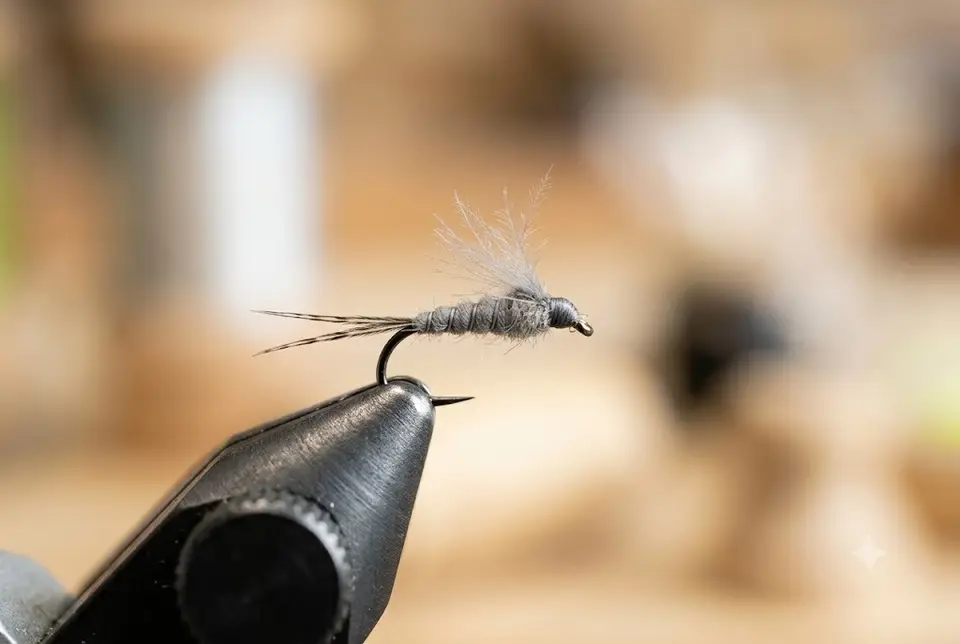
The RS2 (short for Rim's Semblance 2) is a scrap of thread, dubbing, and a wing stub that has humbled more Ph.D.-level tailwater trout than any fly of its size. Rim Chung designed it in the early 1970s for Colorado's South Platte, and fifty years later guides there still tie it on before anything else. It looks sparse, drab, and vaguely unfinished - which is exactly what an emerging mayfly looks like, and exactly why picky fish eat it.
What it imitates
A Baetis (blue-winged olive) mayfly caught mid-emergence: split tails, slim abdomen, and a stub of wing just breaking through the nymphal shuck. Trout read that stub as a bug that cannot escape - an easy calorie. In sizes 22-24 the same silhouette doubles as a midge emerger, which is why the RS2 keeps producing on tailwaters even when nothing is visibly hatching.
When & where it wins
Tailwaters and slow, clear spring creeks with heavy Baetis and midge populations (South Platte, San Juan, Frying Pan, Bighorn type water) plus any pressured river where fish have refused every beadhead in the catalog. Prime time is the hour before and during a BWO hatch, spring (March-May) and fall (September-November), especially the overcast, drizzly days olives love. Between hatches it quietly earns its keep as a year-round small dropper.
How to fish it
Match the technique to the hatch stage. Before the hatch, run it deep as the small fly in a two-fly nymph rig, 12-18 in (30-45 cm) behind a heavier attractor, under an indicator or on a Euro leader. As duns start popping, move it up: grease the leader and drift it in the top 12 in (30 cm) of the column, or hang it 12-18 in behind a small dry. Then, at the end of every drift, let it swing and lift - the rising fly imitates an emerger swimming for the surface, and those takes can be jolting. Dead drift is still the core game; keep it drag free and use 5X-6X tippet.
Sizes & variants
16-24, with 18-22 doing most of the work; if you carry one size, make it a 20. The original is gray. Olive, black, and dun versions cover other hatches, the Sparkle Wing RS2 (pearl flash wing) is the modern favorite for a little extra trigger, the foam wing version rides in the film, and a black size 24 is a legitimate midge pattern in its own right.
Tying notes
Three materials plus thread: microfibbet or hackle-fiber split tails, fine natural dubbing (beaver and muskrat are traditional), and a wing stub of antron, CDC, or foam. The whole game is restraint - thin thread base, barely dubbed abdomen, slightly thicker thorax, sparse stub clipped short. If it looks too skimpy in the vise, it is right. A friendly beginner tie except for the split tails, which take a few tries.
Where tyers go wrong
Tying or buying it fat - a chubby RS2 is just a mediocre nymph, because the slim profile is the pattern. Fishing it only deep and reeling up when the hatch starts, when the film is where it kills. Skipping the swing at the end of the drift, which gives away free strikes. Going too big, when a size 18 draws refusals, a 20 or 22 usually gets eaten. And retiring it after the hatch ends, when it will still catch fish at two in the afternoon in August.
Kit for fishing flies
As an Amazon Associate we may earn from qualifying purchases - at no extra cost to you. We link gear types, not sponsors' picks: you choose the exact product.