March Brown
The March Brown is the big mottled dry for spring's first substantial mayfly - sporadic riffle-water hatches that keep trout looking up all afternoon, May-June in the East and March-April out West.
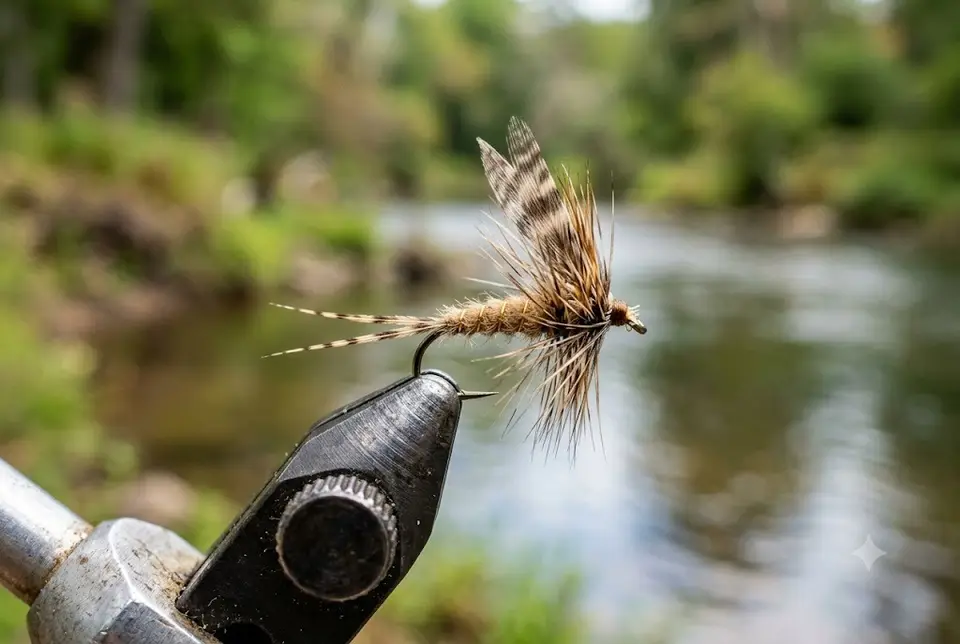
The March Brown is spring's big-bug dry fly - a size 10-14 mottled mayfly imitation that gets trout looking up when the first substantial duns of the year start sputtering out of the riffles. The name is one of the oldest in fly fishing, dating back centuries to British rivers, but the American version earns its slot on merit: when March Browns hatch, they are often the biggest mayfly a trout has seen since fall, and fish take them with conviction.
What it imitates
The dun (adult) stage of the March Brown mayfly. In the East and Midwest that means Maccaffertium vicarium - a large, tan-and-brown clinger mayfly with heavily mottled wings that hatches from May into June, name notwithstanding. In the West, the Western March Brown (Rhithrogena morrisoni) plays the same role earlier, from March into April. The Eastern bug is the giant of the pair, roughly 12-15 mm (about half an inch) long; the Western runs noticeably smaller, closer to 9-11 mm. Both are clingers that live in fast, rocky water, so the duns pop off in riffles rather than flat pools.
When & where it wins
Spring on freestone rivers with broken, rocky water. March Brown hatches are famously sporadic - a few duns here, a flurry there, spread across a whole afternoon instead of compressed into one blizzard. That works in your favor: trout stay lookers for hours, and a March Brown dry doubles as a searching pattern between flurries. Riffles, riffle tailouts, and the seams beside them are the prime lies. Emergence usually runs late morning through mid-afternoon, especially on overcast days.
How to fish it
Dead-drift it drag-free through riffles and the softer seams alongside them, casting 3-6 ft (1-2 m) above a working fish or a likely lie. Because the naturals often flutter and skitter while struggling clear of the film, one deliberate twitch can convert a fish that inspected and refused the dead drift - twitch once, then let it ride again. When fish are slashing but ignoring your dry, they are probably taking emergers subsurface: swing a March Brown wet or soft hackle down and across through the same water. Some days it out-fishes the dry badly.
Sizes & variants
Sizes 10-14, with 12 the workhorse. Carry a couple of 10s for the Eastern hatch, where the naturals run biggest; out West, lean toward 12-14 to match the smaller Rhithrogena. Key variants: the classic Catskill dry with wood duck wings, a parachute version for visibility and flat-water manners, a comparadun for picky fish, and the ancient March Brown wet/soft hackle - arguably the most useful of the lot when nothing is showing on top.
Tying notes
Classic Catskill proportions: tails of dark brown hackle fibers or moose, a tan-to-amber dubbed body (many ties rib it with yellow thread), mixed brown and grizzly hackle, and mottled wood duck flank for the wings. The wood duck wing is what sells the mottled look of the natural - resist substituting plain fibers. The soft-hackle version is beginner-friendly: hare's ear body, brown partridge hackle, done in five minutes at the vise.
Where tyers go wrong
Taking the name literally and expecting March hatches in the East - you want May and June there. Fishing only the flat pools; this is a riffle bug, and the fish eat it in broken water where a slightly sloppy drift is forgiven. Sizing down out of habit - a size 10-12 Eastern natural deserves a size 10-12 fly. And leaving when a flurry ends: sporadic hatches mean the next pod of duns is usually about 20 minutes away.
Kit for fishing flies
As an Amazon Associate we may earn from qualifying purchases - at no extra cost to you. We link gear types, not sponsors' picks: you choose the exact product.