Hex Nymph
The Hex Nymph imitates the giant burrowing nymph of Hexagenia limbata - the biggest mayfly meal in North American trout water. Swim it at dusk before the duns pop, or dredge silt bottoms any month of the season.
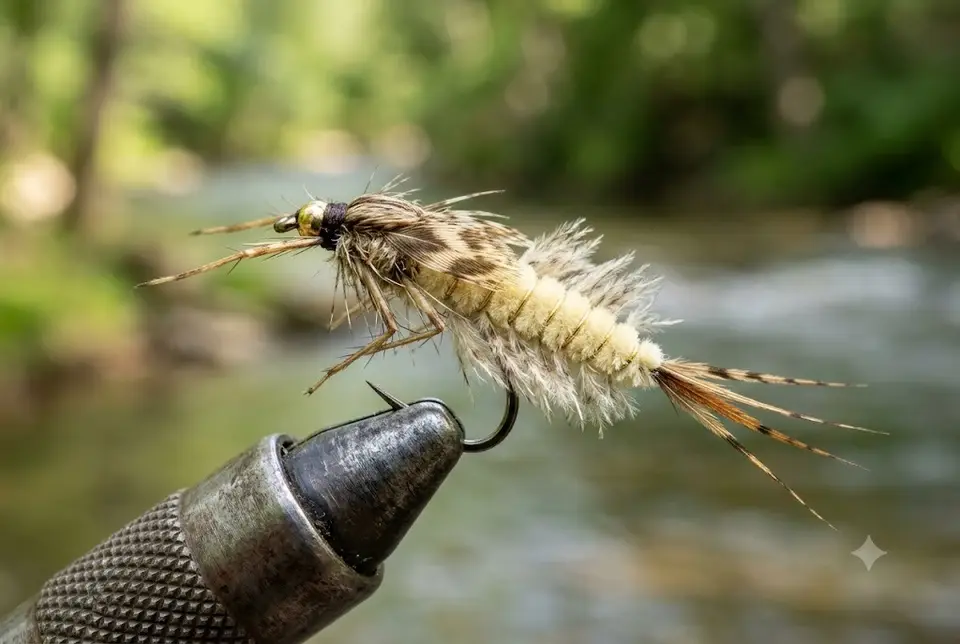
The Hex Nymph imitates the immature stage of Hexagenia limbata, the giant Michigan mayfly - at up to 1.5 in (38 mm), the biggest mayfly in North America and the biggest single bite of insect protein most trout see all year. The famous part of the Hex event is the dusk dry-fly circus, but the nymph is the quiet money pattern: trout eat the swimming, wiggling nymph for an hour before the first dun pops, and they eat it in daylight all season while the naturals grub through the silt.
What it imitates
A burrowing mayfly nymph: pale yellow to tan body, dark brown back, three fringed tails, and the feature that matters most - rows of feathery gills along the abdomen that pulse constantly. Hexagenia nymphs live in U-shaped burrows in silt and marl, so any river or lake with a soft, mucky bottom can hold them in serious numbers. When they emerge they swim to the surface with an exaggerated full-body wiggle, and that movement is the trigger trout key on.
When & where it wins
Late June through mid-July is prime time in the Midwest - Michigan's Au Sable and Manistee, plus silt-bottomed water across Wisconsin and Minnesota. Western anglers get their own version on California's Fall River and Oregon's big spring-fed lakes, sometimes running into September. Fish it from an hour before dark through the emergence; the nymph out-produces the dry right up until duns are actually on the water. It also earns its keep on ordinary afternoons any month the season is open, because trout root nymphs out of the silt year-round.
How to fish it
Movement is the whole game - this is one nymph you should not fish on a lifeless dead drift. On rivers, cast across, let it sink toward the silt, then swing and lift it with slow rod raises and short strips so it climbs through the column like an emerging natural. A hand-twist retrieve with long pauses works well from a boat. On lakes, hang it 2-6 ft (0.6-1.8 m) under an indicator over mud flats and give it an occasional twitch, or slow-strip it on an intermediate line as the light dies.
Sizes & variants
4-8 on 2XL or 3XL nymph hooks matches the natural's 1-1.5 in (25-38 mm) bulk; a 10 covers the smaller burrower species. Carry weighted versions for daytime dredging and unweighted or lightly weighted ties for the emergence swim. Wiggle-nymph and articulated versions add the swimming motion mechanically and are worth the extra tying time on pressured water.
Tying notes
Pale yellow or cream dubbed body, dark turkey-tail or brown back strip, marabou or pheasant-tail fibers for the tails. The gills sell the fly: palmer ostrich or emu herl along the abdomen, or tie in filoplume (aftershaft) feathers - anything that breathes in the water. Keep the profile fat; skinny Hex nymphs look wrong next to the naturals. Go easy on lead in emergence ties so the fly can climb on the lift.
What makes this fly fail
Dead-drifting it like a stonefly nymph and then wondering why every grab comes on the swing. Leaving at sunset, just as the real feeding starts. Going too small because a size 6 'feels wrong' on a trout stream - the naturals really are that big, and the fish want the full portion. And fishing it only during the hatch window: over any silt bottom, a Hex Nymph is a legitimate searching pattern from opening day on.
Kit for fishing flies
As an Amazon Associate we may earn from qualifying purchases - at no extra cost to you. We link gear types, not sponsors' picks: you choose the exact product.