Green Drake
The Green Drake matches the biggest mayfly hatch of the season - a short early-summer window when the largest trout in the river feed on the surface. An event fly, not an everyday fly, and irreplaceable when the event is on.
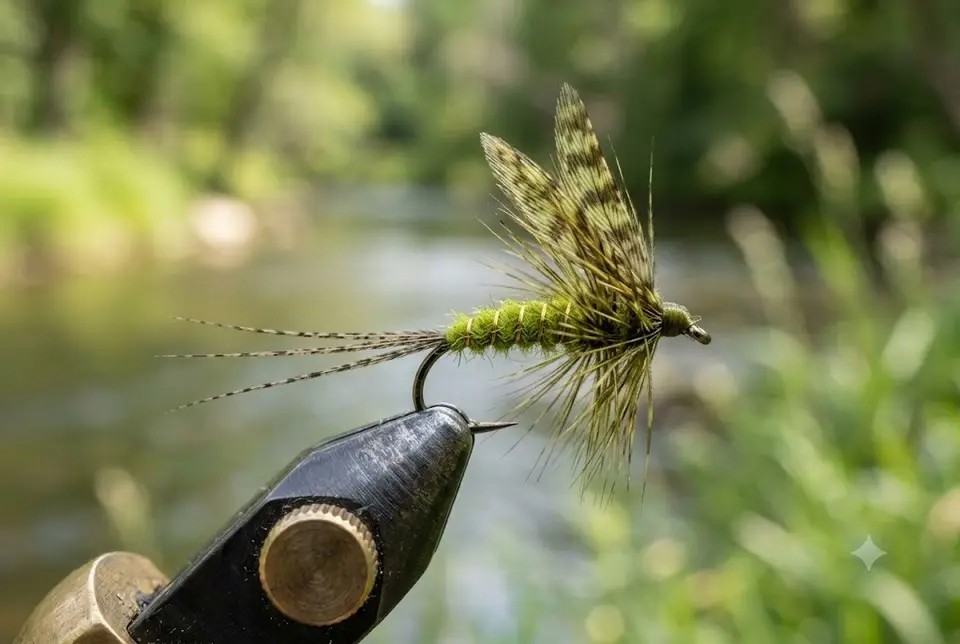
For two or three weeks in late spring and early summer, the biggest mayflies of the season hatch and the biggest trout in the river stop being careful. The Green Drake is the dry fly for that window: a size 8-12 dun imitation with an olive body and dark slate wings, tied to match either the eastern drake of Penn's Creek and the Delaware or the western drake of the Henry's Fork and the Rocky Mountain freestones. It is not an everyday fly. It is an event fly, and when the event is on, nothing else in the box matters.
What it imitates
The freshly hatched dun of the green drake mayflies - two different insects that share one slot in your box. The eastern green drake (Ephemera guttulata) is a huge cream-and-olive burrowing mayfly, close to 1.5 in (38 mm) with tails. The western green drake (Drunella grandis, plus its smaller cousin the 'flav') is stockier and darker, a rich olive-green with smoke-grey wings. Both ride the surface longer than most mayflies while their oversized wings dry - which is exactly why trout eat them with such confidence, and why a high-floating imitation gets taken.
When & where it wins
East of the Mississippi: late May to mid-June, mostly evenings, on rivers like Penn's Creek where the hatch is practically a regional holiday. In the Rockies: late June through July, often midday to late afternoon, with the heaviest emergence on cool, overcast, even drizzly days - the worse the weather, the longer the duns drift and the better the fishing. The hatch moves upstream day by day, so a call to the local fly shop is worth more than a week of guessing. This is the hatch that brings 20 in (50 cm) fish to the surface.
How to fish it
Dead-drift it to rising fish like any dry, with two adjustments. First, use real tippet: 3X-4X (0.20-0.18 mm). The fly is too wind-resistant for 6X, and the takes are not delicate. Second, do not fear a twitch - naturals flutter while drying their wings, and one subtle 2 in (5 cm) hop at the top of the drift often converts a follower. If a fish refuses the dun repeatedly, it is probably eating emergers or cripples in the film; switch to a cripple pattern or trail one behind the dry.
Sizes & variants
8-12. Eastern flies run 8-10, western 10-12, and the flav hatch extends down to 14. Carry two styles: a hackled or Wulff-style tie for riffles and pocket water, and a low-riding comparadun, sparkle dun, or parachute for flat water and picky fish. Extended-body versions keep the length honest without a giant hook. For the east, add the Coffin Fly - the black-and-white spinner of the same insect - because the spinner fall at dusk can out-fish the dun hatch.
Tying notes
A big dry has to float, land upright, and not twist your leader, so body choice matters more than on a size 16. Extended bodies of deer hair or foam give length without weight; dyed-olive grizzly hackle over a yellow-olive dubbed body covers the western insect well. Splay the tails wide - they stabilize the fly like a keel, and moose body hair makes them durable. On comparadun styles, the tall flared deer-hair wing is the whole fly: take the time to spread it a full 180 degrees around the hook.
Where tyers go wrong
Fishing it as a searching pattern - a size 8 dry outside hatch season mostly scares fish. Going too light on tippet and corkscrewing the leader with every cast. Ignoring the emerger stage when fish boil under the fly but will not eat it. And missing the window entirely: the drake hatch is short, date-shifting, and famous, so plan around fresh reports, not last year's calendar.
Kit for fishing flies
As an Amazon Associate we may earn from qualifying purchases - at no extra cost to you. We link gear types, not sponsors' picks: you choose the exact product.