Golden Stone Nymph
The Golden Stone Nymph imitates a bug that spends 2-3 years underwater, which means trout eat it every single day of the year. On fast Western freestones it is the point fly you build the whole rig around.
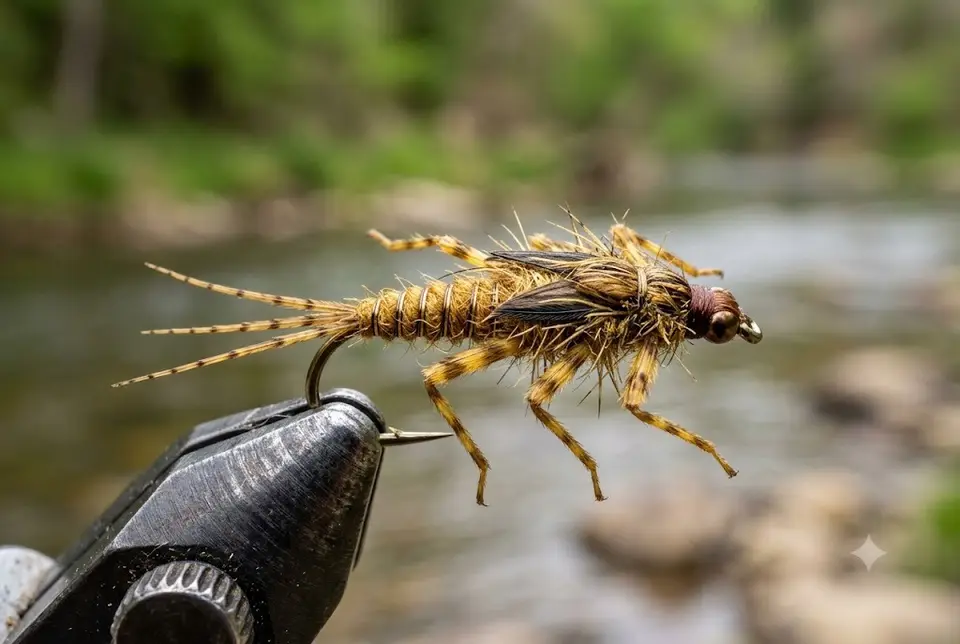
Most flies imitate an insect stage that exists for a few hours or days. The Golden Stone Nymph imitates one that exists for 2-3 years - the golden stonefly spends that long crawling around the riverbed before it ever hatches, so trout see and eat this nymph in January as readily as in June. That is the whole argument for carrying it: a big, meaty, always-available food item that justifies a trout moving 3 ft (1 m) to eat it. It peaks in the weeks before the hatch, when the naturals migrate toward the banks in numbers.
What it imitates
The nymph of the golden stonefly (family Perlidae - Hesperoperla, Calineuria and their relatives): a flat, mottled amber-and-brown crawler, roughly 1-1.5 in (25-38 mm) at maturity, with two tails, two antennae and thick, sprawling legs. Because the species needs 2-3 years to mature, several size classes live in the river at once, which is why a size 12 catches fish even when the adults on the willows run size 6.
When & where it wins
Fast, rocky freestone water. The famous golden stone rivers are Western (Deschutes, Madison, Yellowstone, Gunnison), but the bugs live in tumbling, well-oxygenated streams across much of the US. It produces year-round, with a clear peak in the 2-4 weeks before emergence (May-July depending on latitude and elevation), when nymphs crawl toward shore and constantly get knocked into the drift. Any bump in flows that dislodges bugs is also prime time.
How to fish it
Dead-drift it deep - stonefly nymphs are crawlers, not swimmers, so a tumbling drift near the bottom is the entire technique. Fish it under an indicator or on a tight line (Euro style) through seams, buckets and the soft edges of heavy current. During the pre-hatch migration, fish absurdly close to the bank: trout stack in the last 3 ft (1 m) of river to intercept the crawlers. It is also the classic anchor fly in a two-fly rig: golden stone on point, smaller mayfly or caddis nymph on the dropper. The big fly gets the rig down and draws attention; the dropper often closes the deal.
Sizes & variants
6-12 on 2x-3x long nymph hooks; sizes 8 and 10 cover most rivers most of the year. Weight is near-mandatory - beadhead, lead underwraps, or both. Rubber-leg versions frequently outfish exact imitations (Pat's Rubber Legs is essentially a simplified golden stone and a guide-box staple). Jig-hook versions ride point-up and lose fewer flies to the rocky bottoms these bugs call home.
Tying notes
Amber or golden-brown dubbing for the body, a mottled brown back and wing case (turkey tail or thin skin), gold wire rib, round rubber legs. Chase the two-tone look of the natural: dark back, pale yellowish belly. Build in real weight - a 3.5-4.5 mm tungsten bead plus lead wraps is not overkill for heavy water. Do not agonize over anatomy; a wide, leggy, buggy silhouette in the right size beats a museum-grade imitation that took an hour to tie and is about to be donated to a boulder.
Mistakes at the vise and on the water
Fishing it too shallow - if you never tick bottom, add weight until you do. Ignoring the banks during migration weeks, when the fish have moved to water most anglers wade through. Retiring it once adults appear: multiple year classes mean nymphs stay in the drift all summer. And tying it too skinny: the naturals are wide and flat, and trout appear to key on that bulk.
Kit for fishing flies
As an Amazon Associate we may earn from qualifying purchases - at no extra cost to you. We link gear types, not sponsors' picks: you choose the exact product.