Foam Cricket
The Foam Cricket is the dark, unsinkable terrestrial that saves late-summer afternoons when trout snub your hopper - a black foam body and rubber legs that land with a plop trout swim to investigate.
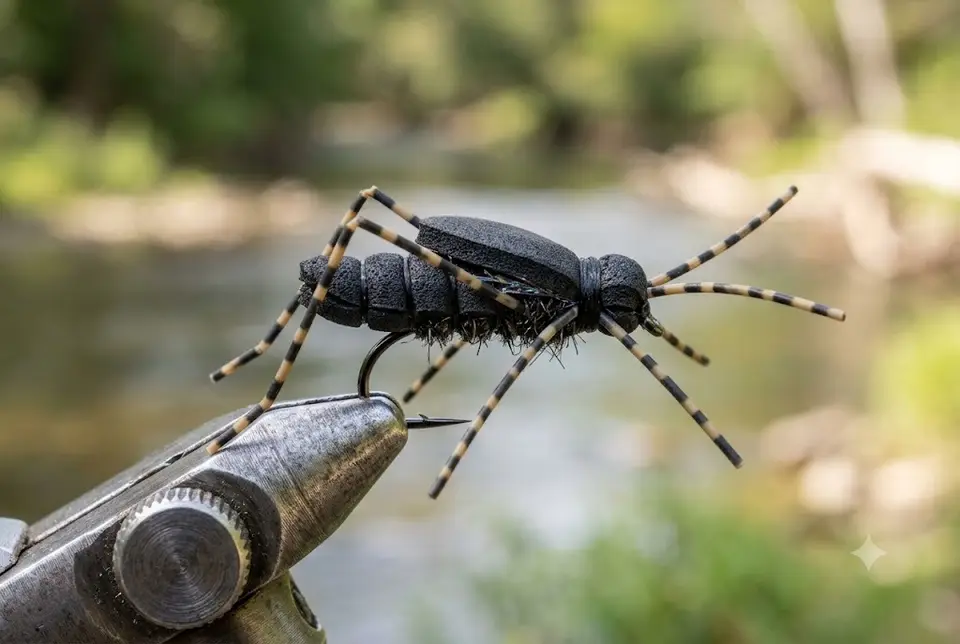
When the hopper bite goes cold but trout are still looking up along grassy banks, the Foam Cricket is the change-up that keeps the afternoon alive. It is a simple black foam body with rubber legs, it floats all day without dressing, and it lands with the soft plop that tells a bank-hugging trout dinner just fell in. Crickets are on the menu from midsummer to first frost on almost every US meadow stream, yet most anglers never fish one - which is exactly why the fly works on trout that have seen fifty hoppers.
What it imitates
A field cricket that tumbled out of streamside grass - dark, blocky, leggy, and helpless. The black foam silhouette also passes for a beetle, a drowned wasp, or 'big dark bug' in general, so trout that are keyed on terrestrials rarely inspect it closely. The rubber legs do the selling: they quiver on the surface even when the fly sits still.
When & where it wins
July through the first hard frost, and best in the hottest, brightest hours when hatches are dead and terrestrials are active - roughly 11 a.m. to 5 p.m. Fish it on meadow streams and any water with grassy or undercut banks, especially on breezy days that knock bugs into the drink. It shines as the follow-up when fish refuse a tan hopper, and its buoyancy makes it a workhorse indicator fly on small water.
How to fish it
Land it with a deliberate plop within 1-2 ft (30-60 cm) of the bank - the splat is the dinner bell, not a mistake. Then do nothing: dead-drift it on a long tippet, adding one small twitch if a fish shows interest but will not commit. For the hopper-dropper game (here, cricket-dropper), hang a size 14-16 beadhead nymph 18-24 in (45-60 cm) below the bend; the foam suspends it easily. Give each drift time: cricket eats are often slow, confident rises, and ripping the fly away early is how most fish are lost.
Sizes & variants
8-14, with 10 and 12 covering most US trout water; go 8 for big western rivers and bass, 14 for pressured spring creeks. Tie or buy some with a bright orange or pink foam sighter on top - black flies vanish in glare. Tan and brown versions split the difference toward hoppers; a Charlie Boy-style tie with a deer-hair underwing adds a softer footprint for flat water.
Tying notes
One of the easiest big dries there is: a strip of 2 mm black craft foam folded over a black dubbed or thread body, round rubber legs splayed at the sides, and a stub of foam or poly yarn up top as the sighter. Superglue the first foam tie-down or the body will spin on the hook. A short-shank, wide-gap dry-fly hook keeps the profile blocky and improves hookups through all that foam. A genuine first-fly pattern for new tiers - ugly ones catch fish too.
What makes this fly fail
Casting it to mid-river instead of tight to the bank, where the real bugs fall in. Presenting it daintily - a cricket does not land like a mayfly, so let it splat. Retiring it in September, right when trout are gorging on terrestrials before winter. And setting the hook on the splash of the rise instead of waiting that extra half-second for the fish to turn down with the fly.
Kit for fishing flies
As an Amazon Associate we may earn from qualifying purchases - at no extra cost to you. We link gear types, not sponsors' picks: you choose the exact product.