Dave's Hopper
Dave Whitlock's deer hair grasshopper - a Joe's Hopper body under a Muddler-style clipped head that still out-fishes foam on pressured summer banks.
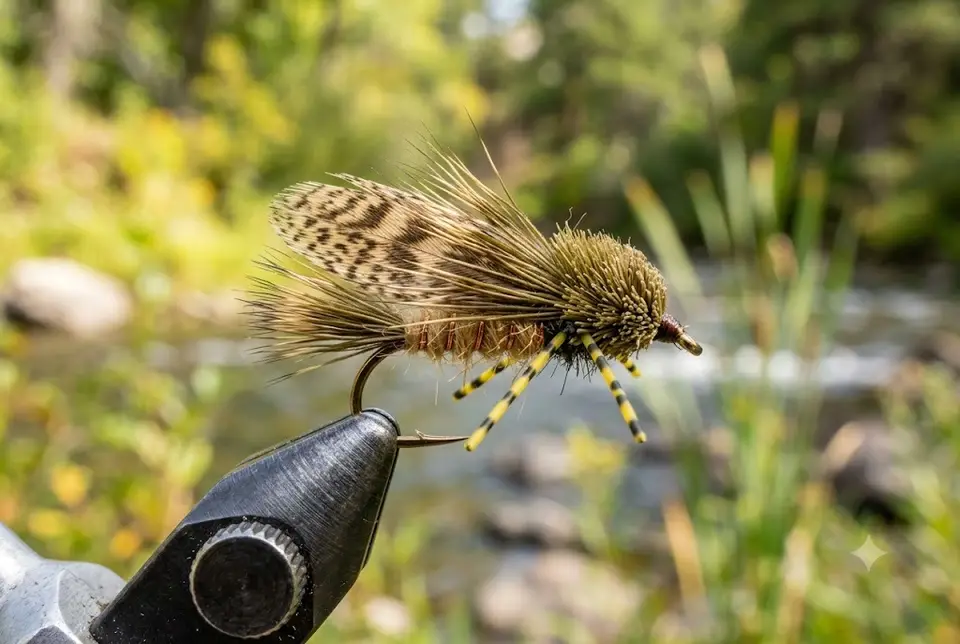
Dave's Hopper is the grasshopper pattern the foam era never managed to retire: Dave Whitlock's marriage of a Joe's Hopper body to a Muddler-style clipped deer hair head, worked out in the 1950s and still the benchmark natural-material hopper. It lands with a convincing plop, silhouettes like the real bug from below, and on pressured summer water where trout have refused every rubber-legged foam creation, it still draws the honest eat. If your river has grassy banks and an August, carry it.
What it imitates
An adult grasshopper, and a well-fed one: yellow yarn body, brown hackle palmered and trimmed for legs in the film, a lacquered turkey quill wing tented over the back, knotted legs kicking rearward, and a spun deer hair head that copies the natural's blocky front end. From a trout's window it reads as 1-1.5 in (25-40 mm) of easy protein.
When & where it wins
Hopper season - roughly July through the first hard frost, peaking on hot, windy afternoons when clumsy naturals get blown off the grass. Meadow streams and grassy banks are prime: Western ranch water, Driftless spring creeks, farm-country rivers anywhere in the US. Wind helps; it delivers the bugs and makes trout look up. On bright, hatchless midsummer days - the worst classic dry-fly conditions - a hopper is often the only surface fly that moves a good fish.
How to fish it
Cast tight to the bank, within a foot (30 cm) of the grass, and let the fly land with an audible plop - the splat is a trigger, not a flaw. Dead-drift it first; if nothing comes, give one sharp twitch to imitate a kicking hopper, then drift again. It also makes a fine indicator in a hopper-dropper rig: hang a beadhead nymph 18-24 in (45-60 cm) below on 4X-5X and you cover two levels at once. Dry the deer hair with a few false casts and powder desiccant after every fish.
Sizes & variants
Sizes 6-14 on 2XL dry-fly hooks; 8-12 covers most water. Match the naturals in your grass - early-season hoppers run small, September bugs are the big ones. Joe's Hopper is the simpler ancestor, the Whit Hopper is Whitlock's own later update, and foam flies like the Morrish Hopper float dropper rigs better but give up the soft natural silhouette. Yellow is the standard body; tan and olive earn a slot late in the year.
Tying notes
An honest intermediate-to-advanced tie - the spun and clipped deer hair head is the hurdle, and knotting pheasant tail legs tests patience (knot a dozen leg pairs in advance and the fly goes much faster). Sequence: red deer-hair tail, yellow yarn body with a small loop over the bend, palmered brown hackle trimmed short, lacquered turkey wing, legs, then spin and trim the head with its collar. No shame in buying the first few; this one is slow at the vise.
Where tyers go wrong
Fishing it mid-river instead of tight to the bank, landing it daintily when a splat sells it, over-twitching (one kick, then let it drift), quitting after a refusal instead of dropping two sizes, and skipping floatant - undressed deer hair waterlogs fast. The biggest one: putting it away in early September, right when the largest trout of the season are keyed on the last hoppers in the grass.
Kit for fishing flies
As an Amazon Associate we may earn from qualifying purchases - at no extra cost to you. We link gear types, not sponsors' picks: you choose the exact product.