Red Hind
The red hind is a small, colorful reef grouper common across the tropical western Atlantic and a frequent catch for bottom anglers.
Last reviewed: October 2026
 AI illustration
 Overview
The red hind is a small, colorful reef grouper common across the tropical western Atlantic and a frequent catch for bottom anglers. It rarely tops a few pounds but fights well for its size, diving hard for structure the instant it is hooked. It is fine table fare, yet highly sensitive to overfishing on its winter spawning aggregations, so selective, conservation-minded harvest matters.
Identification
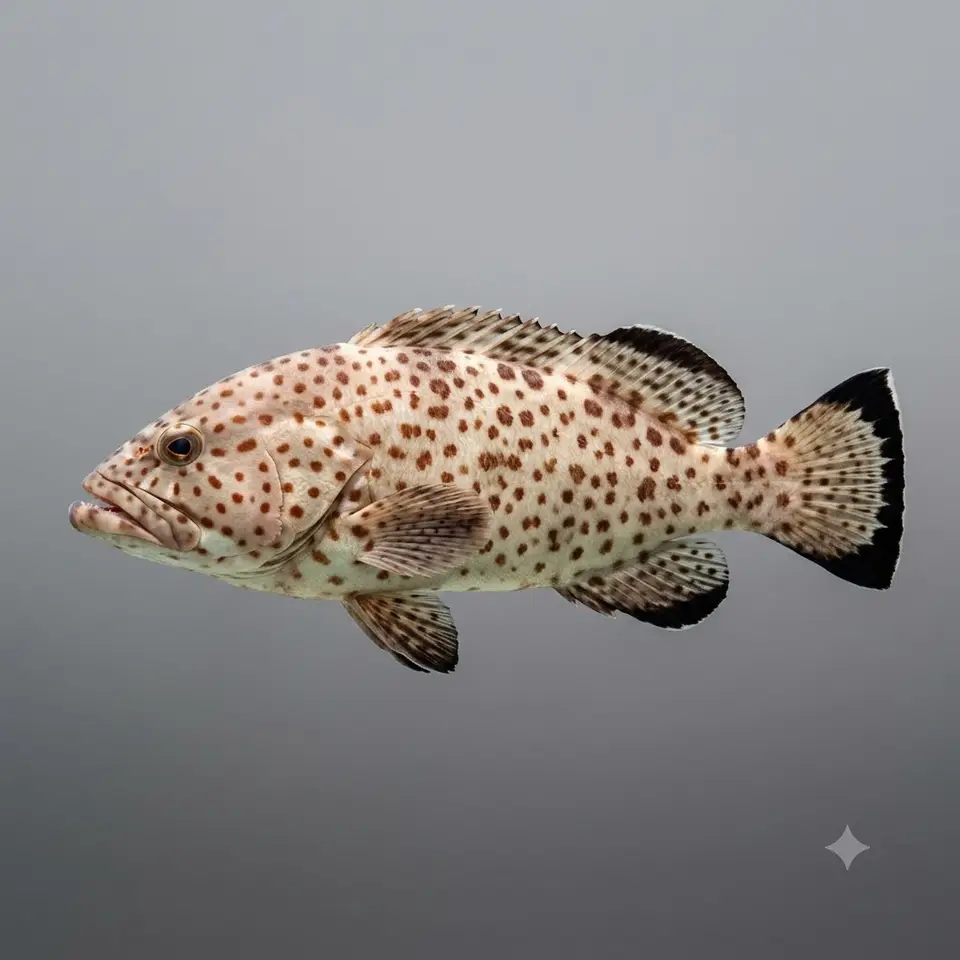
A stout-bodied grouper, pale cream to reddish, densely peppered with reddish-brown to orange-red spots across the head, body, and fins. The clearest tell is the dark, blackish margin along the rear edge of the tail and the soft dorsal and anal fins. It is more heavily and evenly spotted than the similar rock hind, which shows dark saddle blotches along its back.
Range & Habitat
Red hind range from the Carolinas and Bermuda south through Florida, the Gulf of Mexico, the Bahamas, and the Caribbean to Brazil. They favor coral reefs, rocky ledges, and hard bottom, typically from roughly 30 to 160 feet, holding tight to caves, crevices, and reef edges.
Behavior & Diet
They are solitary ambush predators that hold near cover and pounce on passing prey, mostly crabs, shrimp, other crustaceans, small fish, and octopus. Like most groupers they are protogynous hermaphrodites, maturing first as females before some transform into males. In winter they gather in dense, site-specific spawning aggregations, usually around the full moon.
Best Seasons
They can be caught year-round wherever reef structure holds them, with warm, settled weather giving the most consistent bottom action. Cooler months concentrate fish on known aggregation sites, but that is exactly when they are most vulnerable, and many such sites are seasonally closed.
How to Catch Them
Fish the bottom over reefs, ledges, and rockpiles. Drop cut bait, squid strips, or small live baits right to the structure and be ready to lift hard the moment you feel the bite. A hooked red hind bolts straight for its hole and will rock you up if you give it slack.
Tackle & Rigs
Medium conventional or stout spinning gear with 30-50 lb braid or mono handles most fish and gives the backbone to turn them from cover. A simple knocker rig or two-hook bottom rig with a bank sinker sized to hold bottom is standard, using roughly 4/0-6/0 hooks. Use a short, abrasion-resistant leader against the sharp reef.
Landing, Handling & Release
Pump fish up steadily rather than winching to reduce pulled hooks. Fish brought up from deeper reefs often suffer barotrauma, so use a descending device or proper venting to release those that cannot swim back down. Support the body, minimize air time, and release fish you do not intend to keep quickly.
Table Quality
The flesh is white, mild, and flaky, and red hind are considered excellent eating like other groupers. In parts of the Caribbean, however, they can carry ciguatera toxin, and larger fish from suspect reefs pose the greatest risk. Follow local consumption advisories.
Habits That Lose Fish
Fishing with slack line and getting rocked up in the reef is the classic error. Others include ignoring barotrauma on deep releases, keeping fish taken from protected spawning aggregations, and not checking current size, bag, and season rules before a trip.
Regulations & Conservation
Red hind are managed as part of the grouper complex in US federal waters, and Puerto Rico and the US Virgin Islands protect key spawning areas with seasonal closures, roughly December through February. Because aggregating, sex-changing species can be wiped out locally in short order, release fish from spawning sites and always confirm current federal, state, and territorial regulations.
FAQ
Q: Are red hind safe to eat? Generally yes and they are excellent, but in parts of the Caribbean they can carry ciguatera, so heed local advisories and be cautious with larger fish from suspect reefs.
Q: How big do red hind get? Most are one to a few pounds; a fish over about five pounds is a notably large one.
Q: Why do spawning aggregations matter so much? They pack many fish into predictable spots at predictable times, so a few boats can remove a whole local population, which is why many sites are seasonally closed.
Tackle for red hind
As an Amazon Associate we may earn from qualifying purchases - at no extra cost to you. We link gear types, not sponsors' picks: you choose the exact product. The partner-store link may earn us a commission too.