Golden Dorado
The golden dorado is South America's premier freshwater gamefish, a hard-charging river predator prized for blistering runs and acrobatic, gill-rattling leaps.
Last reviewed: October 2026
 AI illustration
 Overview
The golden dorado is South America's premier freshwater gamefish, a hard-charging river predator prized for blistering runs and acrobatic, gill-rattling leaps. Despite the genus name Salminus, it is not a salmon at all but a characiform, more closely related to tetras and piranhas. For US anglers this is a bucket-list, travel-only species: you will fly to Argentina, Bolivia, Brazil, Paraguay, or Uruguay to chase it, and on the best waters it is managed strictly as catch-and-release.
Identification
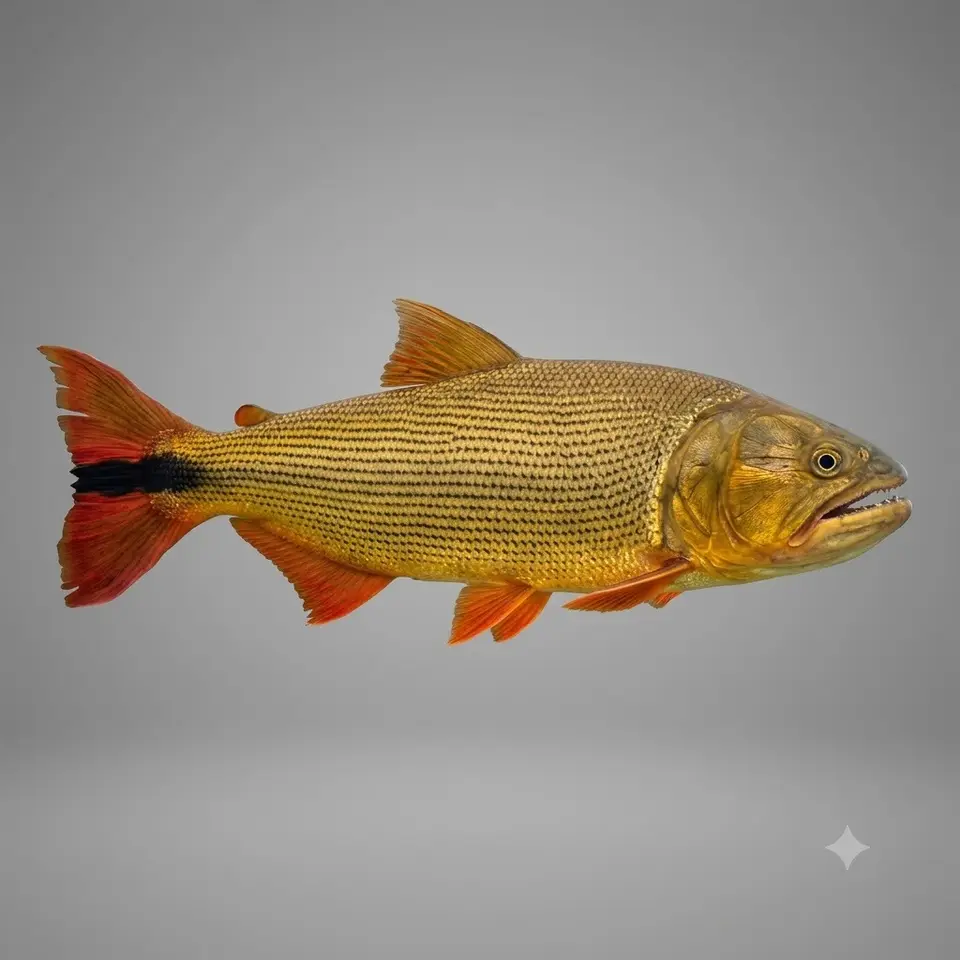
Unmistakable when you see one: a deep, muscular golden-bronze body with fine dark lines tracing the scale rows, reddish to orange fins, and a bold black stripe running through the middle of the tail. The large, blunt head opens into a powerful jaw lined with sharp conical teeth. Adults commonly run several pounds to well over twenty on prime rivers, with larger fish possible.
Range & Habitat
Native to the warm rivers of central and southeastern South America, mainly the Parana, Paraguay, and Uruguay basins across northern Argentina, southern Brazil, Bolivia, Paraguay, and Uruguay. They favor moving water: main-river channels, rapids, rocky drop-offs, tributary mouths, and flooded marshes such as the Ibera wetlands and Bolivia's clearwater jungle streams.
Behavior & Diet
An aggressive apex predator that ambushes and chases baitfish in current seams, eddy lines, and structure. Much of its life follows the migrations of sabalo and other schooling baitfish, and it will crush topwater and streamers with ferocity. Hooked fish jump repeatedly and thrash their heads, throwing hooks at a high rate.
Best Seasons
Timing is fishery-specific and tied to water level and clarity rather than a single calendar window. Bolivia's jungle rivers fish best in the dry season, roughly April through October when water drops and clears; Argentine marsh and river fisheries have their own low-water prime windows. Book through a local outfitter and target falling, clearing water.
How to Catch Them
Both fly and conventional gear work. Fly anglers throw large baitfish streamers and poppers on fast sink-tip or floating lines; conventional anglers cast spoons, spinners, jerkbaits, and topwater plugs, or drift live sabalo where legal. Strip and retrieve aggressively, then set hard and repeatedly against that bony mouth.
Tackle & Rigs
Plan for teeth and power: an 8 to 9 weight fly rod or a medium-heavy baitcaster with braided line. A short wire bite trace or heavy fluorocarbon shock tippet is essential, along with strong, chemically sharpened hooks. Bring backups; teeth and rocks destroy terminal tackle.
Landing, Handling & Release
Lead with release: this fish fights harder than it recovers, so keep it wet and quick. Use a large rubber net, wet your hands, mind the teeth, support the body, and photograph over the water. Revive fully in current before letting go.
Table Quality
Edible but bony, and increasingly released rather than kept. On premier sport fisheries harvest is discouraged or banned outright, and most visiting anglers release every fish. Treat it as a catch-and-release trophy, not table fare.
Habits That Lose Fish
The classic error is a soft hookset; the bony jaw demands a hard, repeated strike. Anglers also lose fish by going too light on the bite leader, and by fighting fish to total exhaustion in warm water, which hurts release survival.
Regulations & Conservation
Globally the golden dorado is listed as Least Concern by the IUCN, but local populations have declined from overfishing, dams, and habitat loss, and rules vary widely by country and province. Many top rivers enforce catch-and-release, seasonal closures, and gear limits. Confirm current local regulations with your outfitter and release fish to protect the fishery.
FAQ
Q: Is the golden dorado a type of salmon? No. Despite the genus name Salminus, it is a characiform, more closely related to tetras and piranhas than to true salmon.
Q: Do I need a wire leader? Yes, a short wire trace or very heavy fluorocarbon bite section is strongly recommended because their sharp teeth cut standard line.
Q: Can I fish for dorado in the United States? No. It is a South American species, so this is international travel angling only.
Tackle for golden dorado
As an Amazon Associate we may earn from qualifying purchases - at no extra cost to you. We link gear types, not sponsors' picks: you choose the exact product.