Golden Mahseer
The golden mahseer is the largest of the mahseers, a Himalayan river giant in the carp family (Cyprinidae) and one of Asia's premier freshwater gamefish.
Last reviewed: October 2026
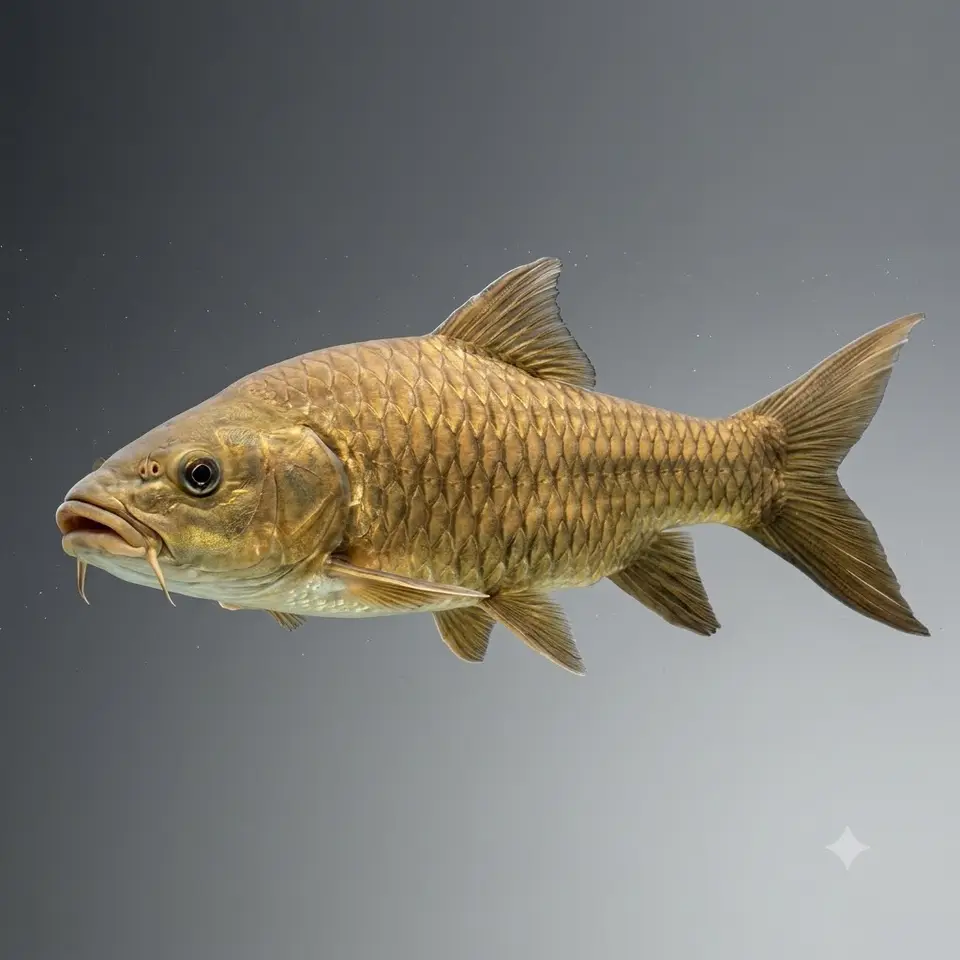 AI illustration
 Overview
The golden mahseer is the largest of the mahseers, a Himalayan river giant in the carp family (Cyprinidae) and one of Asia's premier freshwater gamefish. For a US angler it is a bucket-list, fly-out trip to fast rivers in India, Nepal, or Bhutan, not a domestic catch. It is also a species in serious decline, so treat every fish as strictly catch-and-release.
Identification
Look for a heavy, torpedo-shaped body clad in unusually large, coarse scales over burnished golden-bronze flanks, with thick fleshy lips, a sub-terminal mouth, and two pairs of barbels. The fins often carry orange or reddish tints and the tail is deeply forked. Its size, golden sheen, and oversized scales make it hard to confuse with anything else in its range.
Range & Habitat
Native to the Indus, Ganges, and Brahmaputra basins, it ranges across the Himalayan foothills of India, Nepal, Bhutan, and Pakistan. It is migratory, running up cold hill streams to spawn and dropping into larger rivers, deep pools, and lakes to feed. Classic destinations include the Ramganga near Corbett and the Kali/Mahakali on the India-Nepal border.
Behavior & Diet
Mahseer are opportunistic omnivores, taking aquatic insects, crustaceans, small fish, and even fruit and vegetation that drops into the current. They hold in oxygen-rich runs, pool tails, and current seams, grabbing food swept down by the flow. Hooked, they make blistering, powerful runs in heavy water, earning the local nickname "tiger of the river."
Best Seasons
Two windows produce best: pre-monsoon spring (roughly March to mid-June) as water warms and fish feed hard, and post-monsoon autumn (roughly September to November) once rivers drop and clear. Avoid the monsoon itself, when rivers blow out and fish spawn and most fisheries close. Always confirm the local season and permit rules before booking.
How to Catch Them
Both fly and conventional tackle work. Fly anglers swing and strip large streamers on sink tips through runs and pool heads, while spin anglers throw spoons, spinners, and diving plugs, or fish natural baits like atta dough where legal. Cover water, target current seams and drop-offs, and brace for a savage take and an instant run.
Tackle & Rigs
Bring stout gear: a 9-10wt fly rod or a medium-heavy spinning outfit with a strong drag and 200-plus yards of 30-50 lb braid or ample backing. Use abrasion-resistant fluorocarbon leaders, because these rivers are full of sharp rock, and pinch barbs down or fish barbless single hooks. A smooth, powerful drag matters more than anything else here.
Landing, Handling & Release
Play fish quickly, land them in the shallows or a large soft net, and keep them in the water. Support the body horizontally, stay off the gills, minimize air exposure, and back out barbless hooks with forceps. Revive the fish facing into the current until it kicks off on its own.
Table Quality
The mahseer was historically prized eating, but that is beside the point for a responsible angler today. Because the species is endangered and declining, do not kill or eat golden mahseer - it is a catch-photo-release fish only.
Habits That Lose Fish
Undergunned tackle is the classic error, as light drags and thin leaders get smoked in the first run near rock. Anglers also over-handle fish for photos, hold them out of water too long, or fish closed spawning periods. Skipping local guides and permits is another mistake, since these remote rivers reward local knowledge and legal access.
Regulations & Conservation
The IUCN lists Tor putitora as Endangered, with populations estimated to have fallen by more than half in recent decades due to dams, habitat loss, pollution, and overfishing. Many rivers require permits and enforce catch-and-release, seasonal closures, or protected stretches. Fish only with reputable, conservation-minded outfitters and treat every capture as release-only.
FAQ
Q: Can I keep a golden mahseer to eat? No - it is endangered, so responsible anglers release every fish and never harvest it.
Q: How big do they get? Historically very large, well over 100 lb in old records, but fish that size are essentially gone today and a solid modern trophy is a fraction of that.
Q: Do I have to travel internationally to catch one? Yes - it is native only to Himalayan river systems, making it a destination trip for US anglers.
Tackle for golden mahseer
As an Amazon Associate we may earn from qualifying purchases - at no extra cost to you. We link gear types, not sponsors' picks: you choose the exact product.