Lake Turnover Explained For Anglers
Turnover is the autumn spell when a stratified lake mixes top to bottom and the bite falls apart. Here is what is physically happening, how to recognise it on the water, and where fish stay catchable while it passes.
Please read this first. Autumn fishing means cold water, and cold water changes what a fall out of a boat means. This article covers fish behaviour only. For anything about life jackets, hypothermia, boating rules or ice, treat your national boating authority, coastguard and state or regional agency as the source - in the US that is the Coast Guard and your state boating agency, and comparable bodies elsewhere. We do not give safety, medical or legal advice.
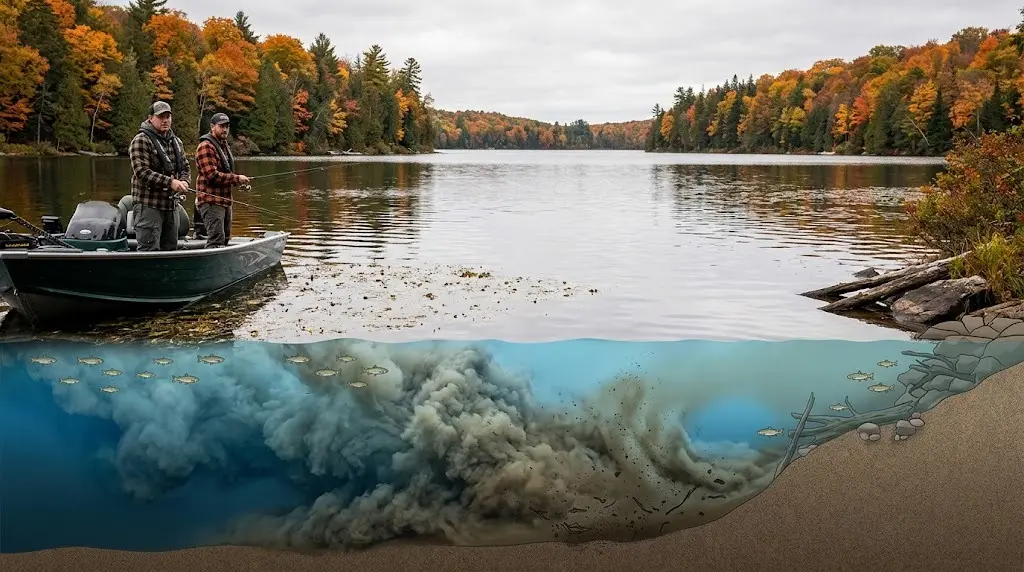
The short version: turnover is what happens when a summer-stratified lake cools enough at the surface that the whole water column reaches roughly the same density, and wind can then mix it from top to bottom. For a while, the lake is a blender. Fish scatter, water clarity goes strange, and the bite that was excellent last weekend can vanish for no reason you can see from the boat.
It is temporary, it is predictable, and it is not the same thing as fall fishing being over. It starts when autumn cooling brings the surface down toward the temperature of the deep water, and the far better fishing of late autumn arrives after it finishes.
What is actually happening
Through summer, a deep lake sits in three layers. The warm, wind-mixed surface layer holds most of the oxygen and most of the fish. Below it is a narrow band where temperature drops sharply - the thermocline. Underneath that is a cold, dense, undisturbed bottom layer that in many productive lakes goes low on oxygen by August, which is why fish will not use it no matter how good the structure looks on your electronics.
Water is at its densest at about 4C, or 39F (USGS Water Science School). As autumn nights cool the surface, that surface water gets denser and sinks, which pulls deeper water up. Once the layers even out, the density difference holding them apart is gone, and - as the IISD Experimental Lakes Area explains - it then takes relatively little wind to mix the whole lake. Whatever was sitting on the bottom - decayed organic matter, suspended sediment, low-oxygen water - gets stirred through the whole column.
That mixing is why turnover looks and smells the way it does, and why it is temporary. Once the mix is complete, the lake is uniform in temperature and oxygenated from top to bottom, and fish can use water they have avoided for months.
How to tell your lake has turned
You rarely get to watch it happen, but the aftermath is obvious once you know the signs:
- Surface temperature reads nearly the same at 2 feet and 25 feet. This is the definitive test if you have the electronics for it, and it beats every other indicator.
- Foam lines, floating debris and drifting mats of dead vegetation appear where they were not before.
- The water looks dirtier or oddly cloudy in a lake that was clear, sometimes with a brownish or greenish tinge from suspended material.
- A distinctly musty, sulphurous or swampy smell off the surface, strongest in deep basins. That is the bottom layer arriving at the top.
- Bubbles rising in open water away from any obvious source.
- Your electronics stop showing a clean thermocline line, and bait that was stacked at a specific depth is suddenly spread everywhere or gone.
Big deep lakes turn over later than small shallow ones, and different arms of the same reservoir can turn at different times - the shallow upper end usually days or weeks before the deep main basin near the dam.
Why the bite dies
Three things happen at once, and none of them are about fish being uncatchable.
The first is that the depth pattern you had disappears. All summer, fish were held in a narrow band by oxygen and temperature. After mixing, every depth is habitable, so a school that was reliably at 18 feet can be anywhere from 4 to 40. You are not fishing water that is dead, you are fishing water where the fish are no longer concentrated.
The second is that the same is true of the bait. Shad and other forage spread out for exactly the same reason, so the predators have no reason to gather.
The third is the change itself. Fish that have been sitting at a stable temperature for months get a rapid change plus low-oxygen bottom water stirred through the column, and anglers find them slow to feed until the lake settles.
Fishing through it anyway
You do not have to wait it out. You have to fish the water that is not affected.
Find water that turned at a different time. Shallow creek arms and upper river sections mix early and settle early. The deep main basin turns last. If the middle of the lake smells like a compost heap, go to the end that turned three weeks ago, or the end that has not turned yet.
Go to moving water. Inflowing creeks, river arms, tailwater sections and areas with current never stratified the same way and are barely affected. This is the single most reliable answer during turnover.
Fish the cleanest water you can find. Clarity is a decent proxy for how disrupted a given area is. Wind-protected pockets on the lee side often stay noticeably cleaner.
Look for green vegetation. Remaining living weed beds hold oxygen and bait and tend to fish better than open water for the duration.
Slow down and downsize. Finesse presentations, smaller profiles, and thorough coverage of small areas beat fast search baits when the fish are not aggressive. The approach in our finesse fishing guide is built for exactly this kind of week.
Cover water differently. Rather than running spot to spot, work vertical structure that spans depths - bluff walls, standing timber, steep points - so a single presentation touches several depths and you let the fish tell you where they are. Our how to read water guide covers picking those spots.
What comes after is the good part
Once mixing completes and the lake stabilises, autumn fishing gets very good. Oxygen is available everywhere, the water keeps cooling, and fish feed hard ahead of winter - the pattern covered in our fall fishing guide. Bait pushes into creeks, predators follow, and you get the most reliable shallow feeding window of the second half of the year.
The practical takeaway: if the lake smells wrong and the fish are gone, you are not out of season, you are early. Check conditions before committing a whole day - the today’s conditions tool is a reasonable starting filter - and if you can only fish that particular week, go find current.
Lakes that never turn over
Not every water body does this. Shallow lakes that the wind mixes all summer never stratify in the first place and so have nothing to turn over. Rivers and streams do not stratify. Lakes in warm climates that never ice over keep a different calendar: the IISD Experimental Lakes Area describes them as mixing in winter and staying layered the rest of the year. Tailwaters below dams take their temperature from the release depth and follow the dam’s schedule, not the season’s.
If your home water is shallow, windswept, or moving, turnover is probably not your explanation for a slow day. Weather fronts, forage movement and fishing pressure are more likely - see weather and fishing for the more common culprits.
Recommended Gear on Amazon
- Portable fish finder - browse current options and reviews on Amazon.
- Water temperature gauge - browse current options and reviews on Amazon.
As an Amazon Associate, we earn from qualifying purchases - at no extra cost to you. This helps us keep producing free, in-depth guides.