How to Gather Sea Urchin
Sea urchins are spiny grazers of rocky shores and kelp beds, gathered by hand for their roe, called uni; the spines go through skin easily, and the rules depend on where you gather.
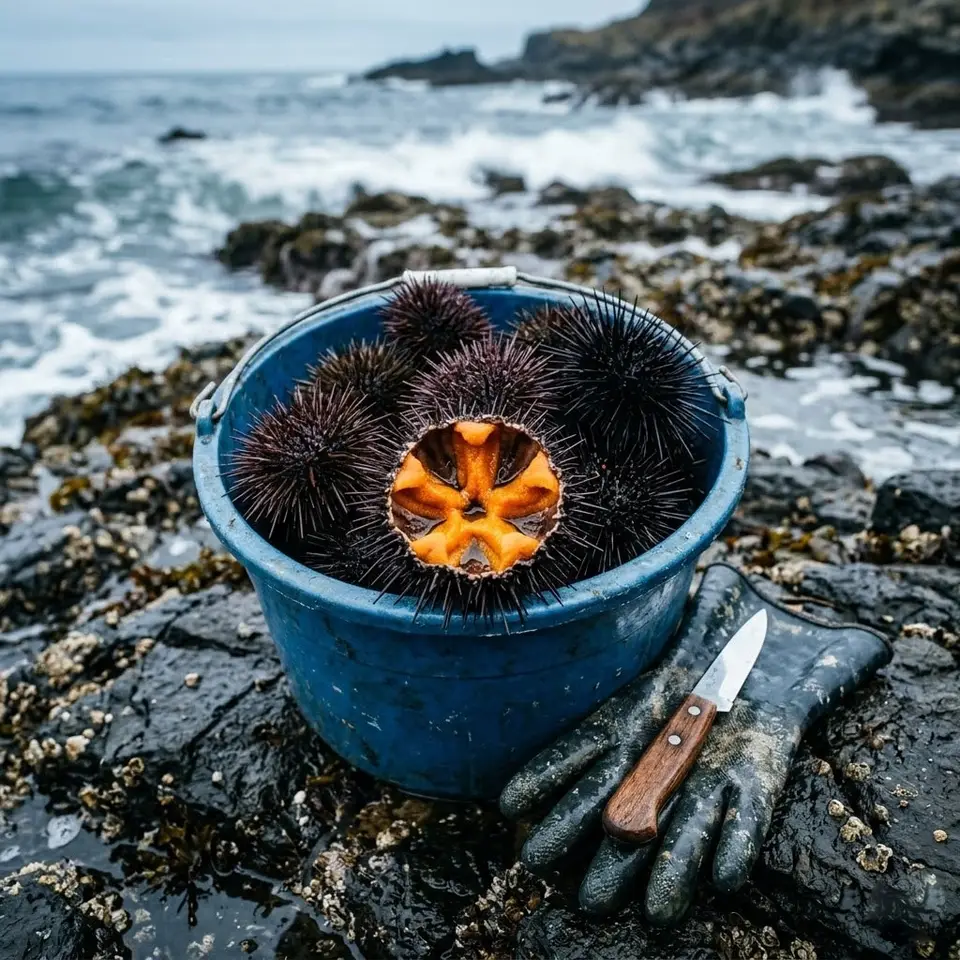
Seasons and limits are set by the agency where you gather, so check them first. The spines pierce skin easily and can break off inside it: handle urchins only in thick gloves, and see a doctor if spines are left in your skin.
Sea urchins belong to the echinoderms, the group of sea animals that also includes sea cucumbers and sand dollars (ADF&G). The part people eat is the gonads: the Alaska Department of Fish and Game (ADF&G) explains that the harvest targets the gonads, known as roe or uni, and that males and females are taken alike (ADF&G). Alaska's commercial fishery sells most of its uni fresh, mainly in Japan (ADF&G).
Alaska's divers take two species commercially: the larger, longer-spined red sea urchin (Mesocentrotus franciscanus) and the smaller, shorter-spined green sea urchin (Strongylocentrotus droebachiensis) (ADF&G). No sea urchin grows bigger than the red: its shell, or "test", can measure more than 18 cm (about 7 inches) across, and its spines reach 8 cm (about 3 inches) (ADF&G). Its color ranges from plain red to dark burgundy, and it crawls slowly over the sea floor using its spines as stilts (ADF&G).
Where and when to find them
Red sea urchins are found from Baja California north to Alaska and across to northern Japan, from the intertidal zone down to 90 m (about 300 feet) (ADF&G). In Alaska they live mainly on rocky shorelines of the outer coast, with the highest densities below the low-tide line down to about 40 feet (12 m) (ADF&G). Green sea urchins are found on the Pacific side from Washington State north to the Arctic Ocean, live in a wider variety of habitats, especially sheltered waters and bays, and are most concentrated from the intertidal zone to about 30 feet (9 m) (ADF&G).
Both species graze on kelp and other algae (ADF&G). Adult red sea urchins feed mainly on kelp, especially Nereocystis and Macrocystis, and often gather in large groups below the tide line in or near kelp beds (ADF&G). Sea otters keep red sea urchins at very low levels along many parts of Southeast Alaska's outer coast, and sea stars are common predators as well (ADF&G).
In Southeast Alaska, red sea urchins reproduce between March and September; they release eggs and sperm into the water and gather in groups while spawning (ADF&G). Seasons and limits for gathering are set by the agency where you gather, and they change, so we do not repeat them here; how to find them is in the law section below.
How they are gathered
In Alaska's commercial fishery, urchins may be taken only by hand picking or with an urchin rake; divers usually work with surface-supplied air or scuba and gather the catch into mesh bags, which are then raised from the bottom (ADF&G). Small urchins less than 5 cm (about 2 inches) across often shelter under the adults (ADF&G); put back any you turn up, along with the rocks you moved.
An urchin's spines are long and sharp, and they pierce skin easily (Merck Manual). Handle them only in thick, puncture-resistant gloves, carry them in a sturdy bucket, and keep them cool until you open them. For gloves and the rest of the kit, see our gear notes.
Opening and eating
The urchin's mouth is on the underside of the shell, where five teeth form a chewing structure called Aristotle's lantern; the shell itself is made of ten fused plates that circle the urchin like the slices of an orange (ADF&G). To open one, keep your gloves on, cut around the mouth on the underside and lift the mouthparts and gut away; the roe is the part you keep.
If you plan to eat uni raw, the U.S. Food and Drug Administration's advice on raw seafood applies: FDA's view is that thorough cooking is the best way to keep the risk of foodborne illness from seafood low (FDA). FDA lists pregnant women, children, older adults and people with weakened immune systems as groups at greater risk, and says they should avoid raw or undercooked fish or shellfish (FDA). We do not give food-safety advice: your doctor and your local health department are the places to ask. For cleaning and cooking ideas, see our catch and cook guide.
Safety and the law
Touching or stepping on urchin spines typically causes a painful puncture wound, and the spines often snap off inside the skin; if they are not removed, they can cause long-lasting pain and inflammation, and joint and muscle pain or rashes can follow (Merck Manual). We do not give medical advice: if spines break off in your skin, see a doctor.
In Washington, the Department of Fish and Wildlife (WDFW) lists the red sea urchin under its Priority Habitats and Species program, which covers species that need special consideration because of their conservation status, their sensitivity to habitat change or their recreational, commercial or tribal importance (WDFW). WDFW's shellfishing regulations page links the current recreational fishing seasons and regulations pamphlet and the emergency rule changes. We do not give legal advice: check the current rules with the fish and wildlife agency where you gather, and see our shellfish safety page for how to look them up.
North America's west coast urchin fishery started in Southern California, where urchins were at first seen as pests: before urchin roe became a valuable product, kelp harvesters spread lime to kill them, and the fishery spread north to Oregon, Washington and British Columbia as the Japanese market developed in the 1970s (ADF&G). In Southeast Alaska, the management plan adopted in 1997 takes a conservative harvest rate and requires stock surveys before harvests, and ADF&G says its main aim has been to avoid the overharvest seen in urchin fisheries elsewhere (ADF&G). Some research suggests that red sea urchins can live more than 100 years, and some found near Vancouver Island may be 200 years old (ADF&G). Take only what you will eat; more species are in the main shellfish section.
Sources
- Alaska Department of Fish and Game, Red Sea Urchin species profile. Read 15 November 2026.
- Alaska Department of Fish and Game, Red Sea Urchin: uses. Read 15 November 2026.
- Alaska Department of Fish and Game, Commercial dive fisheries: sea urchin. Read 15 November 2026.
- Merck Manual Consumer Version, Sea Urchin Stings (Robert A. Barish and Thomas Arnold, full review January 2025). Read 15 November 2026.
- U.S. Food and Drug Administration, Selecting and Serving Fresh and Frozen Seafood Safely. Read 15 November 2026.
- Washington Department of Fish and Wildlife, Red sea urchin. Read 15 November 2026.
- Washington Department of Fish and Wildlife, Shellfishing regulations. Read 15 November 2026.
Kit for squid, snails and the rest
As an Amazon Associate we may earn from qualifying purchases - at no extra cost to you. We link gear types, not sponsors' picks: you choose the exact product.