How to Gather Geoduck
The geoduck is a giant Pacific clam that lives buried deep in sand and mud and can be dug only on the lowest tides of the year, in a strenuous race against the incoming water.
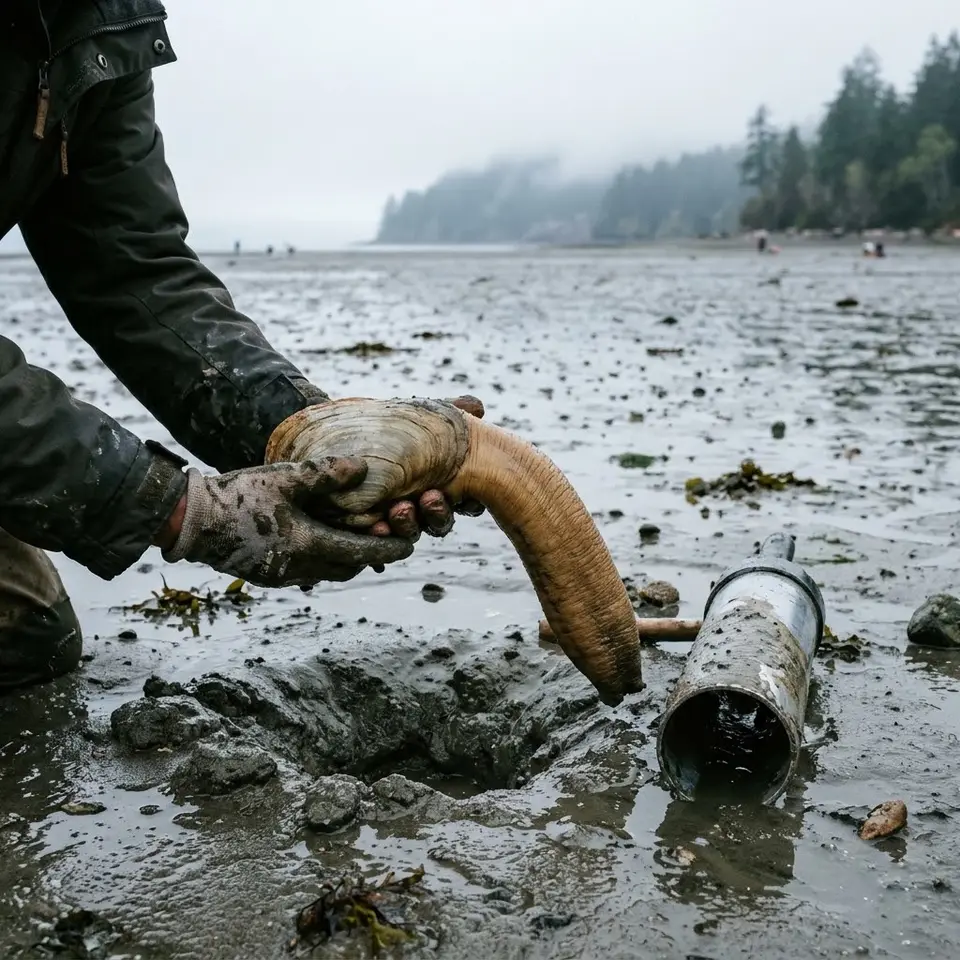
Only dig on open, approved beaches and check biotoxin (PSP/domoic) closures. Deep holes near an incoming tide are genuinely dangerous - fill them in and watch the water.
The geoduck (pronounced "gooey-duck"), Panopea generosa, is the clam the Washington Department of Fish and Wildlife (WDFW) calls the world's largest burrowing clam. It lives buried two to three feet (0.6-0.9 m) deep in mud, sand or gravel, and its siphon and mantle are so large that they cannot be withdrawn into the shell (WDFW). Reaching one means digging a hole that deep, by hand, before the tide comes back.
In Puget Sound, recreationally caught geoducks on public beaches average 2.47 pounds (about 1.1 kg), and the largest one WDFW biologists have weighed and verified was an 8.16-pound (about 3.7 kg) clam dug near Adelma Beach in Discovery Bay in 2000 (WDFW). Geoducks generally reach 1.5 pounds (about 0.7 kg) in three to five years, reach full size by about 15 years and can live at least 168 years (WDFW).
Where and when to find them
The geoduck's range extends from Alaska to Baja California, but only Puget Sound and Hood Canal contain abundant populations; geoducks are rarely found on Pacific coast beaches or west of Clallam Bay in the Strait of Juan de Fuca (WDFW). The vast majority of the population lives below the tide line, and WDFW has observed geoducks with underwater video cameras as deep as 360 feet (about 110 m) in Puget Sound (WDFW).
Natural beds on public beaches are seldom exposed except on tides lower than about -2.0 feet (about -0.6 m), so most sport digging is restricted to fewer than 20 tides a year (WDFW). WDFW publishes a chart of good harvest tides for Puget Sound on its clam, mussel and oyster harvest page. When these low tides fall, WDFW says harvesters can expect large crowds at popular state park locations, and upland access to beaches with geoducks is limited (WDFW). Be mindful of private tidelands and avoid trespassing (WDFW).
Clam seasons are beach-specific and may change every year (WDFW). The current seasons are on the WDFW harvest page and on the Washington State Department of Health's Shellfish Safety Map.
How to dig them
WDFW's rules set out the method. Recreational geoducks may only be taken by hand or with non-mechanized, hand-operated forks, picks, mattocks, rakes and shovels, and a cylindrical can or tube no more than 24 inches (61 cm) across may be used to support the hole while you dig (WDFW). It is illegal to try to capture a geoduck by thrusting any instrument through its siphon, or to possess only the siphon or neck (WDFW).
Any geoduck taken for personal use must be kept by the digger as part of the daily limit, regardless of size, quality or condition (WDFW); the current limit is on the WDFW harvest page. Every license holder who intends to keep a geoduck must take part in the digging, and every hole must be refilled to approximately the original grade as soon as you finish (WDFW). For waders and other kit, see our gear guide.
Handling and cooking
Washington's Department of Health (DOH) advises harvesting shellfish as soon as possible on the receding tide, not harvesting shellfish that have been exposed to the sun for more than one hour (less in very hot weather), keeping them cold after harvest and not storing them in stagnant water.
Most cases of vibriosis come from eating raw or undercooked fish or shellfish, and DOH says Vibrio bacteria are destroyed by cooking shellfish to an internal temperature of 145°F (63°C) for 15 seconds (DOH). DOH advises eating only well-cooked shellfish, especially in summer, and notes that even fully cooked food can be re-contaminated if it is rinsed with seawater (DOH). People with liver disease, cancer, diabetes, HIV-AIDS, thalassemia, a weakened immune system or recent stomach surgery, and people over 65, are especially at risk (DOH). For cleaning and recipes, see our catch and cook guide.
Safety and the law
DOH tests shellfish for three biotoxins that can make people sick: paralytic shellfish poisoning ("red tide"), diarrhetic shellfish poisoning from okadaic acid and amnesic shellfish poisoning from domoic acid (DOH). Most shellfish filter feed and concentrate these toxins from the water; cooking or freezing does not destroy them, and there is no antidote (DOH). Toxic shellfish look, taste and smell the same as safe ones, most toxic blooms do not change the color of the water, and the only way to know is to test them - DOH tests shellfish and closes areas when they are unsafe to eat (DOH).
Check the Shellfish Safety Map for biotoxin closures and advisories on the day you plan to dig, or call the recorded DOH hotline at 1-800-562-5632 (DOH). To harvest shellfish for food safely and legally, both the DOH health status and the WDFW season for a public beach must be open (WDFW). We do not give food-safety advice: the map, the hotline and your local health department are the places to ask.
Anyone digging for geoducks in Washington must have a valid license that includes shellfish harvest (WDFW). Harvesters are responsible for knowing the regulations before they dig, and the rules can vary by species (WDFW). We do not give legal advice: the current rules and seasons are on the WDFW harvest page.
WDFW says geoduck recruitment is infrequent and episodic, and that beds take 55 years on average to recover to pre-harvest densities, citing a 2021 study by Stevick and colleagues (WDFW). Because the beds lie at the bottom of the tidal range, the returning water reaches them first: keep an eye on the tide while you dig and leave with time to spare. For more on biotoxins and closures, read our shellfish safety guide, and browse the shellfish section for other species.
Sources
- Washington Department of Fish and Wildlife, Geoduck clam. Read 15 November 2026.
- Washington Department of Fish and Wildlife, Clam, mussel, and oyster harvest. Read 15 November 2026.
- Washington State Department of Health, Marine Biotoxins. Read 15 November 2026.
- Washington State Department of Health, Vibrio in Shellfish. Read 15 November 2026.
- Washington State Department of Health, Washington Shellfish Safety Map. Read 15 November 2026.
Kit for clams, oysters and mussels
As an Amazon Associate we may earn from qualifying purchases - at no extra cost to you. We link gear types, not sponsors' picks: you choose the exact product. The partner-store link may earn us a commission too.