J-Hook
The classic J-shaped hook - the shape most anglers picture and the default for a thousand jobs. You set it yourself, which is its whole character.
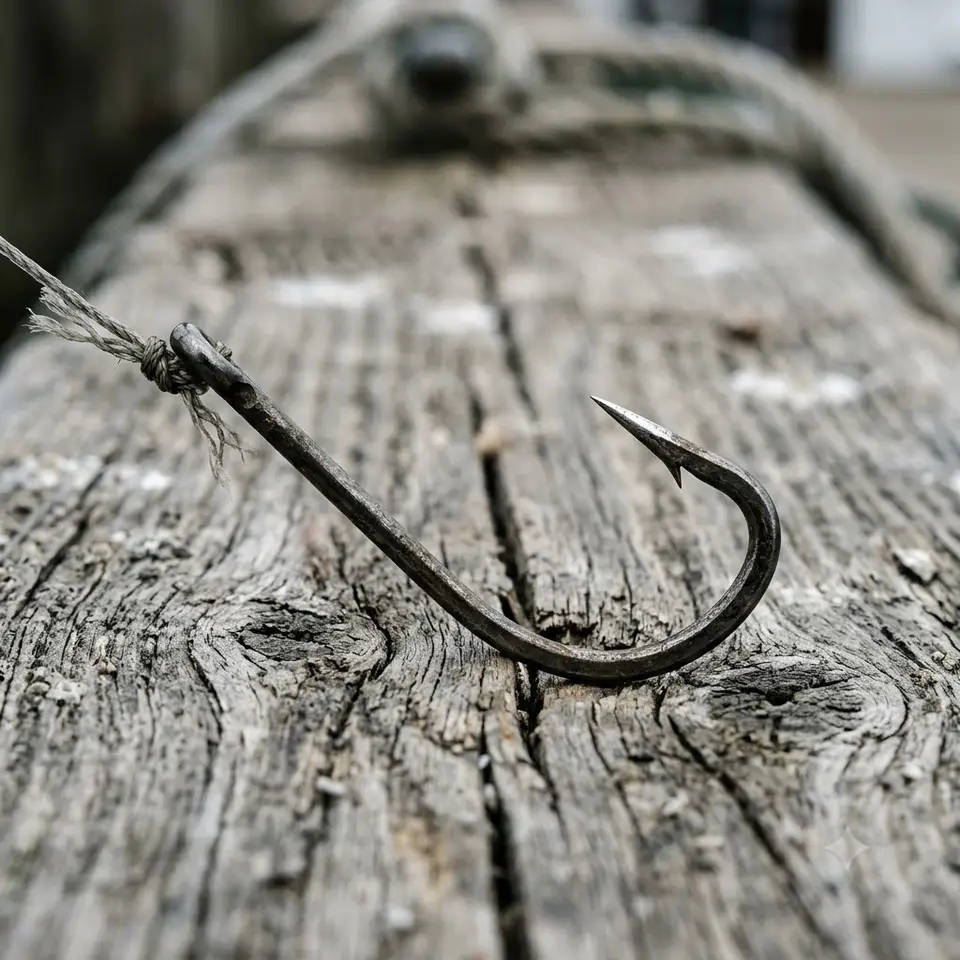
When someone says 'a fish hook,' this is the shape in their head: a straight shank, a curve, a point that stands roughly parallel to the shank. The J-hook is the ancestor of almost every other hook in this catalog, and it still fishes more baits and lures than anything else. The one thing that defines it: unlike a circle hook, YOU drive the point home with a hookset.
What it is
A hook whose point runs roughly parallel to the shank, forming the familiar J. It relies on an angler's hookset to rotate into the jaw - the point does not self-catch.
When to use it
Nearly everything with active bites: worms and cut bait for panfish and catfish, minnows under a float, most lure applications where the hook is moulded or tied in. The default choice whenever you're holding the rod and can set on the bite.
How to rig & set it
Tie with a clinch, Palomar or snell; thread bait so the point stays exposed. On the bite, reel down to tight and sweep-set to drive the point through - a hard, timed set is the J-hook's job.
Sizing
Numbered small-to-large as the number DROPS (size 22 tiny → size 1), then flips to aught sizes that grow (1/0 → 12/0 huge). Match gape to bait and target: size 8-6 panfish, 2-1/0 bass baits, 5/0-8/0 big cut baits.
Strengths & weaknesses
Strong, versatile, cheap, holds a wide range of baits. The weakness is gut-hooking: because you set it, a swallowed J-hook lodges deep - which is exactly why circle hooks exist for soak-and-wait bait fishing.
What costs you hookups
Setting too early (before the fish has it) or too late, burying the point in the bait so it can't bite, and using a J-hook for dead-stick bait soaking where a circle hook would hook cleaner and kill fewer released fish.
Hooks to keep on hand
As an Amazon Associate we may earn from qualifying purchases - at no extra cost to you. We link gear types, not sponsors' picks: you choose the exact product.