Circle Hook
The point curves back toward the shank so it slides over everything except the jaw corner - the conservation standard for soaking bait, where you must NOT strike.
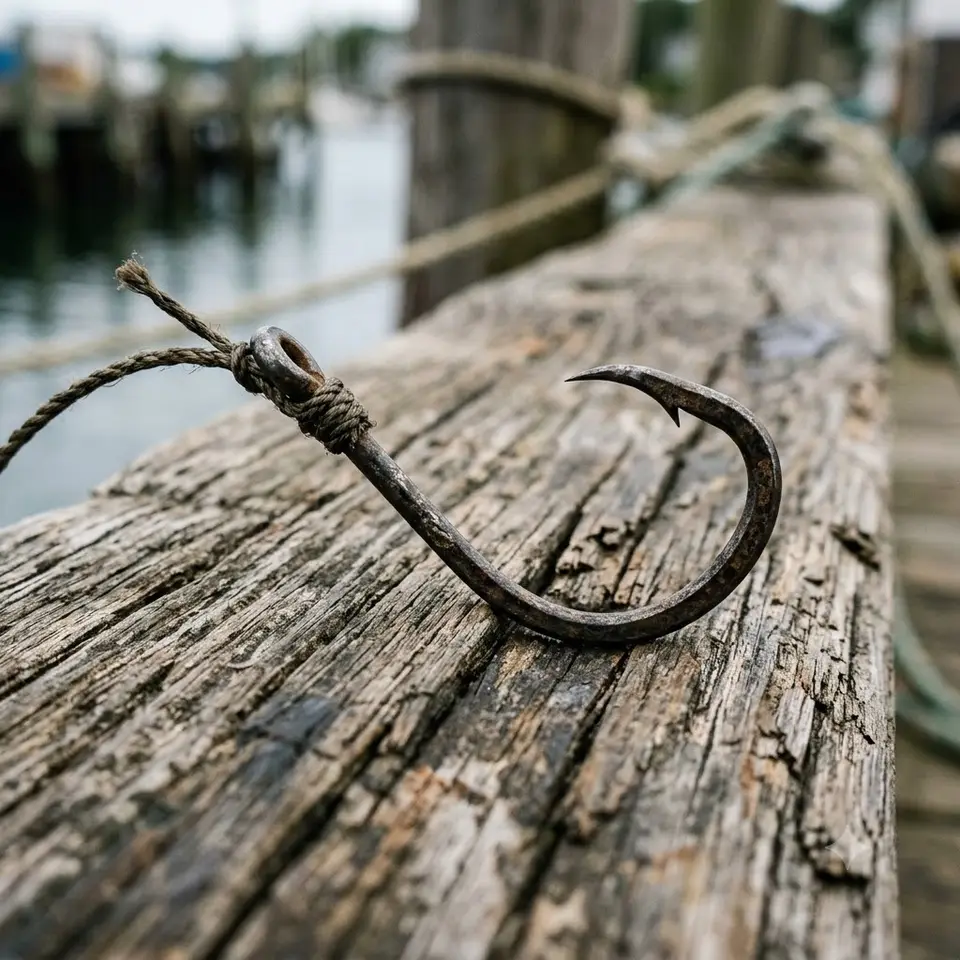
A circle hook looks almost closed: the point turns sharply inward toward the shank. That geometry does something clever - as a fish swallows and turns away, the hook slides harmlessly over the throat and gut until it reaches the jaw hinge, where it catches and rotates into the corner of the mouth. The result is fewer deep-hooked, fewer dead released fish. The catch: you must NOT set the hook. Striking pulls it out of the mouth entirely.
What it is
A hook with the point curled back toward the shank, designed to self-set in the corner of the jaw rather than wherever it happens to be when you strike.
When to use it
Bait fishing where the rod sits in a holder and fish take on their own: surf and pier soaking, catfish sets, live-lining, offshore bait. Required by law in some fisheries precisely for its release survival: the Atlantic States Marine Fisheries Commission mandated circle hooks when fishing with bait in recreational striped bass fisheries, and NOAA Fisheries notes that circle hooks are required when fishing with natural bait for reef fish in federal waters of the Gulf.
How to rig & set it
Hook bait so the point is fairly exposed; a non-offset ('inline') circle releases fish best. When the rod loads, do NOT jerk - just reel until tight and lift steadily; the fish's own motion sets it in the jaw hinge.
Sizing
Same numbering as J-hooks; circle sizes often run a touch large for the bait since the gape is partly closed. Match to bait bulk - too small a gape and the corner-set fails.
Strengths & weaknesses
Dramatically fewer gut-hooks and higher release survival - the conservation win. Weakness: useless for hooksets you time yourself (jigging, lure fishing), and it demands retraining the strike reflex.
What costs you hookups
Striking it like a J-hook (the #1 error - it yanks the bait away), using heavily offset circles where inline is required for release, and undersizing so the narrowed gape can't reach the jaw corner.
Hooks to keep on hand
As an Amazon Associate we may earn from qualifying purchases - at no extra cost to you. We link gear types, not sponsors' picks: you choose the exact product.