Black Crappie
The black crappie is one of America's most beloved panfish, a schooling favorite prized for its willingness to bite and its outstanding flavor.
🗓️ Last reviewed: October 2026
Overview
The black crappie is one of America's most beloved panfish, a schooling favorite prized for its willingness to bite and its outstanding flavor. It is one of only two crappie species, both found only in North America, and it has been stocked so widely that by 2005 it was living in all 48 contiguous states (Wikipedia, "Black crappie"). It fills stringers in spring and offers steady action through the ice in winter.
Identification
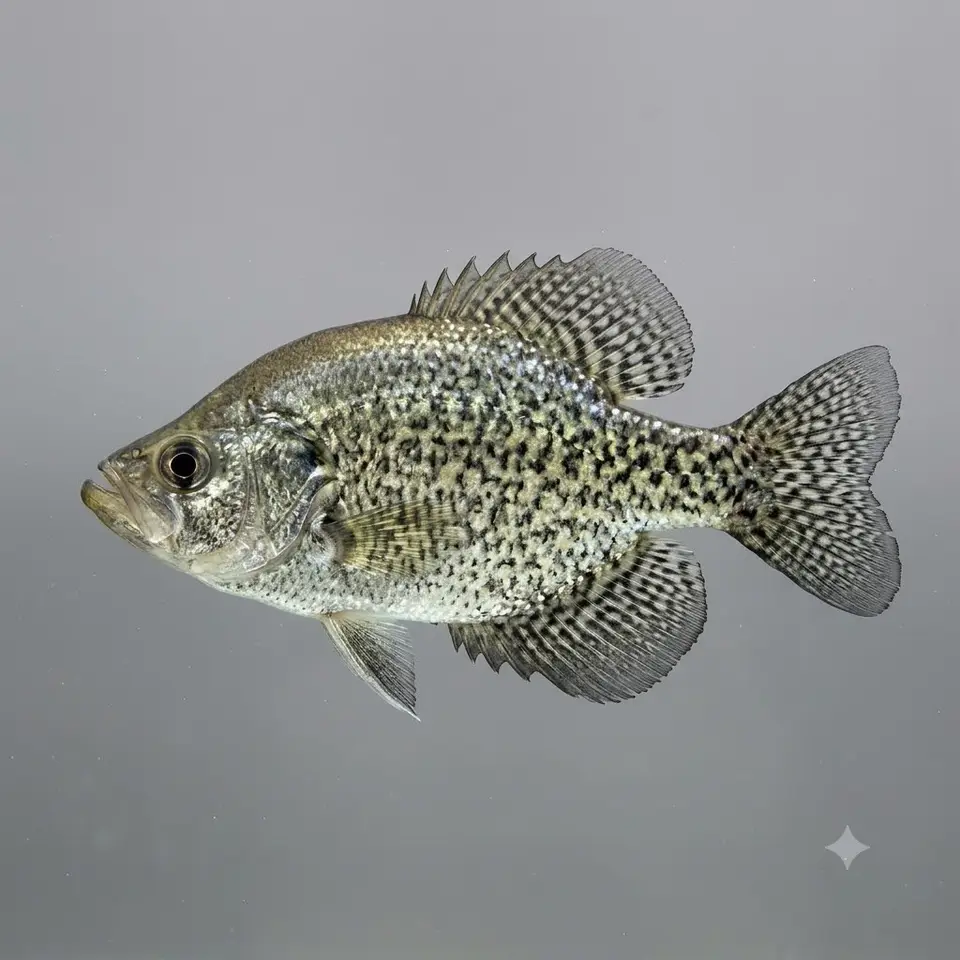
Black crappie are silvery-grey to green with irregular black splotches scattered over the whole body and rows of dark spots on the dorsal, anal and tail fins. The surest mark is the dorsal fin: seven or eight spines, against five or six on a white crappie, which also wears vertical bars instead of speckles. Both crappies are deep-bodied and slab-sided, with a large mouth that reaches back below the eye.
Range & Habitat
The native range is thought to be the eastern United States and Canada, but transplanting has blurred it. Black crappie live in lakes, reservoirs, ponds and the slack pools of large rivers, and they prefer little or no current, clear water and plenty of cover - submerged timber or aquatic vegetation over sand or mud.
Behavior & Diet
Black crappie school tightly around cover and suspend over structure. Small fish live on plankton and tiny crustaceans; adults take small fish such as shad and minnows but, according to Wikipedia's account, eat fewer fish than white crappie do and more insects, insect larvae and crustaceans. They feed most actively at dawn, dusk and after dark.
Best Seasons
Spring is prime as crappie move shallow to spawn around cover, with excellent ice fishing in winter and steady action over brush the rest of the year.
How to Catch Them
Small jigs and minnows fished around brush and docks, spider-rigging and slip-bobbers over structure, and vertical jigging suspended schools.
Tackle & Rigs
Light spinning gear, 4-6 lb line, small jigs and minnow rigs under floats; long light rods help place baits in cover.
Landing, Handling & Release
Handle their soft "papermouths" gently to avoid tearing; ice keepers promptly for the best fillets.
Table Quality
Black crappie are superb - sweet, flaky white fillets that are among the best of all freshwater panfish.
Common Mistakes
Setting the hook too hard on their soft mouths and leaving a productive brush pile too soon.
Regulations & Conservation
Managed as panfish with size and creel limits that vary by water. Always confirm the current state and lake regulations before keeping fish. We do not give legal advice.
FAQ
Black or white crappie? Black crappie have scattered speckles and more dorsal spines; white crappie have vertical bars.
Best eating? Among the very best panfish for the table.
Sources
- Wikipedia, "Black crappie" (read 12 October 2026): identification, range, habitat and diet.
🎣 Tackle for black crappie
As an Amazon Associate we may earn from qualifying purchases - at no extra cost to you. We link gear types, not sponsors' picks: you choose the exact product.