Why Fish Stop Biting Midday
The short answer: bright overhead sun, warm surface water and heavy boat traffic push fish deeper, tighter to cover and into a lazier feeding mode. Here is what changes at noon - and how to keep catching anyway.
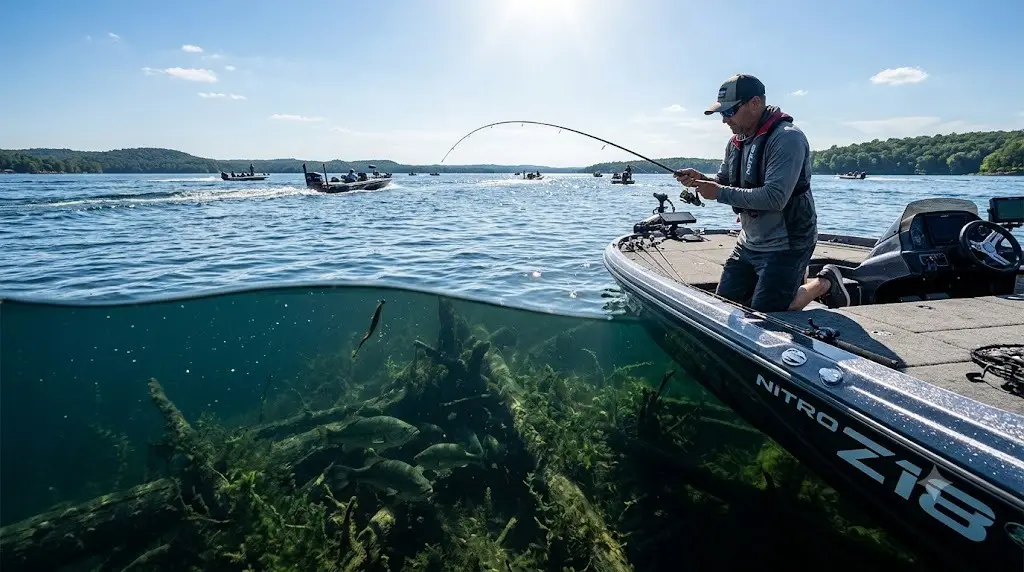
The short answer: fish don’t stop eating at noon - they stop chasing. Bright overhead light makes predators easier to see and prey harder to ambush, warm surface water holds less oxygen, and lake traffic peaks, so fish slide deeper, pin themselves to shade and cover, and switch from hunting to opportunistic snacking. The morning bite doesn’t die; it relocates and slows down. Fish the new location and the new speed and midday is very catchable.
What actually changes at midday
- Light kills the ambush. Most gamefish are ambush hunters that rely on low, angled light to get close to prey. Overhead sun takes away their edge, so they hold rather than roam. It also makes them warier: a bass in clear water under high sun has seen your lure, your line and your boat.
- The surface warms and loses oxygen. Warm water holds less dissolved oxygen, and in summer the top layer bakes first. Fish drop to the cooler, better-oxygenated band (often near the thermocline in stratified lakes), or slide to wind-blown, oxygen-rich banks.
- Prey behaviour changes too. Baitfish tuck into shade and weed; insect hatches concentrate at morning and evening. Less moving food means less reason to move.
- Traffic peaks. Skiers, swimmers and jet skis arrive on schedule. Shallow fish in busy water simply leave.
None of that means feeding stops - anyone who has dropped a jig on a noon fish knows they still eat. They just eat what drifts close.
Where the fish went
Think of the midday pattern as the morning pattern moved down and tightened up:
- Deeper structure: the first drop-off outside the morning flat, channel edges, humps, deep weedlines.
- Shade as structure: docks, overhanging trees, bridge pilings, matted vegetation: a hard shadow line concentrates fish like a wall.
- Cooler inflows: creek mouths and spring seeps become magnets in summer heat.
- Wind-blown banks: a warm breeze stacks oxygenated water and drifting food on one shore: fish follow.
How to catch them anyway
- Slow down and go smaller. A holding fish won’t chase, but it will tip forward for an easy bite. Slow presentations (a jig crawled, a worm dead-sticked, a bait under a float) out-fish fast search lures at noon.
- Fish the shade lines. Cast into the shadow, not the sunshine, and work the edge where dark meets light: that is the new ambush lane.
- Go deeper than feels natural. If the morning fish were in 4 feet, try 10-15. Electronics help; our sonar reading guide covers finding that band quickly.
- Lean on finesse lines and leaders. High sun means better-seen line. Lighter fluorocarbon buys bites in clear water.
- Match the calm. Loud topwater has its noon moments over shade, but subtle usually wins until the light angles again.
And a quiet truth: dawn and dusk are still better. If you can only fish an hour, fish an edge of the day - the best fishing times tool shows the windows. But when your only window is midday, deep, slow and shaded turns a “dead” afternoon into a steady one.
The bottom line
Midday doesn’t switch fish off - it changes the rules. Light, heat, oxygen and traffic move fish deeper and tighter and make them lazier, and anglers who keep fishing the morning water at morning speed conclude the lake died. Move down, slow down, hug the shade, and you’ll find the same fish still willing to eat an easy meal.
Recommended Gear on Amazon
- Drop shot weights - browse current options and reviews on Amazon.
- Polarised fishing sunglasses - browse current options and reviews on Amazon.
As an Amazon Associate, we earn from qualifying purchases - at no extra cost to you. This helps us keep producing free, in-depth guides.